Boat rental in Amsterdam prices: a clear cost breakdown
Amsterdam boat rental prices range from roughly €45–€65 per hour for a small self-drive electric sloop to €150–€600 per hour for a private charter with a skipper. Those figures describe different products, not competing quotes for the same ride.Boat rental in Amsterdam · from €9 · Book tickets

The cost that matters is the full booking total: rental duration, group size, deposit, tourist tax and any services included.
Tickets and prices
Boat rental in Amsterdam
I
other
Pedal boat rental · 1 hour
Rent a pedal boat for 1 hour to pedal along the canals with friends and family.
II
other
Self-drive boat rental · 5 departure locations
Rent a self-drive boat for 2 hours to steer along the canals, with 5 departure locations available.
III
Box office and online booking
- Adult €69
€69
Official websiteFor a short trip through the canal ring, an unlicensed self-drive boat may be the lower-cost option. A skipper-led charter costs more, but removes the need to steer and can make the outing easier to coordinate for a larger group. Public canal cruises are a third category: passengers buy seats on a scheduled route rather than hiring the boat.
Self-drive electric sloops: rates by rental length
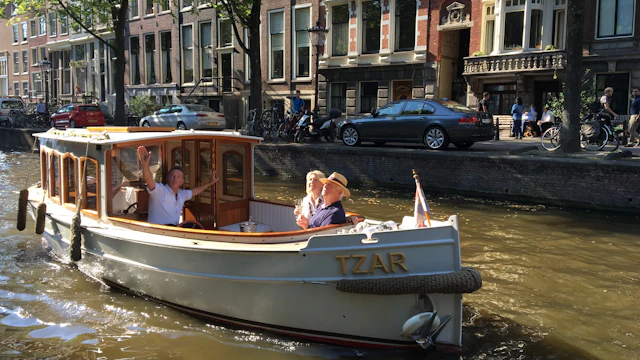
Small electric boats are typically hired by the hour or in fixed-duration blocks. A number of operators allow customers to pilot them without a boating license on the inner canal ring. The designated skipper must remain sober throughout the trip.
The hourly rate can make a short booking look inexpensive. The total changes as the rental extends, and weekend or peak-season demand can move the quote upward. Current examples show the range:
| Rental format | Example price | What the quote covers |
|---|---|---|
| Small electric sloop by the hour | €45–€65 per hour | Typically a minimum two-hour hire; deposit may apply |
| Two-hour self-drive booking | €80–€100 | Example rates vary by operator and day |
| Three-hour block | €89–€140 | Operator and booking conditions determine the rate |
| Four-hour block | €114–€170 | Longer time on the water; tax may be additional |
| Six-hour self-drive booking | Up to €300 | A longer hire, with day-of-week pricing differences |
These are observed examples, not a citywide tariff. One operator lists morning self-drive blocks starting at €69 for two hours, €89 for three and €114 for four, before tourist tax. Another lists €97.50 for two hours, €140 for three and €170 for four, also before tax. A separate weekday offer puts a two-hour rental at €80, compared with €100 on Saturday and Sunday.
The pattern is more useful than any single quote: an extra hour does not necessarily cost the same as the first. Operators set block prices, and a four-hour booking may have a different per-hour yield from a two-hour one. Compare the total for the duration you actually want, rather than multiplying the advertised hourly rate and assuming that is the checkout price.
The advertised hourly rate is only a starting point. Compare the full booking total for your group, date and rental duration.
What the self-drive price buys
The basic product is control of the boat for a defined period. It does not automatically include every cost associated with the booking. Municipal tourist tax is listed separately by some operators, and the refundable security deposit is a temporary cash requirement rather than part of the final rental cost if returned under the provider’s terms.
A self-drive boat suits people who want to set their own pace and are comfortable navigating busy waterways. A rental provider may give route guidance or a navigation map; check what is supplied before departure and whether the proposed duration leaves enough time for the route. A two-hour booking is a tighter itinerary than a four-hour one, particularly if the group wants to stop, take photographs or travel beyond the central canals.
No boating license is required for small self-drive electric canal sloops on the inner canal ring, according to the available rental information. That does not remove the responsibility to operate the boat safely or follow the operator’s instructions. The person designated as skipper must stay sober. Do not treat a no-license rule as permission to improvise with unfamiliar channels or ignore local navigation guidance.
Private boat tour Amsterdam cost: what a skipper changes
A private boat with a skipper is priced on a different basis. Group hire generally falls between €150 and €600 per hour, depending on vessel size, duration and included services. Private group trips commonly work out to about €30–€80 per person for a one- to two-hour outing, though the per-person figure depends heavily on how many people share the charter.
The skipper is a material part of the cost. The group is paying for a crewed trip rather than just access to a boat, and may be paying for a larger vessel or additional service options as well. A bareboat yacht charter is another category again: high-season daily rates average about €555, compared with about €362 in low season, while hiring a skipper averages roughly €100 per day. Those daily figures should not be compared directly with an hourly canal sloop.
Before booking a private charter, establish what the quoted rate includes. The available pricing information does not provide a standard citywide breakdown for catering, drinks or late-night service. Those items can vary by operator, so they should be treated as quote-specific rather than assumed to be included.
For a group, calculate the effective cost per passenger:
- Divide the total charter charge by the number of people actually attending, not the boat’s maximum capacity.
- Add any separately quoted services, such as catering, if the group intends to use them.
- Compare the result with a public canal cruise on the same basis: a private departure offers control over the group and booking, while a public cruise sells seats on a shared service.
- Confirm the trip length and route before comparing per-person figures. A one-hour charter and a two-hour cruise are not equivalent products.
A larger group can make a private charter’s per-person cost more competitive, but that is not guaranteed. The decisive variables are the charter rate, headcount and what is bundled into the service.
Deposits, tourist tax and the amount due at booking
The deposit and municipal tourist tax should be separated from the rental price in any budget calculation. Self-drive bookings commonly require a refundable deposit of €100–€150. Examples include a €100 deposit paid before departure at one operator and a €150 deposit for another hourly rental.
A deposit is not the same as a fee. It may be returned after the rental, subject to the provider’s conditions. It still affects the amount the renter needs available on the day, so a budget based only on the advertised hire charge is incomplete.
Amsterdam’s municipal tourist tax is listed at €2.70 per person in the available rental examples. Some operators explicitly exclude it from the advertised rate. For a group, that small per-person charge accumulates, so multiply it by the number of passengers and check whether it is collected during checkout or before departure.
A practical cost ledger has four lines:
1. Base hire: the quoted rate for the chosen boat and duration.
2. Tourist tax: €2.70 per person where applicable.
3. Deposit: commonly €100–€150 for self-drive rentals; refundable under the provider’s conditions.
4. Optional services: any extras confirmed in the individual booking terms.
This distinction prevents two common budgeting errors: counting a refundable deposit as a permanent expense, and treating a displayed rental rate as tax-inclusive when the operator lists tax separately.
Season, weekends and booking timing
High season runs from April to September. Peak summer months and weekends command higher rental rates, with examples showing a clear difference between weekday and weekend two-hour self-drive prices. That is a pricing pattern, not a fixed surcharge that applies uniformly across Amsterdam.
Inventory absorption matters here. When demand concentrates on warm weekends and summer dates, lower-priced time slots may be harder to secure. Booking earlier can preserve more choice of departure time and boat type; it does not guarantee the lowest possible rate. Compare the final quote for the exact date rather than relying on an older price example.
If the date is flexible, compare a weekday with a weekend and, where available, a morning slot with a peak daytime departure. The relevant saving is the difference in the final booking total, including tax and any deposit requirement—not simply a lower headline hourly rate.
Availability can also be a constraint separate from price. Several self-drive departure points and booking options are offered, but the most convenient location or time may not be available for every date. Check the departure point against the intended route and allow time to reach it. A cheaper slot at a less convenient location may not be the better value if it compresses the time on the water.
Public cruise or private rental?
A public canal cruise is not a rental. It is a scheduled shared tour, usually with a set route and departure. A private self-drive boat gives the group control of the vessel, while a skippered charter combines private use with a designated operator.
| Option | Pricing basis | Best fit | Main trade-off |
|---|---|---|---|
| Public canal cruise | Per passenger | A simple ride on a scheduled route | Shared boat and fixed itinerary |
| Self-drive electric sloop | Per boat and rental period | A group that wants to navigate independently | Deposit, tax and skipper responsibility |
| Private charter with skipper | Per boat, often hourly | A group seeking a private, crewed outing | Higher total charge; service details vary |
| Bareboat yacht charter | Usually per day, with skipper priced separately | A longer charter rather than a short canal visit | Different vessel, duration and cost structure |
A public classic canal tour has been listed at €19.50 per adult and €9.75 per child in the available pricing data. Those fares are examples and may change; they are not directly comparable with a private boat’s total price. For a small party, paying per passenger on a shared cruise can be simpler. For a larger group, divide the private quote by the actual headcount and compare like-for-like durations.
The choice is therefore not just “cheap versus expensive.” It is a decision about control, group size and responsibility. A self-drive rental buys flexibility at a lower headline rate. A skipper-led private boat buys a managed trip at a higher hourly cost. A public cruise minimizes planning and keeps the group on a set route.
A workable budget before you book
Start with the number of passengers and the time needed on the water. Then compare the relevant product rather than mixing hourly sloops, private charters and public cruise seats into one price list. For self-drive hire, add the per-person tax and note the deposit separately. For a private charter, request the total for the intended duration and group size, with services itemized.
The resulting comparison is straightforward:
- Lowest initial boat-hire range: small self-drive electric sloops, from roughly €45–€65 per hour, usually with a minimum rental period.
- Typical short self-drive examples: around €80–€100 for two hours, before any separately listed tax or deposit.
- Private crewed charter: roughly €150–€600 per hour, with the final rate shaped by vessel and service.
- Public cruise: priced per passenger, with a fixed shared route rather than private use.
The market divides cleanly. If the priority is the lowest boat-level cost and the group accepts navigation responsibility, a self-drive electric sloop is the more economical direction. If the priority is a private trip without a member of the group steering, budget for a skipper-led charter and compare its per-person yield at the expected headcount.
Practical info
Currency: EUR
Driving: on the right
Emergency number: 112