Seattle home staging: A winter lighting plan
Here's the mistake I see sellers make every winter: they stage their home with gorgeous neutral furniture, fresh flowers on the counter, and a perfectly made bed — then switch on whatever bulbs were already in the fixtures when they bought the place.
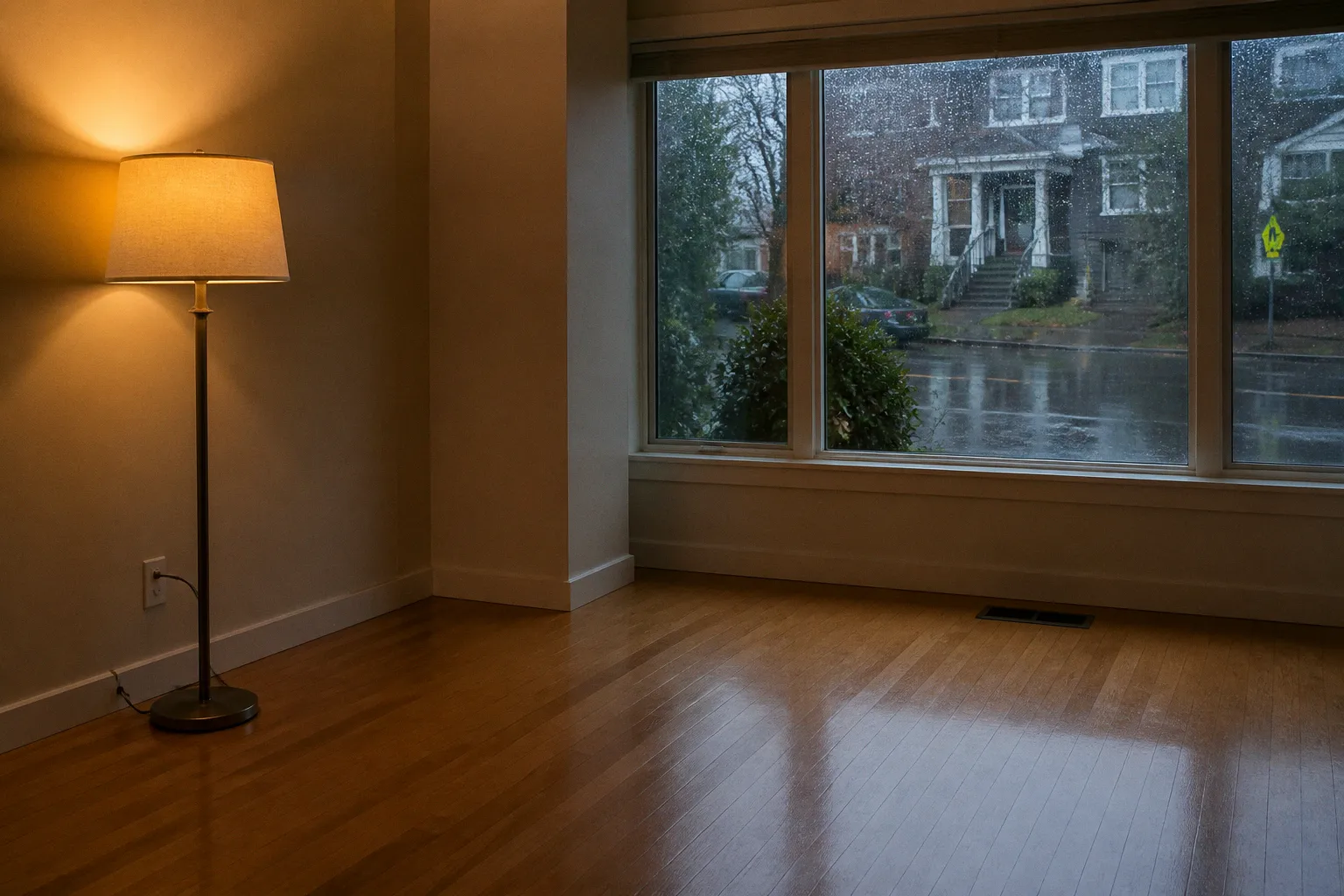
The listing photos look dim. The open house in the afternoon feels like a cave. A home that looked balanced and welcoming on paper suddenly feels smaller, colder, and less finished in person.
You're not selling furniture. You're selling atmosphere. And in Seattle's winter, where Pacific Northwest weather is sunny only about 29% of the time, atmosphere is often a lighting problem before it is a furniture problem. The gray sky is not something you can control. The shadows in the living room, the dark hallway, and the weak porch light are.
Fix the lighting before buyers arrive, or accept that they're making their first judgment in conditions you could have improved.
The Reality of PNW Winters: Why Standard Staging Fails in the Dark
Standard staging is usually designed around a generous assumption: that daylight will do part of the work. The furniture creates proportion, the art gives the room personality, and natural light makes the whole arrangement feel more open.
Seattle winter does not reliably cooperate.
The daylight is short, low, and frequently filtered through cloud cover. Even when the sky is technically bright, the light entering through the windows may be cool and diffuse. It does not always reach the back of a deep living room, the lower level, the hallway, or the corners beneath an overhang. By late afternoon, a home can feel like evening before the showing schedule says it should.
That changes the staging brief. You are no longer simply arranging a room so that it photographs well in good conditions. You are building a visual system that works when the weather is gray and a buyer arrives after work.
A dim room creates conclusions buyers may never say out loud. It can feel smaller than it is. A basement can feel damp even when it is dry. A dining room can seem disconnected from the rest of the house. A narrow entry can feel inconvenient rather than welcoming. Buyers do not need to identify the precise cause. They register the feeling and carry it into the rest of the visit.
Winter staging in Seattle is not about adding brightness everywhere. It is about controlling where the eye lands when natural light cannot do it for you.
A home that has been staged only for a sunny day is effectively unfinished for much of the local selling season. If you're listing between late fall and early spring, audit every light source before the listing photos are taken and before the first private showing.
Start at the entry and move through the house as a buyer would. Do not inspect the rooms only from their usual seating positions. Stand in the doorway. Look toward the corners. Walk from a bright room into a darker one. Pay attention to the transition between floors and to the view from the front door into the main living area.
Look for:
- A hallway that has one weak fixture but no light reaching the floor.
- A living room with a bright center and dark corners.
- A kitchen where the counters disappear beneath the upper cabinets.
- A bathroom mirror that casts shadows across the face.
- A bedroom where the only useful light comes from the ceiling.
- A stairwell that feels visually separate from the rest of the home.
- A lower level that depends entirely on one overhead fixture.
Those are not small decorative flaws. They interrupt the buyer's sense of how the home functions.
Layering for Depth: Ambient, Task, and Accent Lighting Techniques
One overhead fixture in the middle of the ceiling is not a lighting plan. It is what a builder installed, and it may be what you've tolerated for years. A single fixture casts a downward cone, leaves the edges of the room behind, and makes furniture look as if it has been placed beneath a spotlight.
A strong Seattle home staging lighting strategy uses three layers at the same time: ambient, task, and accent. Each one answers a different question in the buyer's mind.
Ambient lighting: the base layer
Ambient lighting is the overall illumination of the room. It may come from recessed cans, flush-mount fixtures, pendants, chandeliers, or built-in ceiling sources. Its job is to make the room readable from wall to wall.
The goal is not maximum brightness. It is evenness. Buyers should be able to see the room's shape without finding one glaring fixture and several shadowy zones around it.
If you have recessed cans, check whether they are all producing the same color of light. Mixed bulbs are especially distracting in photographs and in open-plan spaces. A warm bulb beside a blue-white bulb creates a visual break that makes the lighting feel accidental. Replace mismatched lamps where practical, and use compatible bulbs throughout the same sightline.
A single dome light in a hallway may technically illuminate the space, but it rarely makes the hall feel intentional. A better fixture can throw light in more than one direction, while a nearby table lamp or wall-mounted fixture can prevent the end of the hall from disappearing.
Ambient light removes the basic darkness. On its own, though, it can flatten the room. That is where the other two layers matter.
Task lighting: the functional layer
Task lighting tells buyers how the room is meant to be used.
In the kitchen, that means under-cabinet lighting that reaches the counters. In the home office, it may be a desk lamp positioned so the workspace looks ready rather than abandoned. In the bathroom, it means sconces or vertical lighting that illuminates the face instead of creating shadows from above. In a bedroom, table lamps make the nightstands feel purposeful and the room feel settled.
Task lighting also gives the eye a series of destinations. A buyer sees the kitchen island, then the breakfast corner, then the range wall. In a bedroom, the lamps establish symmetry and scale. In a den, a reading lamp makes an otherwise awkward corner look usable.
This is particularly useful in rooms with competing functions. A Seattle bungalow may have a living room that also serves as a dining area, office, or passage to the backyard. Lighting can separate those zones without adding furniture or making the room feel crowded.
Accent lighting: the depth layer
Accent lighting is what keeps a staged home from looking as if someone simply turned on every switch.
Picture lights can draw attention to artwork or a fireplace. A small lamp can give a console table a reason to exist. A low light behind a plant or beside a textured wall can create depth without making the room feel theatrical. LED strips inside a glass-front cabinet can make a kitchen look finished, provided the light source itself is concealed.
Accent lighting may create shadows. That is not automatically a problem. Intentional, soft shadows give a room dimension. The problem is uncontrolled shadow: a dark corner beneath a stair, a black recess beside a fireplace, or a pendant that leaves the dining chairs in silhouette.
Walk room by room and turn on every existing light. Then stand at the entrance and identify the areas that still feel visually absent. Add portable fixtures where they solve a real gap:
- Use a floor lamp to lift a dark corner beside a sofa or reading chair.
- Use a table lamp on a console at the end of a hallway.
- Add a pair of lamps to a bedroom when the ceiling fixture is too harsh.
- Place a small lamp near a home office or secondary work surface.
- Use plug-in sconces only when the cords can be hidden safely and neatly.
- Add discreet puck lights to dark shelving or cabinetry when they improve a feature buyers will notice.
The point is not to fill every outlet. It is to make the room legible and to guide the buyer's attention toward the features you want them to remember.
If a full staging package is not in the budget, prioritize the main living areas, entry, kitchen, primary bedroom, and any lower-level space. A few well-placed floor and table lamps can change the perceived balance of a room more effectively than another decorative object.
Color Temperature Science: Why 2700K–3000K Beats Clinical Cool White
This is where sellers who have thought carefully about lighting often make their worst mistake. They walk into a hardware store, see “Daylight” on the box, and assume that brighter and bluer must be better.
Not in a Seattle winter.
Cool white light can look clinical and sterile when it is combined with the gray-blue light coming through the windows. In living spaces, high-color-temperature bulbs can make white walls look icy, wood floors less inviting, and neutral upholstery flatter. The room may be technically well lit while still feeling uncomfortable.
For most staged residential interiors, the useful range is 2700K to 3000K, generally described as warm white. It has enough clarity for photographs and movement through the room without turning the home into a showroom or office.
Warm light supports the materials buyers expect to see in a house: wood, wool, linen, painted millwork, stone, and brass. It gives a fireplace wall more presence, makes a dining area feel finished, and prevents a bedroom from reading as a temporary storage space.
| Factor | Warm White, 2700K–3000K | Cool Daylight, 5000K and above |
|---|---|---|
| Overall impression | Residential, calm, inviting | Clinical, sharp, institutional |
| Strongest use | Living rooms, bedrooms, dining areas, entries | Limited task areas when carefully balanced |
| Relationship to gray winter daylight | Softens and warms the room | Can intensify the blue cast |
| Effect on wood and warm neutrals | Brings out depth and warmth | May make them look dull or disconnected |
| Best staging approach | Use consistently across visible fixtures | Avoid as the dominant tone indoors |
Consistency matters more than chasing a particular bulb label. A warm living room that opens into a blue-white kitchen creates a jarring transition. In an open-plan home, the buyer reads both spaces at once, so mismatched color temperature makes the lighting feel improvised.
There are exceptions. A kitchen with a cool stone countertop or a modern metal finish may need a slightly cleaner task light to preserve the way the surface looks. A bathroom mirror may benefit from a neutral tone if the warmest bulb makes the room's finishes appear yellow. But these should be deliberate choices, not the result of whatever bulbs happened to be in the drawer.
Color temperature is only half the decision. The other half is brightness.
A warm bulb with insufficient output will not solve a dark room. Look at lumens rather than relying only on wattage, particularly when replacing incandescent bulbs with LEDs. Match the output to the fixture, ceiling height, room size, and finish of the shade. A dark fabric shade absorbs more light than a clear or pale shade. A heavily frosted globe spreads light softly but may not throw enough illumination into a long entry.
Dimmers can be useful, but do not assume they make every fixture flexible. Confirm that the bulbs and switches are compatible, and set the light level before showings. A room should feel bright enough to photograph and navigate without looking overexposed or aggressively lit.
The same principle applies to listing photography. Take a few test images from the angles the photographer will use. Check whether a window is blown out while the room remains dark, whether a pendant creates glare, or whether one bulb is visibly bluer than the others. Lighting problems that seem minor in person can become obvious in photographs.
Maximizing Natural Light Transmission Through Window and Surface Care
Artificial light is your primary tool in a dark season, but it should not have to fight through avoidable obstruction.
Start with the windows. Rain, dust, pollen, and general grime accumulate on exterior glass during the wet months. Interior glass collects its own film, particularly in homes with fireplaces, kitchens, pets, or frequent condensation. Clean both sides where safely accessible, and do not overlook the frames and sills. A bright window surrounded by dusty trim still looks neglected.
Screens are a judgment call rather than an automatic rule. If they are visibly dirty, damaged, or heavily obscuring the view, clean them or remove them temporarily where appropriate and safe. If a screen is necessary for ventilation or helps the home look maintained, keep it in place. The objective is to improve clarity without creating a maintenance or safety issue.
Window coverings need a similar review. Open blinds and curtains fully during showings unless privacy, glare, or security requires another arrangement. If a window looks small, avoid stacking heavy drapes over most of the glass. Mounting curtains wider than the window can help expose more of the opening, but only if the hardware and fabric look intentional.
Sheers can soften a harsh view while still allowing light through. Dark, lined drapes can be beautiful in a lived-in home, but they may absorb the little natural light available during a winter showing. For staging, use window coverings as tools: soften, frame, or conceal when necessary, but do not let them become the main visual feature of the room.
Let surfaces carry the light
Floors, walls, counters, and mirrors all affect how far light travels.
Reflective flooring can help distribute light through a room, but removing every rug is not automatically the answer. Rugs provide scale, warmth, and sound control, and an entirely bare room can feel unfinished. Instead, look at whether a rug is too dark, too large, or positioned where it blocks the visual plane. A lighter rug with a lower-contrast pattern may preserve the room's comfort without absorbing all the light.
Mirrors are useful when they reflect something worth seeing. A large mirror opposite or perpendicular to a window can bring more brightness into a darker zone. A mirror at the end of a hallway can make the corridor feel less compressed. In a small entry, it can reflect the door or a nearby lamp and give the space more depth.
Do not place mirrors randomly. A mirror aimed at a blank wall, a cluttered utility area, or a neighboring bathroom door magnifies the wrong thing. Before hanging one, stand where the buyer will stand and check the reflection.
Light-colored walls help, but “light” does not mean every room must be painted stark white. Warm neutrals, soft beige, balanced greige, and restrained off-white can reflect light while still giving the home a sense of material and finish. Test undertones in the actual room. A gray with a blue base may become noticeably colder beneath an overcast sky, while a warm neutral can support the 2700K–3000K lighting plan.
Deep colors are not forbidden. A navy office, green powder room, or charcoal fireplace wall can add character. The question is whether the room has enough light and contrast to carry the color. In a dark lower level with small windows, a deep accent wall may absorb the very light you need to make the space feel usable. In a well-lit room with layered fixtures, the same color may look deliberate and sophisticated.
Before the listing goes live, check the small surfaces buyers see at eye level:
- Clean mirrors, glass doors, cabinet fronts, and polished hardware.
- Remove fingerprints from dark appliances, glossy paint, and switch plates.
- Dust the tops of lamps, shades, sconces, and ceiling fixtures.
- Clear window sills so light reaches the room without competing with objects.
- Keep reflective counters edited rather than crowded; clutter breaks up the light.
- Replace yellowed or cracked fixture covers that make clean bulbs look dirty.
- Open interior doors where doing so improves the flow of light between rooms.
Your windows are not decoration during a winter sale. They are part of the home's infrastructure. Clean them, expose them, and let the available daylight travel as far as it can.
Curb Appeal After 4 PM: Safety and Welcoming Exterior Illumination
Exterior lighting is often treated as an afterthought because sellers spend their attention on the kitchen and living room. In Seattle's winter, that is a mistake. Buyers may arrive in the late afternoon or evening, when the first impression is being made under porch lights, path lights, and whatever illumination reaches the property from the street.
The exterior has to accomplish two things at once: help people move safely and make the home look cared for.
Begin with the path from the sidewalk or driveway to the front door. Buyers should be able to see changes in grade, steps, edges, and the actual route to the entrance. A path that is technically present but visually lost in shadow creates hesitation before anyone has seen the interior.
Check the porch fixture itself. Clean the glass, remove cobwebs, replace a weak bulb, and make sure the light reaches the door, lock, threshold, and immediate landing. If the fixture is dated or too small for the entry, a replacement may offer more improvement than another seasonal decoration.
Path lights do not need to turn the front yard into a runway. They need to create a steady visual rhythm and mark hazards. Solar fixtures can work when they receive enough daylight and are positioned correctly, but wired or plug-in options may provide more reliable illumination in a shaded yard. Keep cables secured and avoid fixtures that lean, flicker, or look temporary.
Pay attention to the address numbers. Buyers and agents need to identify the property without searching through dark facades. Numbers should be clean, visible, and positioned where they can be read from the approach. If the home has a long driveway, make the route and parking area clear rather than leaving visitors to guess where to stop.
Safety lighting around stairs, retaining walls, side yards, and the garage is especially important. Motion sensors can be useful, but sudden, extremely bright activation can feel more like a security alarm than a welcome. Set the fixtures so they illuminate the area without shining directly into a visitor's eyes or into the main living-room windows.
| Exterior element | Common problem | Staging response |
|---|---|---|
| Front porch light | Dim bulb, dirty globe, or light aimed at the wrong spot | Clean the fixture and use a warm bulb that illuminates the door and landing |
| Walkway | Dark gaps or unclear route | Add steady path lighting and remove visual obstructions |
| House numbers | Difficult to read after dark | Clean, contrast, or improve their position and illumination |
| Steps and stairs | Shadowed edges or poor visibility | Light the risers, treads, or adjacent walls without creating glare |
| Garage and side yard | No visibility for evening arrivals | Add controlled motion-activated or dusk-to-dawn fixtures |
| Front facade | Bright entry with a dark surrounding house | Balance the porch light with subtle illumination near key architectural features |
Exterior lighting also signals maintenance. A clean, balanced facade says that the property has been looked after. A single bare bulb surrounded by darkness can make buyers wonder what else has been deferred, even when the house is in good condition.
Make sure the interior remains visible from outside without turning the windows into black mirrors. A few warm lamps near the front rooms can create depth from the street. Close blinds where privacy requires it, but avoid presenting a fully dark home after the sun goes down.
The Hard Rule
Here's the rule of thumb I give every seller listing during Seattle's darker months: treat lighting like pricing — get it right before you go to market, because you do not get a second chance at a first impression.
A late price adjustment cannot fully undo the impression created by a home that looked dark, cramped, or neglected during its first showings. Buyers remember the feeling of a listing that failed to connect. They may not remember which fixture was wrong, but they remember that the house did not seem as welcoming as the photos suggested.
Audit every room. Layer the light: ambient, task, and accent. Keep visible bulbs in a coherent warm-white range, generally 2700K–3000K. Clean the windows and the fixtures. Let daylight travel. Use mirrors with intention. Protect the entry, the walkway, and the approach after dark.
Then walk through the property again as a buyer would — from the curb, through the front door, down the hall, into the main living space, and toward the rooms that usually lose the most light. Turn on the fixtures, look for dead zones, and remove anything that competes with the room's best features.
The Seattle market does not owe a home a bidding war. But a home that looks warm, clear, safe, and ready gives buyers a reason to compete. In winter, that impression starts with light.