Basilica Cistern tickets: the fastest online booking route
Sixty minutes. That is how long a tourist at the Basilica Cistern ticket window can stand in line during high season — anywhere from half an hour to a full hour of idle time on the busiest days between April and October.
The queue at the entrance is the real ticket price
In a city where every itinerary hour is already competing with the Hagia Sophia, the Blue Mosque, Topkapı and a Bosphorus ferry, that is not a minor surcharge. It is a hidden line item on your trip's budget, paid in sweat and patience rather than lira.
Tickets and prices
Book tickets — from €45| Option | Type | From |
|---|---|---|
| Basilica Cistern Skip-the-Line Entry Ticket and Audio Guide | skip-the-line | from €42 |
| Istanbul: Hagia Sophia, Topkapi & Basilica Cistern Tickets | skip-the-line | from €118 |
Prices checked on August 14, 2026 · current price on the partner page.
Prices are indicative and may change — confirm the price and availability on the partner page.
Partner link — GetYourGuide ticketsThe good news is that this line is patchable. The site — officially Yerebatan Sarnıcı, managed by İBB Kültür A.Ş., the Istanbul Metropolitan Municipality's culture arm — runs its own digital sales channel, and a handful of authorized resellers can hand you a QR code by email. Buy it before you fly, and the ticket window becomes a five-second walk past the queue, straight to security. This guide is the construction document for that shortcut: where to buy, what it costs, what you skip, and what you don't.
Thirty minutes of standing in line is not "the Istanbul experience" — it is a budget leak you can patch with one email.
Why the ticket window is the bottleneck
The physical ticket office sits at street level, just above the sunken entrance to the cistern. Every visitor who arrives without a pre-purchased QR code funnels through the same doorway. The cistern's underground footprint — roughly 140 meters long and 70 meters wide, around 10,000 square meters of columned vault — comfortably absorbs large crowds below, but the street-level intake is narrow. On a busy Tuesday in May, that geometry is what produces the 30-to-60-minute wait.
Online booking restructures that geometry for you. When you purchase a digital ticket, you bypass the purchase queue and arrive at a separate, faster-moving entry for visitors who already hold a QR code. You will still pass through security screening — no digital ticket, and no ticket of any kind, exempts you from the bag check and metal detector — but you skip the slow lane.
So let's be precise about what online buying solves, and what it doesn't:
- It solves: the ticket purchase queue at the window.
- It does not solve: security screening, or the walk down the steep stairway into the cistern.
Think of it the way a renovation consultant thinks about a punch list: pre-paid materials go straight to the install site. Standing in line at the ticket counter is mixing drywall by hand when you could have ordered it pre-cut.
The official channels — Passo and yerebatan.com
The municipal operator, İBB Kültür A.Ş., runs ticket sales through two official outlets inside Turkey and a small number of authorized resellers that serve international visitors. If you want the cleanest path with no resold markup or third-party fees, these are the channels that matter.
Passo (passo.com.tr) is the official online ticketing partner for İBB Kültür A.Ş. venues. The platform is in Turkish, but the booking flow is straightforward:
1. Select Yerebatan Sarnıcı (Basilica Cistern) from the venue list.
2. Choose your date and time slot.
3. Pick daytime entry or Night Shift.
4. Pay by card and receive your QR code by email within minutes.
yerebatan.com is the cistern's own official site and offers the same municipal tickets, often with clearer English-language navigation than Passo. Both routes deliver the same product: a valid QR code tied to your name and visit date.
Authorized skip-the-line resellers — third-party platforms that contract with the municipality — are the simplest option for non-Turkish speakers, and they advertise their skip-the-line status in English. Prices are typically a few euros above the municipal face value, in exchange for an English-language checkout and customer support if something goes wrong with the code. Whether that convenience premium is worth it is a cost-to-value decision, and it depends on how much you value your time over a few euros of markup.
Avoid unofficial resellers that don't clearly name İBB Kültür A.Ş. or Passo as the underlying supplier. The QR code at the gate is checked against the municipal database, and an unsourced ticket will bounce — at which point you are back in the 60-minute queue you were trying to avoid.
Daytime vs. Night Shift — the cost comparison
The Basilica Cistern runs two daily sessions, and the price gap between them is wide enough to change how you plan the day.
| Parameter | Daytime entry (09:00 – 18:30) | Night Shift (19:30 – 22:00) |
|---|---|---|
| Standard foreign adult fee | 1,950 – 2,250 TL (≈ €25 – €42) | ~3,000 TL (≈ €50) |
| Atmosphere | Even, museum-style lighting; columns fully visible | Dim, atmospheric, smaller crowds |
| Best for | First-time visitors, photographers wanting full visibility, families | Couples, photographers chasing mood, repeat visitors |
| Availability | Daily | Daily, though winter schedules for Night Shift sessions can vary |
The Night Shift premium is real, and it runs roughly a 30–50% surcharge over daytime rates. Whether it earns its keep depends on what you value. Photographers tend to find the dim, moodier lighting inside the cistern genuinely worth the upcharge. Visitors on a tight two-day Istanbul itinerary usually get more value from a daytime ticket, because they can pair it with the Hagia Sophia or Topkapı in the same afternoon without burning their best daylight hours underground.
The Night Shift is not just an entry fee — it is a labor cost. You are paying more so your daylight hours stay free for the rest of the city.
A quick cost-to-value framing: if the Night Shift costs an extra ~1,000 TL (≈ €8–€25) and saves you from a daytime crowd you would have spent 30 minutes navigating, the math works for visitors who have already done the Hagia Sophia in daylight and want a different feel. For a first-timer with one shot at the cistern, daytime is the disciplined choice — full visibility across all 336 columns, including the Medusa heads in the northwest corner, which are easy to miss in low light.
Three things online tickets do not do
A few recurring misconceptions about online booking are worth addressing head-on, because believing them at the gate costs time.
1. The Museum Pass does not work here. The Republic of Turkey's MüzeKart — the official Museum Pass that covers the Ministry of Culture and Tourism sites — does not grant entry to the Basilica Cistern. The cistern is operated by İBB Kültür A.Ş., a municipal entity, not the national Ministry of Culture. If you try to scan a MüzeKart at the gate, it will not register, and you will be redirected to the ticket window — the very queue you were trying to skip.
2. Online tickets do not bypass security. What you skip is the ticket purchase line. Security screening — bags through the scanner, walk through the metal detector — is mandatory for everyone, QR code or not. Plan roughly five extra minutes for this even with a pre-purchased ticket, especially during peak hours.
3. You cannot buy these tickets on the Ministry of Culture portal. The national e-bilet platform handles Ministry-run museums like Hagia Sophia and Topkapı Palace, not the cistern. If you are used to scanning QR codes through that app for every site in Istanbul, do not assume it covers the cistern — it doesn't, and you will find that out at the entrance.
What your ticket actually grants you access to
It is worth pausing on what you are paying for, because the cistern is unusually generous for a venue at this price point.
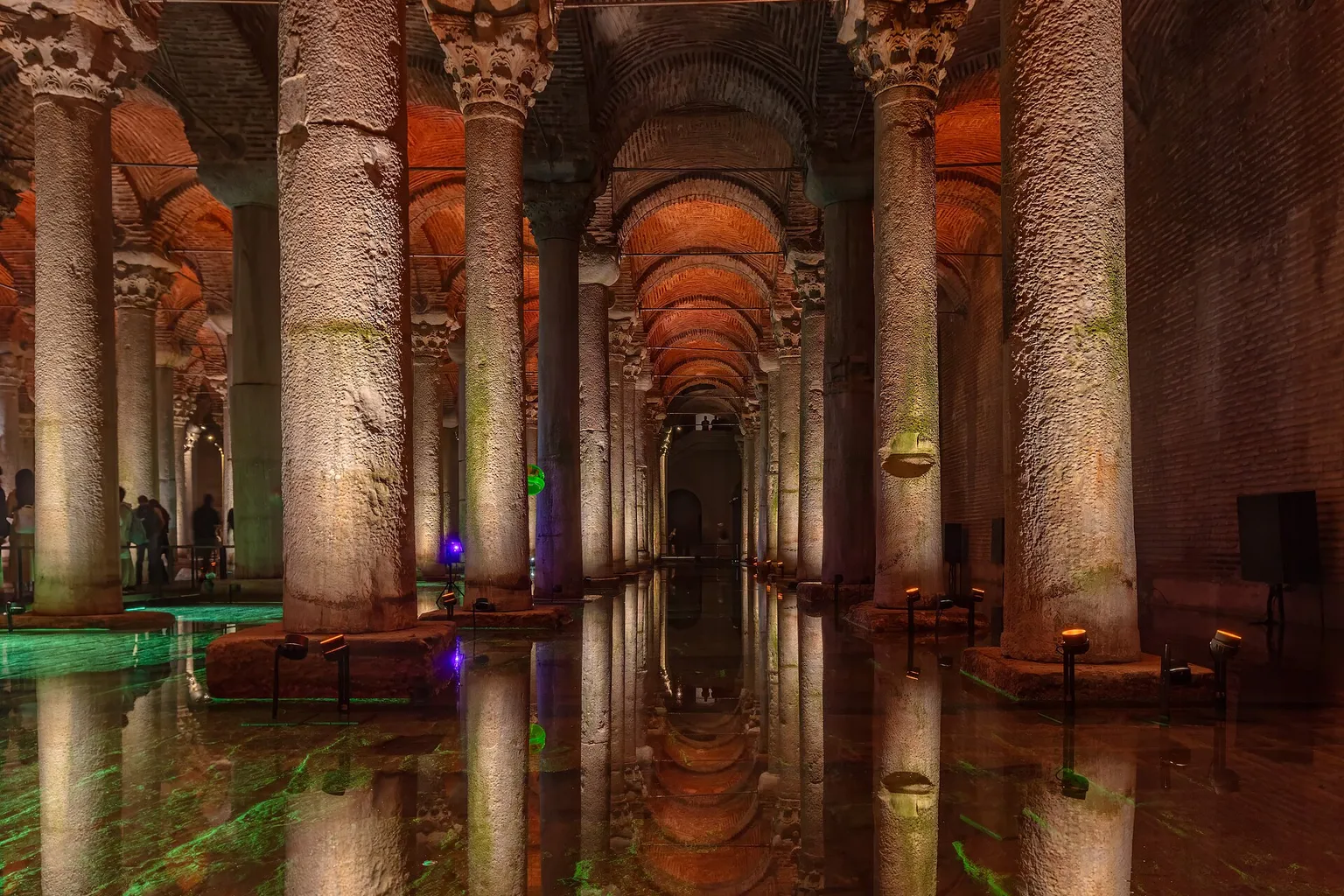
The underground reservoir was built in 532 AD under Byzantine Emperor Justinian I, originally as a covered water basin supplying the Great Palace of Constantinople and surrounding buildings. The surviving structure covers roughly 10,000 square meters (140 m × 70 m), supported by 336 marble columns arranged in 12 rows of 28. Each column stands about 9 meters tall. At full capacity the basin once held 80,000 cubic meters of water — a figure that gives some sense of the engineering scale of what Justinian's engineers cut into the bedrock below the city.
Highlights that justify the ticket on their own:
- The two Medusa head column bases in the northwest corner, repurposed from a Roman temple and placed sideways or upside down for reasons still debated by art historians.
- The weeping column near the entrance, decorated with tear-drop and eye motifs and lit to look perpetually damp.
- The raised wooden walkway, which keeps visitors above the shallow water still pooled at the lowest points of the floor.
Allow roughly 30–45 minutes inside for a relaxed walk-through, more if you photograph. The site is fully indoors and shaded enough that summer heat is not an issue, though the floor can be damp — closed-toe shoes are a small but worth-it upgrade over sandals.
The verdict: where to spend, where to save
Here is the disciplined bottom line on this purchase.
Spend on the official online ticket through Passo or yerebatan.com. This is non-negotiable if you are visiting between April and October. The price is the same as the on-site window; what you buy with the booking is your time. Thirty to sixty minutes, recovered, is worth more than the small convenience fee, if any, the official channels charge.
Save by skipping the Night Shift on a first visit. The atmosphere is genuinely different and worth returning for, but only after you have seen the cistern once in full daylight and understood the layout. A first-time visitor paying the premium for atmospheric lighting will not know what they are looking at in the dim — and will not have a frame of reference to judge whether the upcharge was worth it.
Spend on an authorized English-language reseller only if you are uncomfortable with Turkish-language checkout and the few extra euros feel like a fair convenience fee. The municipal channels work fine for everyone else, and the reseller premium is essentially a translation tax.
Save by skipping any third-party reseller that does not clearly identify Passo or İBB Kültür A.Ş. as the underlying supplier. A discounted "Basilica Cistern ticket" from an unfamiliar marketplace is not a deal — it is a risk that the code will be rejected at the gate, at which point you are standing in the 60-minute queue you were trying to avoid, having paid twice.
Book online, walk past the line, take the daytime slot, and keep the Night Shift for a return trip. That is the spend-vs-save verdict: pre-pay for your time, choose the disciplined tier for the first visit, and use the savings for a Bosphorus dinner instead.
Practical info
Currency: TRY
Driving: on the right
Emergency number: 112
FAQ
How can I skip the queue at the Basilica Cistern?
Where can I buy official Basilica Cistern tickets online?
How much does a Basilica Cistern ticket cost?
Does MüzeKart include the Basilica Cistern?
Do online Basilica Cistern tickets include security fast-track access?
Photo: Diego Delso / CC BY-SA 4.0 — Wikimedia Commons