AccroCamp Chartres tickets: a four-step booking plan
The main variable in AccroCamp Chartres ticketing is not the calendar. It is participant height. The park uses three pass tiers, and each tier unlocks a different section of the course network.
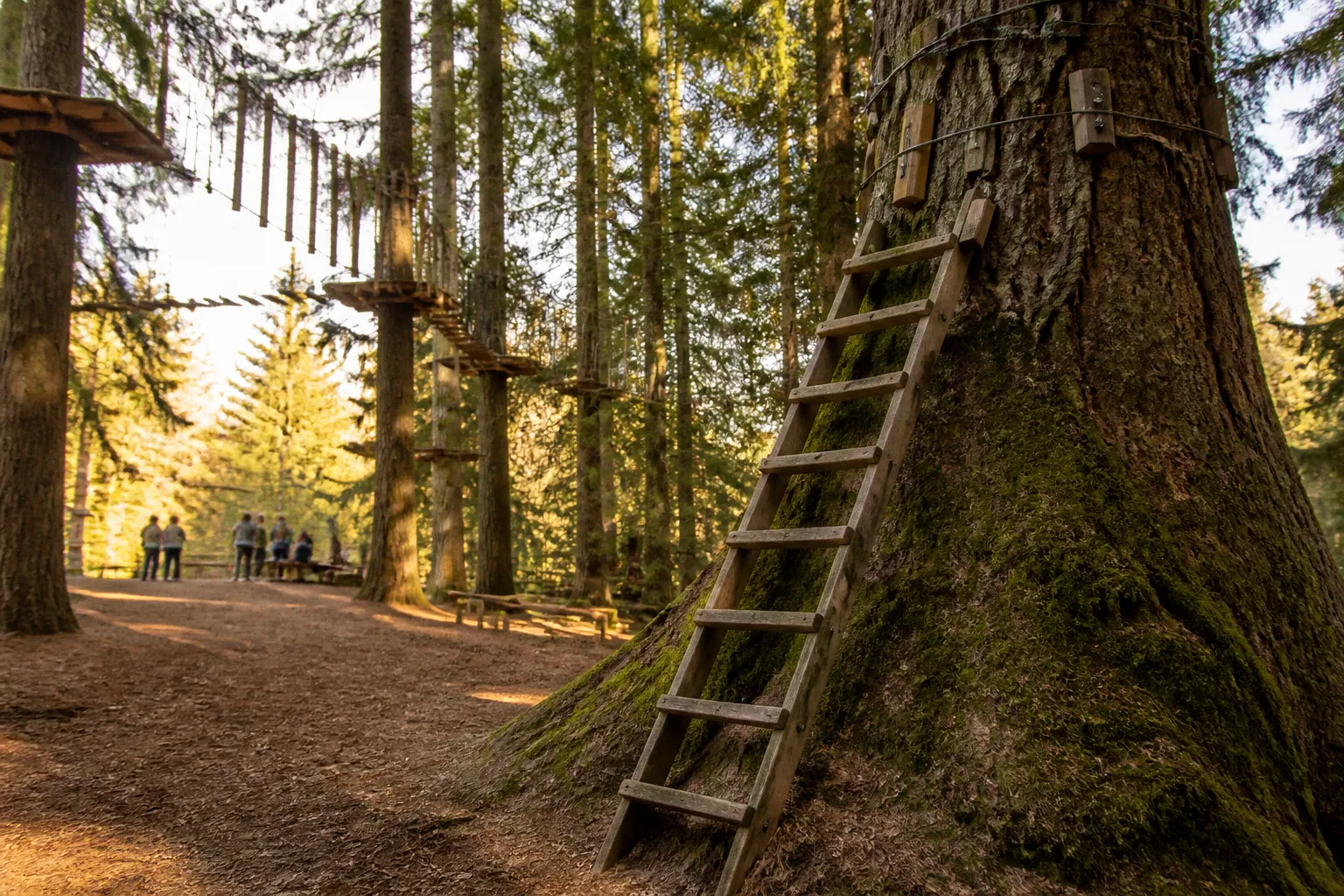
Booking the wrong pass creates a practical problem at arrival: access is controlled by height thresholds, not by age alone or by a general admission assumption.
Tickets and prices
AccroCamp Chartres
I
Save
Box office and online booking
- Adult €28
- Child €18.50
€28
Official websiteII
entry ticket
Entry Ticket · 3 Hours
This entry ticket grants three hours of access to tree climbing courses for all levels.
€28
Book ticketsAccroCamp Chartres operates in Parc André Gagnon, near the center of Chartres. A standard visit can last up to three hours, including equipment fitting, the safety briefing, and the supervised introductory course. That makes the booking decision more precise than simply selecting a date and paying for entry.
The efficient method is binary. Measure the shortest participant first. Then select the highest pass that person qualifies for, book online when the schedule is confirmed, and arrive with enough time for harness fitting and the safety sequence.
Step one: measure height before selecting a pass
AccroCamp Chartres entry passes are structured around minimum height thresholds:
| Pass tier | Minimum height | Course access |
|---|---|---|
| Pass Vert | 1.10 m | Courses 1 and 2 |
| Pass Bleu | 1.25 m | Courses 1 through 4 |
| Pass Parc | 1.40 m | Full park access |
This is the first filter in the booking process. The pass is not simply a pricing preference. It defines which aerial courses a participant may use.
A child who measures 1.18 m qualifies for Pass Vert but not Pass Bleu. A participant at 1.32 m can use Pass Bleu but does not meet the threshold for Pass Parc. The distinction matters because the higher tiers expand access to more demanding sections of the park. Selecting a broader pass for someone below the relevant height requirement does not solve the eligibility issue.
Measure without footwear on a level surface. Do not rely on an approximate age category or a previous measurement from school, a doctor’s office, or a theme park. The operational threshold is expressed in metres, and small differences can determine the available pass.
The correct sequence is:
1. Measure every participant, starting with the shortest child.
2. Match each person to the highest eligible pass.
3. Check whether the group will use the same course range.
4. Book the appropriate pass for each participant rather than assuming one group-wide category.
5. Keep the measurement decision separate from the payment decision.
That last point is useful. A cheaper or more convenient ticket is irrelevant if it does not correspond to the participant’s height. Eligibility controls access.
Children under eight require adult participation
Children under eight must be accompanied on the courses by an adult who completes the aerial obstacles with them. This is not the same as an adult standing below the course or supervising from the ground. The adult must participate in the activity.
That requirement changes the group calculation. A family booking with two young children may need two participating adults if both children need direct accompaniment at the same time. The park’s rule should therefore be considered before tickets are purchased, particularly for families travelling with one adult and several children.
The adult should also meet the relevant height requirement for the pass being selected. The booking needs to account for the actual participants on the course, not only the children.
The shortest participant determines the usable route. The youngest participant determines the required adult involvement.
Step two: choose online booking or on-site purchase
AccroCamp Chartres offers both online reservation and walk-in purchase. The rates are not identical. Advance online booking is the lower-cost channel for the listed pass tiers, while on-site purchase carries a premium.
This creates two separate questions:
- Is the visit date fixed?
- Is the group willing to accept less scheduling certainty?
If the date and approximate arrival window are known, online booking has a clear financial advantage. It also allows the group to settle the pass selection before reaching Parc André Gagnon. That reduces friction at the entrance, where the staff must still verify height, fit equipment, and conduct the safety sequence.
On-site purchase remains useful when the itinerary is fluid. It avoids committing to a date before travel plans are stable. The trade-off is direct: the group may pay more, and availability for a preferred time may be less certain.
The online process should be treated as a reservation for a timed activity, not as a generic admission voucher. Select the date, review the available time slot, assign the appropriate pass tier, and confirm the number of active participants. The exact layout of the booking interface may change, so the reliable decision points are the date, the time slot, the height threshold, and the participant count.
Online booking versus walk-in purchase
| Factor | Online reservation | On-site purchase |
|---|---|---|
| Rate structure | Lower advance rate for the listed passes | Higher walk-in rate |
| Availability | Depends on remaining slots for the selected date | Depends on capacity at arrival |
| Planning value | Stronger; time can be selected before travel | Lower; the visit is decided at the park |
| Best use case | Fixed itinerary and known participant heights | Flexible day with uncertain timing |
| Main risk | Choosing the wrong tier or date before arrival | Paying more or finding the preferred slot unavailable |
The online option is not automatically better for every group. It is better when the booking information is accurate. If a child’s height is close to a threshold, measure again before confirming. Do not assume that an incorrect pass can be upgraded without charge on arrival. That policy is not established in the available information.
The same logic applies to date selection. If the visit is part of a tightly scheduled day in Chartres, a reservation protects the plan. If the group is travelling during a busy period and wants to arrive without a booking, the risk shifts from payment to capacity.
Step three: use the Wednesday morning discount window
AccroCamp Chartres offers a 50% discount on Wednesday mornings from 10:00 a.m. to 12:00 p.m., outside school holidays and public holidays. This is the most defined value opportunity in the available schedule.
The restriction matters. The discount is not a general mid-week rate and should not be treated as available on every Wednesday. School holidays and public holidays remove the qualifying condition. Families planning around the promotion must check the calendar classification before building the itinerary around it.
The discount window also has a time limit. A booking or arrival after noon does not fit the stated period. Since the park visit includes equipment fitting, a video briefing, and an introductory course, arriving near the end of the window reduces the practical value of the promotion. A 11:45 arrival may still fall inside the stated period, but it leaves little margin for the entry process and could compress the usable activity time.
A better plan is to arrive near the beginning of the morning period. That provides:
- More time for the safety procedure before the main courses.
- A lower probability that the group loses activity time to late arrival.
- Better alignment between the discounted window and the three-hour maximum session.
- Greater flexibility if the child’s height or harness fit requires additional attention.
The promotion is therefore a scheduling tool, not merely a price reduction. Its value depends on using the full operational window efficiently.
When the promotion is strongest
The Wednesday morning offer works best for a group that can meet four conditions:
1. The visit falls outside school holidays and public holidays.
2. Everyone can arrive before the discounted period ends.
3. The participants already meet the required height thresholds.
4. The day does not depend on a narrow connection to another attraction or appointment.
If those conditions are not met, the standard online reservation may be the cleaner choice. Saving money while creating a late arrival problem is a poor trade. The relevant comparison is not discount versus no discount. It is discount with usable course time versus discount with avoidable schedule pressure.
Step four: plan the three-hour session and safety sequence
A ticket covers up to three hours of park activity. That duration includes more than time on the aerial obstacles. The session also covers professional equipment fitting, a video briefing, and an introductory harness course supervised by an instructor.
This distinction changes arrival planning. The three-hour period should not be interpreted as three uninterrupted hours on the highest course available. The opening portion is procedural. It establishes whether the participant can operate the equipment and follow the park’s safety system.
AccroCamp Chartres uses continuous lifelines. Participants remain secured without needing to detach from the safety line between obstacles. That reduces one common operational failure point: the need to manually disconnect and reconnect at every transition. It does not eliminate the requirement to follow instructions. The participant still needs to understand how to move through the course, manage the equipment, and respond to staff guidance.
The correct arrival plan is conservative:
- Reach Parc André Gagnon before the selected slot.
- Keep the booking confirmation accessible.
- Allow time for the group to assemble before equipment fitting begins.
- Expect a professional to fit the safety equipment.
- Watch the video briefing rather than treating it as optional background information.
- Complete the introductory harness course under instructor supervision.
- Move to the selected course level only after the staff confirms readiness.
The procedure is especially relevant for children. A child may meet the minimum height but still need time to understand the equipment and movement pattern. Height determines access. It does not predict comfort, coordination, or speed on the course.
Clothing and footwear are operational issues
Wear clothing that allows unrestricted leg and shoulder movement. Avoid loose items that can catch on equipment or obstacles. Secure phones, keys, and other objects before entering the course area.
Closed, stable footwear is the prudent choice. Open-toed shoes and flip-flops should not be treated as acceptable course footwear. The available park information does not establish them as permitted, and they provide inferior protection and stability for an aerial obstacle course.
For children, use clothing that can tolerate contact with harness straps and platforms. Long hair should be secured. The objective is not appearance. It is to prevent an avoidable interruption once the harness has been fitted.
Opening hours, season, and timing the arrival
The annual operating season runs from mid-February to mid-November. Standard operating hours are listed as 10:00 a.m. to 7:00 p.m., with the last departure in the late afternoon. The stated last departure varies by schedule, with references to approximately 5:00 p.m. or 5:30 p.m. October and November use shorter hours, generally 10:00 a.m. to 6:00 p.m., with the last departure earlier in the afternoon.
For planning purposes, the closing time is not the same as the final usable departure time. A park may remain open while no new participant can begin a full session. This is normal for an activity with equipment fitting, instruction, and a maximum three-hour duration.
Do not build a late-day reservation around the published closing hour. Check the selected date’s departure cutoff during the booking process. The practical question is when the participant must begin, not when the gates close.
A morning slot is operationally cleaner for several reasons:
- It creates more recovery time if the visit runs longer than expected.
- It leaves the afternoon available for Chartres sightseeing.
- It fits the Wednesday discount period when applicable.
- It reduces the risk of arriving after the final departure.
- It gives staff more time to resolve a height, equipment, or participant-readiness issue.
Afternoon sessions can work. They simply leave less margin. In a city itinerary with cathedral visits, meals, rail connections, or pre-booked tours, the park should be placed before the fixed appointment rather than after it.
Getting to Parc André Gagnon
AccroCamp Chartres is located at Parc André Gagnon, 6 Place Saint-Jean, 28000 Chartres, France. The park is not an abstract citywide attraction. The exact destination should be entered into the route plan before departure, particularly if the group is carrying bags, travelling with children, or connecting from the station.
The arrival calculation should include four separate intervals:
1. Travel time to Parc André Gagnon.
2. Time to locate the correct park entrance or activity area.
3. Time to organize the group and present the booking.
4. Time for the operator’s equipment and briefing process.
Only the first interval appears in most itineraries. The other three are what produce late arrivals.
Avoid carrying unnecessary luggage into the activity area. Aerial courses are equipment-intensive. Loose bags and personal items complicate the fitting process and create a storage question that is better solved before arrival.
For a group staying elsewhere in Chartres, the location near Parc André Gagnon makes the activity compatible with a central-city itinerary. The timing still requires discipline. A three-hour session plus travel can occupy most of a half-day, particularly once the first briefing and course progression are included.
A practical booking model for different groups
The same ticketing process produces different decisions depending on the composition of the group.
Family with children under eight
Measure all children first. Identify which adults will complete the courses with them. Then match each participant to the appropriate pass tier. Do not book only the children and treat the adults as spectators if the children are under eight.
The reservation should leave room for the introductory course. Young participants may require more explanation before they move onto the main obstacles. The three-hour limit is sufficient for a structured visit, but it is not a reason to delay arrival.
Mixed-age family
A mixed-age group may not use the same course range. The youngest participant may qualify only for Pass Vert, while older children or adults qualify for Pass Bleu or Pass Parc. The group can still visit together, but the route allocation may differ.
This is where a height chart is more useful than an age list:
| Participant | Measurement decision | Booking implication |
|---|---|---|
| Below 1.10 m | Does not meet the stated minimum | Cannot use the listed aerial passes |
| 1.10–1.24 m | Pass Vert range | Access limited to courses 1 and 2 |
| 1.25–1.39 m | Pass Bleu range | Access to courses 1 through 4 |
| 1.40 m or taller | Pass Parc range | Eligible for full park access |
| Under eight years old | Separate age-based supervision rule | Must be accompanied by a participating adult |
The table combines two different controls. Height determines the pass. Age determines the adult participation requirement. Neither substitutes for the other.
Adult group
Adults can focus on the pass tier and the time slot. The main operational error is selecting a broad access pass without confirming whether the full course network is actually the purpose of the visit.
If the group wants a shorter activity or is using the park as one stop in a larger day, a lower tier may be sufficient for eligible participants. If the objective is full park access, the 1.40 m threshold becomes the decisive condition.
Flexible traveller
A flexible traveller can use on-site purchase if the date and departure time are uncertain. The cost is less predictable, and the preferred slot may not be available. This approach is rational only when schedule flexibility has more value than the online rate difference.
The errors that create avoidable friction
Most booking failures are procedural rather than technical.
Treating age as the primary eligibility rule
Age does not replace the height thresholds. A tall child may qualify for a broader pass. A shorter older child may not. Measure first.
Booking one pass for the entire group
A group can contain participants eligible for different tiers. Applying the highest pass to everyone may waste money. Applying the lowest pass to everyone may limit the adults or older children unnecessarily.
Arriving at noon for the Wednesday discount
The promotional period ends at 12:00 p.m. The entry process begins before the course. A late arrival reduces the useful margin. Schedule the group near the start of the window.
Confusing park closing with final departure
The last course departure is earlier than the published closing time. Late-day planning must use the departure cutoff.
Assuming the three hours are all climbing time
The session includes fitting and instruction. That is not lost time. It is the safety system required before using the obstacles.
Treating continuous lifelines as permission to ignore instructions
The continuous safety connection reduces the need to detach and reconnect. It does not remove the need to use the equipment correctly or follow the instructor’s sequence.
Arriving with unsuitable footwear
Flip-flops and open-toed shoes are not a responsible assumption for an aerial course. Use secure footwear that stays on the foot during climbing, transitions, and landings.
Final decision: reserve online or wait?
The booking decision is straightforward.
Reserve online if the date is fixed, participant heights are confirmed, and the group wants the lower advance rate and stronger time-slot control. Use the Wednesday morning discount when the calendar qualifies and the group can arrive early enough to use it properly.
Wait for on-site purchase if the itinerary is genuinely flexible and the group accepts a higher rate or reduced availability. That is a valid trade-off, but it should be deliberate.
The market-style projection is binary:
- Fixed schedule: online reservation is the stronger position.
- Flexible schedule: walk-in purchase preserves optionality but carries a higher cost and capacity risk.
AccroCamp Chartres is not difficult to book. It is easy to book imprecisely. Height, adult participation, session timing, and final departure hours determine whether the reservation functions as planned. Resolve those variables before payment, and the visit becomes a controlled three-hour activity rather than a sequence of avoidable decisions at the entrance.