NWMLS purchase agreement: before and after commission reforms
A buyer can now tour homes with a signed brokerage agreement, negotiate the broker’s compensation separately, and still arrive at an offer where the seller’s contribution is left blank.
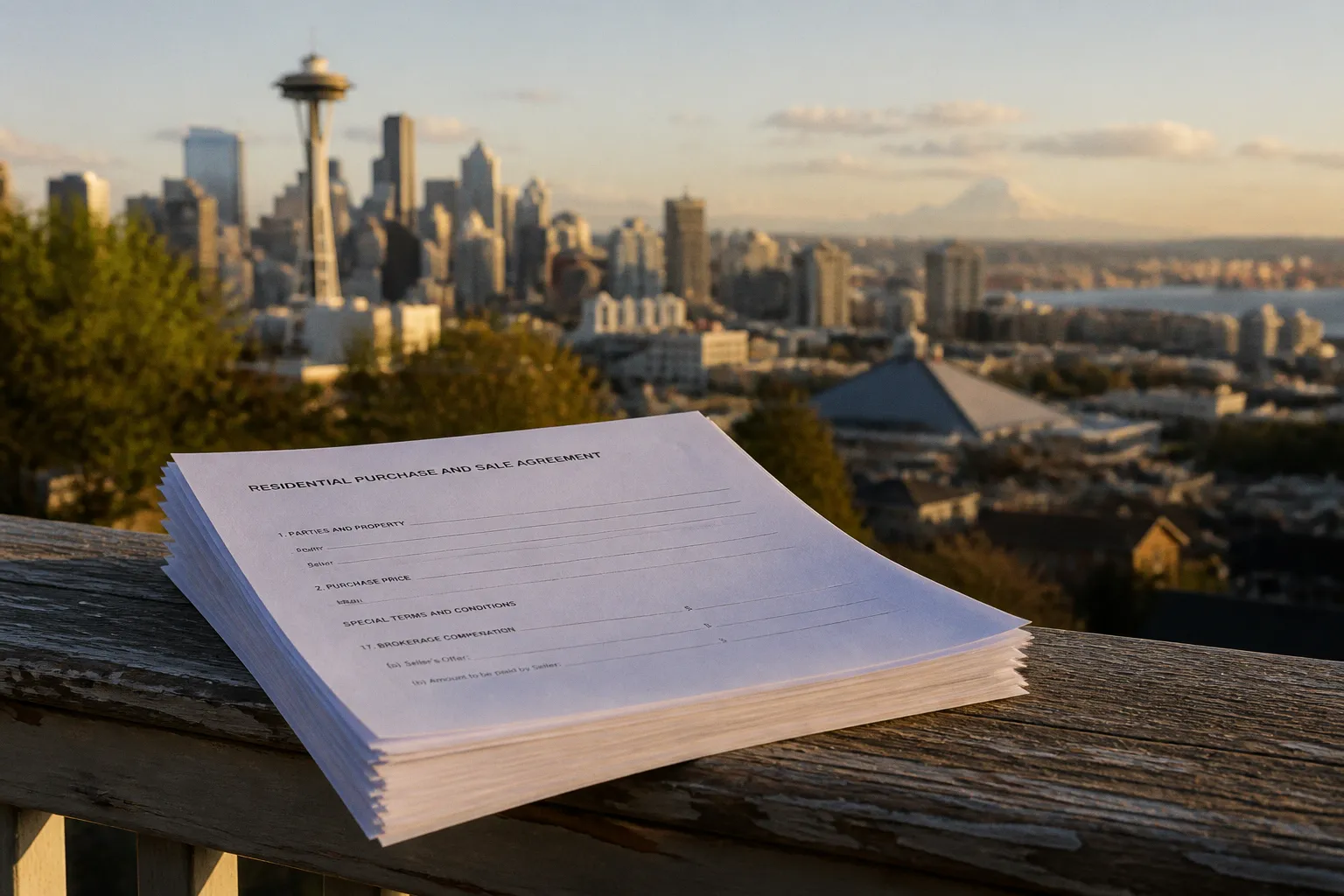
On the revised NWMLS purchase agreement, that blank is not harmless formatting. It can determine whether the buyer’s broker receives anything from the seller at closing.
That is the practical consequence of the 2024 commission reforms in the Seattle market. The change was not a simple removal of buyer-agent compensation from the Multiple Listing Service. NWMLS continues to allow compensation offers to be displayed. The bigger shift happened inside the transaction documents: compensation must be discussed, documented, and negotiated more explicitly between the buyer, the buyer’s broker, and the seller.
For homeowners and buyers, the new system rewards preparation. The old habit of treating commission as a background line item no longer works.
The evolution of NWMLS compensation transparency
The current forms make more sense when viewed as the end of a five-year sequence rather than a single August 2024 event.
On October 1, 2019, NWMLS removed the requirement that a seller offer compensation to a buyer broker in order to list a property. At the same time, NWMLS allowed compensation offers to be displayed publicly. That created flexibility without making seller-paid buyer-broker compensation disappear.
On October 3, 2022, NWMLS eliminated default commission-sharing between listing and buyer brokers. If a seller chose to offer compensation to the buyer broker, that payment would come directly from the seller rather than automatically through the listing firm.
Then Washington’s revised Agency Law, under RCW 18.86, took effect on January 1, 2024. Brokers were required to enter into a written services agreement with buyers at the beginning of the relationship, before touring homes. NWMLS Form 41 became the central document for setting out that relationship and its compensation terms.
The next major step came on August 15, 2024, when NWMLS revised Form 21, the Residential Purchase and Sale Agreement. The former buyer-broker compensation checkboxes were replaced with two fields in Specific Term 17:
- Seller’s Offer
- Amount to be Paid by Seller
Both fields must be completed in every offer.
That distinction matters. The first field describes the compensation the seller is offering. The second records the amount the seller will actually pay under the buyer’s offer and the negotiated purchase contract. They are related, but they are not interchangeable.
The reform did not make buyer-broker compensation invisible. It made the negotiation harder to ignore.
NWMLS is also independent from the National Association of Realtors and did not opt into the national NAR settlement. That means Seattle-area buyers should not assume that rules or form practices from an NAR-affiliated MLS automatically apply to an NWMLS transaction. In this market, the document language controls.
Form 21: where the commission conversation becomes contractual
The revised NWMLS Form 21 is not merely a cleaner version of the old purchase agreement. It changes the point at which compensation becomes part of the offer strategy.
Previously, a buyer and broker could discuss compensation in the buyer-broker agreement while the listing information often supplied a familiar expectation about seller-paid compensation. The revised process requires the buyer’s offer to state what the seller is offering and what the seller will pay.
That creates several possible structures.
Seller offers enough to cover the negotiated amount
Suppose the buyer’s Form 41 establishes that the buyer’s broker will receive a negotiated amount. The property’s listing indicates that the seller is offering the same amount, and Specific Term 17(b) on Form 21 records that the seller will pay it.
The transaction is relatively straightforward. The seller’s contribution is documented in the purchase agreement, and the buyer has a clear record of how the obligation will be handled at closing.
The buyer should still review the numbers rather than relying on a percentage or a listing notation. A compensation offer may be expressed in a way that does not match the buyer’s written obligation. It could be a percentage, a flat fee, or another negotiated structure.
Seller offers less than the buyer’s agreed obligation
This is where the buyer’s cash exposure becomes real.
Assume the buyer has agreed to pay the broker a certain amount under Form 41, but the seller offers less in the listing or in negotiations. The buyer may need to cover the difference, negotiate a larger seller contribution, revise the offer price, or decide that the property no longer works financially.
The answer depends on the buyer-broker agreement and the negotiated purchase contract. There is no universal rule that automatically shifts the shortfall to the seller.
This is why buyers should understand their compensation agreement before submitting offers. A buyer who waits until the offer is drafted may discover that the compensation gap competes with the down payment, closing costs, inspection work, or post-closing repairs.
Specific Term 17(b) is left blank
The revised form gives the parties a place to state the amount to be paid by the seller. If the buyer’s broker leaves Specific Term 17(b), “Amount to be Paid by Seller,” blank, the broker risks receiving no compensation from the seller for that transaction.
That does not necessarily mean the buyer owes nothing. It means the seller’s payment has not been properly established in that field. The buyer may still have a separate contractual obligation under Form 41.
This is one of the most important mechanical details in the NWMLS purchase agreement commission changes. A missing entry can create ambiguity at exactly the point where the parties need precision.
A seller contribution exceeds the negotiated broker compensation
The revised structure also allows a different conversation. If the seller’s offer exceeds the buyer-broker compensation negotiated with the buyer, the buyer may request that the excess be credited to the buyer at closing through Form 41C.
Form 41C is now focused on buyer credits. It is not a general form for renegotiating broker compensation. Any credit remains subject to lender approval and the terms of the transaction.
That lender condition is not a footnote. Credit structures can affect underwriting, cash-to-close calculations, and the permitted use of seller concessions. A buyer should have the lender review the proposed credit before treating it as available money.
The main Form 21 scenarios
| Transaction structure | What Form 21 needs to show | Likely financial effect for the buyer |
|---|---|---|
| Seller pays the negotiated broker amount | Seller’s Offer and Amount to be Paid by Seller align with Form 41 | No separate buyer funding for the covered amount, assuming the contract closes as written |
| Seller offers less than the negotiated amount | The seller-paid amount is stated, but does not cover the buyer’s obligation | Buyer may need to fund the difference or renegotiate |
| Seller offers nothing | The seller-paid field reflects zero or another negotiated result | Buyer’s Form 41 obligation may remain payable by the buyer |
| Seller offers more than the negotiated amount | The excess may be requested as a buyer credit through Form 41C | Credit may reduce cash needed at closing, subject to lender approval |
| Seller-paid amount is left blank | The offer does not clearly establish the seller’s payment | Creates compensation risk and should be corrected before acceptance |
The numbers also influence offer strength. A seller may compare two offers with the same purchase price but different requests for credits or broker compensation. A higher seller contribution can affect the seller’s net proceeds and may require a stronger price, cleaner contingencies, or a more certain closing timeline.
Form 41: the buyer’s agreement comes before the offer
Washington’s January 2024 Agency Law update moved the buyer-broker relationship into a more formal stage. Before a broker tours homes with a buyer, the parties generally need a written services agreement such as NWMLS Form 41.
From a project-management perspective, Form 41 is the budget baseline. It defines the compensation the buyer has agreed to, the circumstances under which it is earned, and the sources from which payment may come. Without that baseline, a buyer cannot accurately evaluate whether a seller’s offer is sufficient.
The agreement also limits the compensation a buyer broker may receive. Under the revised Form 41, the buyer broker cannot receive compensation from any source that exceeds the amount agreed upon with the buyer.
That rule changes how buyers should read a listing compensation offer. The listing figure is not automatically the broker’s final entitlement. The buyer’s agreement and the purchase contract must work together.
The “Showing Properties” clause was also deleted from the revised Form 41. That reflects the broader shift away from treating property tours as a casual, undefined service. The relationship now needs to be discussed in terms of representation, services, duration, compensation, and termination provisions.
A buyer should be able to answer these questions before touring seriously:
- Is compensation a percentage of the purchase price, a flat amount, an hourly amount, or another formula?
- If the seller pays less than the agreed amount, who covers the difference?
- If the transaction does not close, is any payment still due under the agreement?
- Can the buyer terminate the relationship, and under what conditions?
- Does the agreement apply to one property, a defined period, or a broader search?
- How will the broker handle a seller credit that exceeds the negotiated compensation?
- Are there loan-program restrictions that affect how the contribution can be structured?
These are not abstract legal questions. They are cost-to-close questions.
A buyer who signs Form 41 without understanding the shortfall provision may later focus on the headline purchase price while missing a five-figure obligation. In a market where buyers are already balancing interest rates, inspection repairs, appraisal risk, and closing costs, that is an avoidable budgeting error.
Form 41C: buyer credit, not compensation repair
One of the easiest mistakes after the August 2024 changes is using the wrong mental model for Form 41C.
Form 41C was revised to focus exclusively on buyer credits. If the seller’s offer is higher than the buyer-broker compensation negotiated under Form 41, the buyer may request that the excess be credited to the buyer at closing. The form does not serve as a general mechanism for adjusting the broker’s compensation agreement.
The distinction is practical:
- Form 41 establishes the buyer-broker services relationship and agreed compensation.
- Form 21 states the seller’s offer and the amount the seller will pay in the purchase contract.
- Form 41C addresses a buyer credit when the seller’s contribution exceeds the negotiated buyer-broker compensation.
The credit still has to fit within the buyer’s loan parameters and closing statement. A lender may reject a credit that exceeds allowable costs or is not tied to a permitted expense. Some loan programs also apply specific concession limits.
For a buyer using conventional financing, the lender will evaluate the credit against closing costs and program rules. For a VA borrower, the analysis requires additional care because the policy changed in 2024.
VA loans and the separate compensation question
Effective August 10, 2024, VA Circular 26-24-14 temporarily allowed VA home-loan borrowers to pay buyer-broker fees directly at closing. That policy change is reflected in updated Form 41 compensation terms.
This matters because a VA buyer may have less flexibility than a conventional buyer when deciding how to handle a compensation shortfall. The buyer may be able to pay the fee directly, but the transaction still has to comply with the loan program’s underwriting and closing requirements.
The commonly cited VA seller concession cap is 4%, and buyer-agent fees are excluded from that cap under the updated policy framework. That does not mean every seller-paid structure will work automatically. The lender still needs to confirm how the fee, any seller credit, and other concessions appear in the transaction.
For a VA buyer, the sequence should be deliberate:
1. Review the compensation obligation in Form 41.
2. Ask the lender how direct payment at closing will be treated.
3. Compare the seller’s offer with the negotiated broker amount.
4. Model the cash-to-close result before submitting the offer.
5. Put the agreed seller payment into the correct Form 21 field.
6. Use any buyer-credit structure only after lender review.
The key is not the loan label alone. It is the interaction between the buyer-broker agreement, the purchase agreement, the closing disclosure, and the lender’s interpretation of the program rules.
What the reforms mean for Seattle buyers
Seattle buyers have traditionally had to compete on more than price. Financing strength, contingency timing, inspection strategy, earnest money, appraisal terms, and closing flexibility can all influence a seller’s decision. Compensation now joins that list.
A buyer should evaluate a property using a complete acquisition budget rather than a purchase-price budget:
- Down payment
- Loan and lender charges
- Title and escrow costs
- Prepaid taxes and insurance
- Inspection and specialist reports
- Immediate repairs
- Moving and storage
- Buyer-broker compensation not covered by the seller
- Any appraisal or financing contingency exposure
A $900,000 home with a modest seller contribution may require less cash at closing than a $875,000 home where the buyer must fund a compensation gap and several immediate repairs. The list price alone does not determine affordability.
The offer strategy also changes. If the seller is not offering the amount needed to cover the buyer’s negotiated compensation, the buyer has several levers:
- Increase the purchase price while requesting the seller contribution, if appraisal risk is acceptable.
- Reduce another requested credit.
- Offer a shorter inspection or financing timeline, if the buyer can genuinely perform.
- Use available cash to cover the difference, without compromising reserves.
- Negotiate a different compensation arrangement with the broker before submitting the offer.
- Walk away from a property whose total cost exceeds the buyer’s approved budget.
That last option is not a failure of negotiation. It is disciplined underwriting at the household level.
Buyers should also distinguish between a seller’s willingness to contribute and the property’s ability to support the requested price. A larger seller-paid amount can make an offer more attractive in cash-flow terms, but the appraiser evaluates the property’s value, not the buyer’s compensation agreement. If the price is pushed above comparable sales, the buyer may carry appraisal risk.
What the reforms mean for Seattle sellers
For sellers, the new structure turns compensation into a more visible net-proceeds decision.
The question is no longer simply, “What commission is customary?” The better question is, “What combination of price, seller-paid costs, concessions, and certainty produces the strongest net result?”
A seller may decide to offer no buyer-broker compensation, a fixed amount, a percentage, or another negotiated figure. NWMLS continues to permit public display of compensation offers, so the seller’s choice may be visible to buyers and their brokers. A zero offer is allowed, but it may affect the pool of buyers who can comfortably pursue the property.
That is especially relevant for first-time buyers and buyers with limited liquid reserves. If a buyer must fund both the down payment and an uncovered broker fee, the property may become inaccessible even if the monthly payment is manageable.
The seller’s listing strategy should therefore connect three numbers:
1. The likely market value of the property
2. The seller’s desired net proceeds
3. The contribution level that supports buyer demand without overpaying
A seller who offers compensation should make sure the amount is accurately described and that the purchase agreement records the amount the seller will pay. A seller who chooses not to offer compensation should expect buyers to negotiate around that decision, potentially through price, credits, or other terms.
The economics are property-specific. A renovated Ballard home with strong demand may attract buyers willing to absorb more costs. A dated property with a high fixture allowance, deferred maintenance, or a weak inspection profile may need a more buyer-friendly contribution to compete.
This is where pre-sale preparation and transaction mechanics meet. Spending $8,000 on targeted repairs that improve inspection results may produce more value than offering the same amount as a concession. In another property, a seller contribution may be the cleaner lever because the home’s condition is already strong and the buyer’s objection is primarily cash-to-close.
The right answer depends on cost-to-value ratio, not on a universal percentage.
Negotiation mechanics: compare net, not headline terms
The revised forms make it easier to compare offers accurately, but only if the parties look past the purchase price.
Consider two offers on the same Seattle property:
| Offer element | Offer A | Offer B |
|---|---|---|
| Purchase price | $900,000 | $910,000 |
| Seller-paid buyer-broker amount | $0 | $18,000 |
| Requested buyer credit | $0 | Subject to lender approval |
| Inspection contingency | 10 days | 5 days |
| Financing contingency | 21 days | 14 days |
| Seller’s gross price before other costs | Lower | Higher |
| Buyer’s immediate compensation exposure | Higher | Potentially lower |
Offer B may produce a better seller result, but only if the higher price survives appraisal and the shorter timelines are credible. Offer A may be simpler on paper but less workable for the buyer’s cash position.
Neither offer can be evaluated by price alone. The broker compensation line interacts with:
- Appraisal probability
- Earnest money amount
- Financing type
- Inspection findings
- Seller’s relocation or purchase timeline
- Buyer’s cash reserves
- Lender approval of credits
- Title and escrow requirements
- The buyer’s willingness to accept post-closing repair costs
For sellers, the useful calculation is net proceeds after negotiated contributions and expected transaction costs. For buyers, the useful calculation is total cash required and total first-year ownership cost.
That is the spreadsheet that deserves attention—not a generic commission headline.
A disciplined workflow before signing
The cleanest way to avoid confusion is to treat the transaction documents as a coordinated set rather than isolated forms.
Before the buyer tours properties
The buyer and broker should review Form 41 in plain numbers. If the compensation is a percentage, calculate it at several likely purchase prices. A fee that sounds modest at $700,000 changes materially at $1.1 million.
The buyer should also understand what happens if the seller pays nothing or pays less than the agreed amount. That scenario should be modeled before the buyer becomes emotionally committed to a property.
Before writing the offer
The buyer’s broker should identify the seller’s stated compensation offer and compare it with the buyer’s Form 41 obligation. The difference, if any, belongs in the offer strategy.
The buyer should know:
- How much cash remains after down payment and closing costs
- Whether the lender permits the proposed credit
- Whether the purchase price supports the requested contribution
- Whether the buyer is willing to pay a shortfall
- Whether the compensation structure affects the strength of the offer
While completing Form 21
Specific Term 17 should not be treated as a clerical afterthought. The seller’s offer and the amount to be paid by the seller need to be completed clearly and consistently with the negotiated terms.
A blank, mismatch, or vague reference can create an avoidable dispute. If the parties are using a buyer credit, that structure should be documented through the appropriate addendum rather than improvised in unrelated language.
Before acceptance and closing
The buyer, broker, lender, escrow officer, and closing documents should all reflect the same agreement. If the terms change during negotiation, the parties should update the relevant forms instead of relying on an email summary or verbal understanding.
The final question is simple: who pays what, to whom, and at what point in the closing process?
If the answer requires several assumptions, the paperwork is not finished.
In the new NWMLS framework, compensation is part of the offer’s engineering: price, credit, contingencies, and cash-to-close have to balance.
The bottom-line strategy for homeowners
The August 2024 NWMLS form revisions did not eliminate negotiation. They moved more of it into the open.
For buyers, the priority is to sign Form 41 with a clear understanding of the maximum obligation, then use Form 21 to negotiate the seller-paid amount deliberately. For sellers, the priority is to choose a contribution strategy based on demand, net proceeds, property condition, and the type of buyer the listing needs to attract.
The revised forms also make poor coordination more expensive. A buyer can have a valid services agreement but no seller payment. A seller can make an attractive compensation offer that is not accurately carried into the purchase agreement. A buyer credit can look useful until the lender rejects it. A higher purchase price can appear favorable until the appraisal comes in short.
Spend on the item that removes the largest transaction obstacle. If the property has obvious inspection defects, targeted renovation may deliver better value than a larger concession. If the house is market-ready but buyers are short on closing liquidity, a properly structured seller contribution may improve the offer pool. If the broker compensation gap is the problem, negotiate it before the offer is submitted—not after acceptance.
Spend vs. save verdict: spend on clarity first. A precise Form 41, a fully completed Form 21, and lender-reviewed credit terms cost little compared with a missed compensation obligation or a failed closing. Save on automatic assumptions about “standard” commissions; under the current NWMLS purchase agreement, the number is negotiated, documented, and tied directly to the economics of the deal.