Weltmuseum Tickets: Choosing the Best Option for Your Visit
Weltmuseum Wien holds between 400,000 and 500,000 ethnographic and archaeological objects. It presents its permanent collection across 14 exhibition galleries inside the Neue Burg, one wing of the Hofburg Palace.
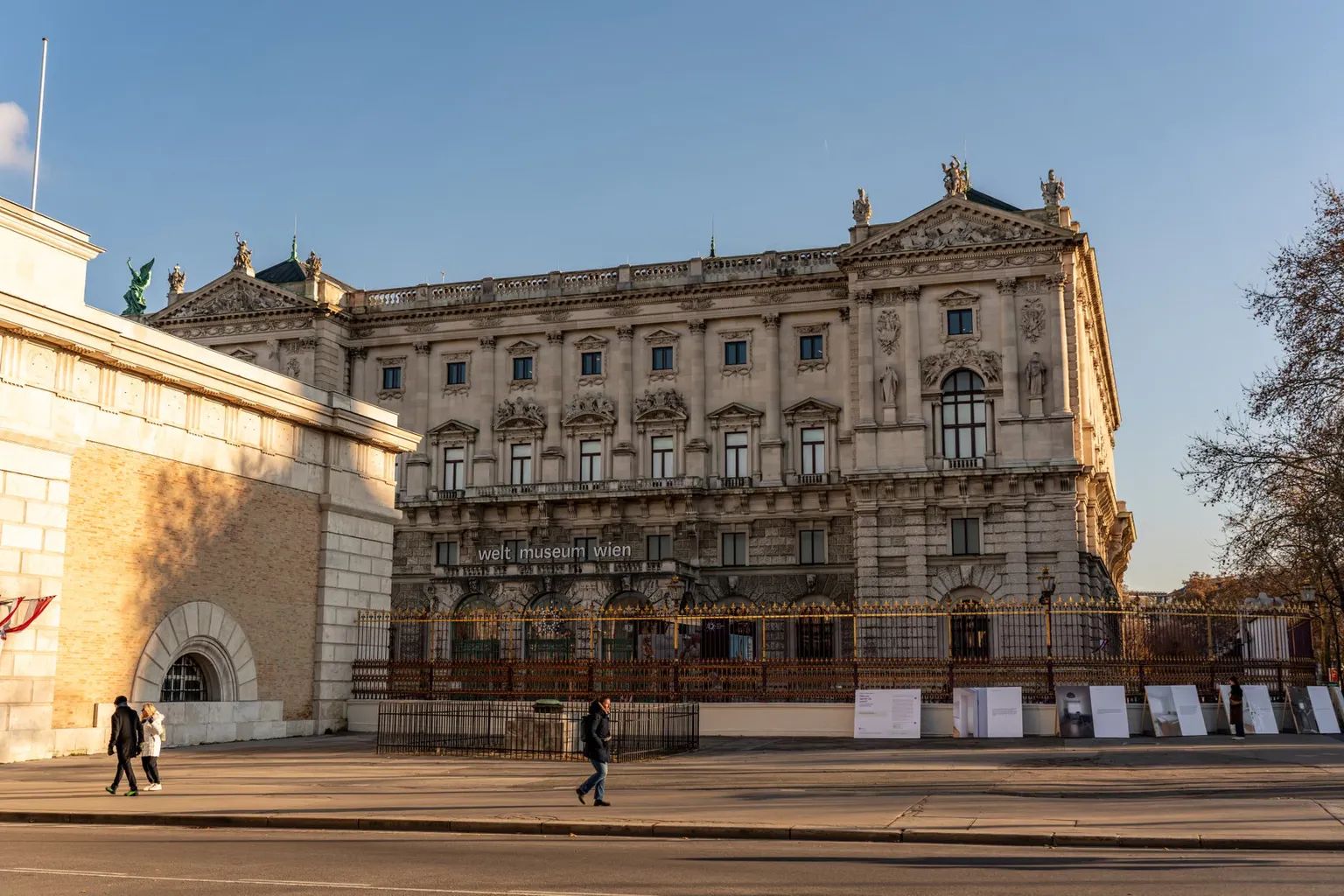
The ticket is more useful than its name suggests: it is not limited to the Weltmuseum itself, but is tied to two other permanent collections in the same building.
Tickets and prices
Weltmuseum
I
Save
Box office and online booking
- Adult €16
- Child free
- Reduced €12
€16
Official websiteII
entry ticket
Entry ticket · 14 spots left today
This entry ticket grants access to a collection of ethnological cultural treasures from all over the world.
€16
Book ticketsThat bundled structure is the detail most likely to affect your plans. A standard Weltmuseum ticket can provide access to the Imperial Armoury and the Collection of Historic Musical Instruments as well as the museum’s own galleries. Arriving at Heldenplatz without understanding that arrangement can lead to two avoidable mistakes: paying separately for a collection already included in your admission, or leaving the Neue Burg without seeing exhibitions covered by the same ticket.
The practical question is therefore not simply how much Weltmuseum tickets cost. It is which admission product matches your itinerary, whether your preferred date requires a time slot, and which rules still apply to your visitor category when you book.
Understanding the Bundled Entry System at the Neue Burg
Three permanent collections operate under the KHM-Museumsverband umbrella at the Neue Burg, the Hofburg extension facing Heldenplatz at 1010 Wien. The Weltmuseum Wien occupies the main gallery areas, while the same admission structure also covers:
- The Imperial Armoury (Hofjagd- und Rüstkammer), with Habsburg military, hunting, and ceremonial objects.
- The Collection of Historic Musical Instruments (Sammlung alter Musikinstrumente), devoted to instruments connected with the musical life of the imperial court and its wider historical setting.
The useful way to think about the arrangement is as one admission framework with three destinations inside one building. That does not necessarily mean that every ticket type, special event, or guided programme has identical conditions, but the standard museum visit is built around this shared Neue Burg structure.
A Weltmuseum ticket is best understood as a Neue Burg admission, not as access to a single isolated gallery.
This distinction matters because the Neue Burg is not the same venue as the main Kunsthistorisches Museum building across Maria-Theresien-Platz. A ticket for the Weltmuseum and its Neue Burg partners does not automatically function as admission to the KHM’s picture gallery or Kunstkammer in the principal building. Those are separate museum areas and should be treated as a separate stop when planning your day.
The difference is easy to miss on a map. The collections belong to the same broad federal museum network, and visitors often group them together as part of the Hofburg or KHM complex. For ticket purposes, however, the location and the product still matter. If your itinerary includes both the Neue Burg and the main Kunsthistorisches Museum, check whether a broader museum pass or combination product is more appropriate than buying only a Weltmuseum entry.
What the bundle changes in practice
The three-collection arrangement affects both time and value.
First, leave enough room for more than the Weltmuseum’s headline galleries. The Armoury and the musical-instrument collection are not remote add-ons requiring a separate journey across Vienna. They are part of the same building experience, which makes them particularly easy to overlook. Visitors who arrive with a narrow one-museum plan may discover too late that they have spent most of their available time in the first galleries.
Second, do not assume that a ticket for one KHM-associated venue automatically covers every KHM-associated venue. The museum network is broad; admission products are not interchangeable by default. Read the scope of the exact product in the official KHM shop, especially if the wording refers to the Neue Burg, a specific exhibition, or a citywide pass.
Third, consider the order of your visit. The Weltmuseum’s permanent galleries can absorb most of the attention, especially for visitors interested in the museum’s global collections. The two partner collections are easier to fit in before or after the main visit if you know in advance that they are included. A little planning here is more useful than trying to reconstruct the ticket structure at the entrance.
Standard Pricing, Discounts, and Free Admission Criteria
Weltmuseum Vienna admission options are organized around visitor status, documentation, and the kind of product being purchased. Exact prices can change, and some products have their own validity rules, so the official KHM shop remains the appropriate place to confirm the current amount before payment.
The basic structure looks like this:
| Visitor profile or product | Typical admission treatment | What to verify |
|---|---|---|
| Adults | Standard admission | Current price, selected date, and any time-slot condition |
| Vienna City Card holders | Reduced admission may apply | Whether the card is accepted for the chosen product and which proof must be shown |
| Students, seniors, and qualifying groups | Reduced admission may apply | Valid identification and the definition of the qualifying category |
| Visitors under 19 | Free admission is available under the museum’s youth policy | Current entry procedure, documentation, and whether advance reservation is recommended or required |
| Multi-museum pass holders | Weltmuseum may be included | Participating venues, validity period, and whether a reservation is needed |
| Guided-tour participants | Admission plus programme conditions | Whether the tour price includes entry or requires a separate museum ticket |
The important correction to many simplified descriptions is that free admission and frictionless admission are not the same thing. Visitors under 19 are eligible for free entry, but that fact alone does not establish that they can always walk directly through the standard gate without a reservation, ticket collection, or age verification. The procedure can depend on the current booking system, capacity management, or the particular product selected.
For a youth visitor, the sensible approach is to check the current instructions in the official KHM shop before travelling. Bring the identification or proof of age requested by the museum, and do not assume that a free admission policy removes every booking requirement. The benefit is the absence of an admission charge; the practical route into the building should still be confirmed.
The same principle applies to reduced admission. A Vienna City Card, student card, senior qualification, or group status may affect the price, but the discount is not a substitute for documentation. If the ticket is purchased online, check whether the reduced category is selected during booking and whether the supporting card must be shown at the entrance. If you are buying at the desk, have the relevant proof ready rather than relying on a verbal explanation of eligibility.
When a pass makes sense
Several broader products may include the Weltmuseum as part of their coverage:
- The 7 Museums Pass, which covers a defined group of federal museums during its validity period and may be offered with different age-based rates.
- The Bundesmuseen Card, an annual product for participating federal collections, including the Weltmuseum and other major museums in the network.
- City sightseeing passes, such as the Vienna Pass, which can include the Weltmuseum among a much larger group of attractions.
The arithmetic is only useful when it reflects your actual itinerary. A pass can be attractive if you plan to visit several participating federal museums or use a city pass intensively. It is less persuasive when the Weltmuseum is your only planned museum or when the other included venues are unlikely to fit into your schedule.
Use three questions to compare standalone Weltmuseum ticket prices with combination tickets:
1. How many included venues will you realistically visit? A pass is not good value merely because it lists many attractions.
2. Does the product cover the locations you actually want? Confirm whether it includes the Neue Burg collections, the main Kunsthistorisches Museum, or both.
3. Does it change the booking process? Some passes may still require a reservation or a separate time-slot step, even when admission itself is covered.
Free admission for visitors under 19 removes the price barrier, but it does not by itself answer the operational question of how entry should be arranged.
A standalone ticket is usually the clearer choice for a focused visit. A combination product becomes more compelling when the rest of your Vienna plan already includes several museums within the same network. The right decision is less about finding the cheapest headline price than avoiding a pass whose validity and booking rules do not match your day.
Navigating Official Online Booking and Time-Slot Requirements
The safest route for Weltmuseum tickets is the official KHM-Museumsverband online shop. It provides the current products, prices, availability, and instructions attached to each ticket type. That matters because the conditions are not necessarily identical for a standard admission ticket, a free youth reservation, a guided programme, or a broader museum pass.
For a regular dated visit, the booking process generally follows this sequence:
1. Choose the product that matches your visit. Decide whether you need standalone admission, a combination ticket, a pass-related entry, or a guided programme.
2. Select the intended date. Availability can vary by day, season, holidays, and special museum activity.
3. Review the entry requirement. If the product uses time slots, choose an available window and read whether the slot applies to the museum entrance or to a particular programme.
4. Enter the correct visitor category. Discounted and free admissions may require different selections from standard adult tickets.
5. Complete the purchase or reservation. Keep the confirmation accessible in the format requested by the shop.
6. Check the final instructions before leaving. Look for the entrance location, arrival guidance, required identification, and any conditions affecting re-entry or changes.
Time slots should be treated as an arrival-management tool, not as a limit on the length of your museum visit. A designated entry window normally governs when you may enter; it does not automatically tell you that you must leave after a fixed number of minutes. Still, the exact terms attached to the ticket control, so read the product description rather than assuming all tickets work identically.
If the online shop shows no availability for a preferred time, do not convert that information into a stronger claim than the system supports. Online inventory and box-office availability may not be identical, and the supplied booking information does not establish that a time slot unavailable online must also be unavailable at the desk. The practical conclusion is more restrained: an online sold-out display means you should not rely on being admitted at that time, and you should verify current options with the official KHM shop or the museum’s box office before making the trip.
Why unofficial tickets are a poor shortcut
The KHM-Museumsverband warns visitors to be cautious about tickets purchased outside its authorized sales channels. A ticket from an unverified reseller may not carry the same validity guarantee as a ticket issued through the official system. That is enough reason to avoid treating a secondary-market confirmation as interchangeable with an official booking.
It would be too strong to say that every credential not originating from the museum’s own infrastructure will be automatically rejected. The documented concern is narrower and more useful: unauthorized tickets are not guaranteed to be valid, and the museum may apply its own verification and admission conditions. If something goes wrong, a reseller’s promise does not replace the museum’s rules.
Before buying from any third-party platform, compare the offer with the official KHM shop:
- Is the product clearly identified as Weltmuseum admission?
- Does it name the Neue Burg collections covered?
- Is a date or time slot specified?
- Are the terms for cancellation, transfer, and age-based admission clear?
- Does the price include only museum entry, or also a tour or city pass?
- Can the seller explain how the ticket will be recognized at the museum?
In most cases, the apparent convenience of an intermediary is not worth adding uncertainty to a time-sensitive visit. The official shop gives you the best chance of seeing the current admission conditions as the museum defines them.
Buying at the museum
Tickets may also be available at the Neue Burg box office, subject to the museum’s current operating arrangements and capacity. On-site purchase is useful for visitors whose plans are flexible, but it is not a guarantee of immediate entry at the preferred time. Arriving without a confirmed booking means accepting whatever products and entry windows remain available when you get there.
That distinction is particularly important for visitors working around a train departure, a guided tour elsewhere, or a tightly scheduled day at the Hofburg. If your visit depends on entering at a particular hour, confirm the slot through the official channel rather than assuming that the desk will reproduce the online choice.
Guided Tours, Add-On Programs, and Museum Passes
Standard admission and guided programming serve different purposes. A normal ticket gives you access to the covered collections; a guided tour adds interpretation, structure, and a scheduled group experience. One does not automatically include the other.
The Weltmuseum’s programme can include different formats, such as:
- Thematic guided tours, which spend more time on a region, collection, exhibition theme, or cultural narrative.
- Short tours or Kurzführungen, which offer a more concentrated introduction to a particular area or set of objects.
- Special programmes, whose availability, language, duration, and price may change with the museum calendar.
The exact relationship between a tour booking and museum admission should be checked for the specific event. Some programmes may require a separate admission ticket; others may state their own entry arrangement. Do not assume that paying for a guided session automatically settles every admission requirement.
The choice depends on how you prefer to move through the museum:
| Visitor profile | A reasonable starting point | Why it may work |
|---|---|---|
| First-time visitor with limited background | A thematic tour, if available in a suitable language | It can supply a route through the galleries and explain connections that are easy to miss alone |
| Visitor returning for a particular subject | A short or focused tour | It concentrates attention without repeating an entire first visit |
| Specialist or highly motivated visitor | Standard admission with independent time | The open-ended format allows closer study of selected objects |
| Family including younger visitors | Flexible admission first, then a programme if interest holds | It avoids forcing a long structured session on visitors who may prefer to explore |
| Visitor using a museum or city pass | Pass admission plus any required tour booking | The pass may cover entry without covering the programme itself |
The museum’s well-known objects can also distort expectations. The Aztec feather headdress and the James Cook Pacific collection are among the highlights associated with the permanent galleries. They are not reasons to assume that a guided tour is the only way to see the collection. A tour may provide context or a more deliberate route, but standard admission is the relevant product for visitors who simply want to enter the permanent exhibitions.
The reverse is also true: buying a standard ticket does not promise a guided explanation of every major object. If interpretation is central to your visit, look for a programme that matches your language, date, and available time. If your priority is freedom to pause, return to a gallery, or follow a personal research interest, independent entry may be the better fit.
Combining the museum with the rest of the Hofburg
The Neue Burg works well as part of a wider central Vienna itinerary, but a pass should be assessed by venue rather than by the visual impression of a single palace complex. Nearby attractions may belong to different institutions or use separate admission products. A Weltmuseum Vienna entry pass is not automatically a Hofburg-wide pass.
This is where combination tickets can be useful, provided their scope is explicit. Before purchasing, identify each venue you want to visit and match it against the pass terms. If the product covers the Weltmuseum’s Neue Burg partners but not the main Kunsthistorisches Museum, it may still be valuable, but it should not be treated as a universal KHM ticket.
Operating Hours and Planning Your Arrival at the Hofburg
The standard weekly pattern described for the Weltmuseum is six days of operation, with Monday closed and Tuesday offering extended evening hours. The usual schedule is:
| Day | Published schedule in the standard pattern |
|---|---|
| Tuesday | 10:00–21:00 |
| Wednesday | 10:00–18:00 |
| Thursday | 10:00–18:00 |
| Friday | 10:00–18:00 |
| Saturday | 10:00–18:00 |
| Sunday | 10:00–18:00 |
| Monday | Closed |
Holiday arrangements, temporary changes, and special programmes can affect those hours. Check the current listing before fixing your itinerary, particularly if you are travelling on a public holiday or planning to arrive close to closing time.
Tuesday’s late opening is useful for visitors who want to combine the museum with other central Vienna sights during the day. It can also make the schedule less compressed: a later museum visit leaves more room for a morning appointment, a separate collection, or travel into the city. It should not be treated as a guarantee of lower visitor numbers, however. Evening entry may be calmer on some days and busy on others.
The entrance is at the Neue Burg on Heldenplatz. This is the point to enter into your navigation, rather than relying only on “Hofburg,” which covers a much larger complex. The building is prominent, but the surrounding palace area has multiple entrances and institutions. A ticket confirmation with the exact venue name is more useful than a general map pin.
Burgring is the nearest tram stop mentioned in the standard arrival information, with a short walk across the square to the Neue Burg. The museum is also centrally located for visitors already in the inner district. Walking from Stephansplatz or Karlsplatz is possible, although the actual time will depend on the route, pace, and pedestrian conditions.
There is no dedicated museum parking arrangement that makes driving an obvious choice for this location. Public transport or walking is generally simpler, especially when the visit forms part of a central Vienna day.
A practical arrival sequence
A low-friction visit usually comes from checking the details in the right order:
1. Confirm the venue. Make sure the ticket names the Weltmuseum or the relevant Neue Burg admission rather than only another KHM location.
2. Check the date and slot. Compare the confirmation with the day and entry window you selected.
3. Review visitor documentation. Reduced-price and free admissions may require proof of age, status, or card ownership.
4. Plan to reach Heldenplatz with a modest buffer. Five to ten minutes before the designated window is a reasonable planning margin; arriving extremely early does not necessarily create earlier access.
5. Keep the confirmation ready. A readable digital ticket or the format specified by the official shop makes the entrance process easier.
6. Ask about the bundled collections before setting off through the galleries. Knowing what the ticket covers helps you protect time for the Armoury and historic instruments.
7. Avoid leaving the building casually. Unless the ticket terms explicitly provide re-entry, treat the admission as intended for one continuous visit.
The last point is a planning precaution, not a claim that every product has identical re-entry rules. If you need to leave for a meal, appointment, or another museum, ask staff or check the ticket conditions before exiting. A short question at the entrance is preferable to discovering later that the same credential cannot be used again.
Making the Ticket Choice Work for Your Visit
The Weltmuseum’s admission system becomes manageable once four separate issues are kept apart: what the ticket covers, who qualifies for a reduced or free rate, whether a time slot is attached, and whether a pass changes the value calculation.
For a focused visit, standalone admission through the official KHM shop is usually the cleanest option. It avoids paying for attractions you will not use and gives you a direct view of the current booking conditions. It is also the easiest product to understand when the main goal is the Weltmuseum’s permanent galleries and the other two Neue Burg collections.
For a broader Vienna itinerary, compare the standalone price with the 7 Museums Pass, Bundesmuseen Card, or an applicable sightseeing pass. Count only the venues you genuinely expect to visit. A pass that looks economical on paper can become expensive in practice if its validity period, participating museums, or reservation rules do not fit your schedule.
For visitors under 19, the confirmed free-admission policy changes the price calculation, but it should not be turned into an assumption of automatic walk-in entry. Verify the current procedure through the official KHM shop, bring any requested proof of age, and follow the instructions attached to the reservation or ticket category.
For visitors considering a third-party seller, the calculation is different again. A lower advertised price is not useful if the ticket’s validity is uncertain or the product does not correspond to the Neue Burg admission you need. Official purchase is the safer baseline, and any departure from it should be made only after checking the terms carefully.
The most important fact remains the bundled scope: one Weltmuseum admission can open the three permanent Neue Burg collections, while the main Kunsthistorisches Museum across the square remains a separate question. Once that boundary is clear, choosing between a standalone ticket, a combination product, and a wider museum pass becomes a matter of itinerary rather than guesswork.
The best Weltmuseum tickets are not necessarily the cheapest ones advertised. They are the tickets whose venue, visitor category, date, and booking conditions match the visit you are actually planning. Confirm those four details in the official KHM shop, arrive at the Neue Burg on Heldenplatz with the right documentation, and treat the bundled collections as part of the experience rather than as an afterthought.
Practical info
Currency: EUR
Driving: on the right
Emergency number: 112