Royal Treasure Museum tickets: which option fits your visit?
The most common mistake with Royal Treasure Museum tickets is treating every admission option as interchangeable. It is not.
A solo visitor, a family with two children, a senior traveler, and a group that wants an explanation from a guide are not making the same transaction.
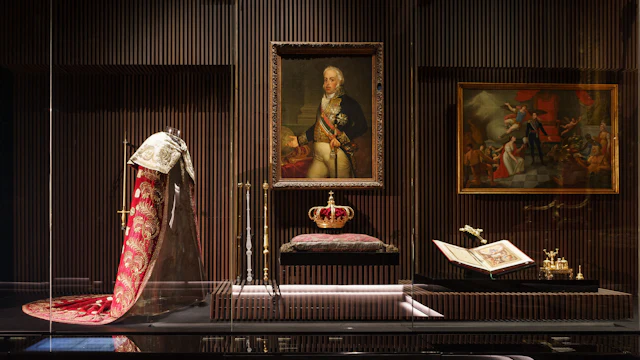
Royal Treasure Museum
- Tuk-tuk tour with treasure huntcruisefrom€200
Prices checked on August 14, 2026 · current price on the partner page.
Official website — tesouroreal.pt
- Time to spend: 2–3 h
- Best time to visit: morning
Prices are indicative and may change — confirm the price and availability on the partner page.
Partner link — GetYourGuide ticketsYou are buying access to a high-security collection inside the west wing of Ajuda National Palace, not simply adding another room to a Lisbon sightseeing route. The ticket type affects what you pay, how efficiently you move through the museum, and whether the visit fits your schedule. Choose by visitor profile and timing—not by grabbing the first available option and hoping the details sort themselves out.
The Royal Treasure Museum opened on June 1, 2022. Its permanent exhibition presents Portugal’s Crown jewels and related objects in 11 thematic sections spread across three floors inside a specialized vault. That layout gives the museum real weight, but it also means a rushed visit can turn into a poor-value admission. You need enough time for security, orientation, the exhibits themselves, and the climb through the full route.
Treat the ticket like a contract: match the terms to your party before you commit. The cheapest option is not always the lowest-cost decision.
Start with the admission category, not the headline price
Royal Treasure Museum ticket prices vary by visitor category and format. The basic adult admission is the cleanest choice for one adult between the standard working-age bracket, especially if you already know the collection you want to see and do not need a guide.
That option gives you control. You choose your arrival time, move at your own pace, and avoid paying for explanation you may not use. If your Lisbon itinerary is already crowded with timed attractions, that flexibility matters. You can spend more time in the sections that interest you and less time in displays that do not.
But do not automatically put every member of your party on the standard adult ticket. The museum has reduced categories for younger visitors and seniors, free admission for very young children, and a lower rate for visitors with documented disability above the stated threshold. Professional and museum-sector memberships, including ICOM, APOM, and ICOMOS credentials, can also qualify for a reduced rate.
The practical decision tree is straightforward:
- If you are an adult traveling alone or with other standard-rate adults, compare regular admission with a guided option only if interpretation is central to the visit.
- If you are traveling with children or young people, check their age category before booking. Do not assume a child automatically requires a full-price place.
- If someone in your party is a senior, use the concession category rather than treating the booking as a block of adult admissions.
- If you have an eligible disability or a professional museum membership, bring the required proof. A concession without documentation is not a strategy; it is a rejected claim at the desk.
- If you hold a Lisboa Card, check whether the card covers this museum under its current terms before purchasing separate Royal Treasure Museum tickets.
The age bands matter. Youth admission applies to visitors from 7 through 24, while children from 0 through 6 enter free. Senior admission begins above 65. Those boundaries are not decorative details, particularly for families with teenagers or multigenerational groups.
Do not guess the category. Count the ages on the date of the visit, review the conditions attached to your card or concession, and keep proof available. Museums have little patience for improvised eligibility arguments, and neither should your itinerary.
Family and group tickets: where the math changes
For a family, the dedicated family ticket can be more efficient than assembling separate admissions. The family format covers two adults and two young people, which makes it relevant for a household traveling with two eligible children or young adults.
That does not mean every family should select it automatically. If your party includes a child under the free-admission age, a senior, or a visitor who qualifies for another concession, run the comparison before you check out. A family product is designed around a specific combination of visitors. Once your group differs from that combination, the supposed convenience can become dead weight.
Use this sequence:
1. Separate the party by eligibility. List standard adults, youth, seniors, free-admission children, and concession visitors.
2. Compare the family format against the individual combination. Do not compare it against four standard adult admissions unless that is actually your group.
3. Check whether the ticket requires the party to enter together. Group conditions can affect your meeting point and arrival plan.
4. Confirm whether a Lisboa Card changes the calculation. A cardholder may not need the same ticket product as the rest of the party.
5. Book the option that leaves the fewest unresolved conditions. Saving a small amount is not useful if the group arrives with unclear eligibility or mismatched entry terms.
For larger groups, the public guided tour is a different proposition. It is not merely a bulk admission. You are paying for a structured interpretation of the collection and accepting a more fixed rhythm. That can work well for school groups, organized tours, and visitors who want the historical context explained rather than assembled from labels.
The private guided format also has group-specific rules. For groups over 30 people, an additional private-visit fee applies. That is the kind of term that disappears in a casual search and shows up later as a budget problem. If you are coordinating a large party, ask for the full group structure before anyone transfers money.
| Visitor situation | Usually the most sensible starting point | Main condition to verify |
|---|---|---|
| One adult or a pair of adults | Standard individual admission | Whether a Lisboa Card or professional credential applies |
| Visitor aged 7–24 | Youth concession | Age on the date of entry |
| Visitor over 65 | Senior concession | Proof of age if requested |
| Child aged 0–6 | Free admission category | Whether a separate reservation or ticket allocation is still required |
| Two adults with two eligible young people | Family admission | Whether every member fits the family definition |
| Group wanting interpretation | Public guided tour | Tour language, schedule, and meeting instructions |
| Group above 30 people | Private or organized group format | Additional group fee and entry coordination |
| Museum professional or eligible disabled visitor | Specialized concession | Documentary proof at entry |
The table is a starting point, not a substitute for the current booking conditions. Ticket systems change their products, availability, and restrictions. Read the terms attached to the option you are actually buying.
Schedule the museum around the last-entry rule
The Royal Treasure Museum operates on a seasonal timetable. From May 1 through September 30, it is open daily from 10:00 a.m. to 7:00 p.m. From October 1 through April 30, it is open daily from 10:00 a.m. to 6:00 p.m.
The critical detail is not the closing time. It is the last-entry rule: admission stops 60 minutes before closing.
That gives you a hard cutoff of 6:00 p.m. during the summer schedule and 5:00 p.m. during the winter schedule. Arriving at 6:10 p.m. in July does not give you 50 minutes inside. It gives you a problem.
If your route reaches Ajuda late in the day, move the museum earlier or move it to another day. Do not build an itinerary that depends on a last-minute walk from Belém, an uncertain taxi queue, or a delayed lunch. Lisbon is generous with attractions and less generous with your assumptions about transit time.
The museum’s three-floor exhibition route also argues against a late scramble. Even if the building admits you near the final hour, you will be asking your group to absorb a substantial collection under a shrinking clock. That is a bad use of the ticket and an even worse way to see the Crown jewels.
Plan backward from the last entry time:
- Allow time to reach Ajuda National Palace rather than planning around the museum door alone.
- Add a buffer for finding the correct entrance and completing any security procedure.
- Arrive early enough to move through the first section without immediately watching the clock.
- If you are visiting the palace as well, check the admission relationship between the two sites before building the day. Do not assume that a standard palace ticket automatically includes the Treasury.
- Keep the final hour for orientation and departure, not as the main viewing period.
The museum is closed on December 25 and January 1. Those dates are obvious hazards, but holiday schedules can create less obvious planning issues around them. If your Lisbon visit crosses the end of December, verify the operating calendar before committing to a timed route through Ajuda.
For a broader itinerary, you can also review Lisbon museum planning tips if you need to coordinate the Treasury with other attractions. Keep the Royal Treasure Museum in the middle of the day when possible, not as the item you squeeze in after everything else.
Guided admission versus self-guided entry
The self-guided ticket is the better fit when you want autonomy. You can pause at the objects that hold your attention, move past sections that do not, and control the total duration. That matters if you are traveling with children, managing mobility needs, or combining the museum with another appointment.
The guided option earns its place when context is the point. The Royal Treasure Museum is not just a display case of expensive objects. Its 11 thematic sections are designed to organize the collection across history, monarchy, ceremony, and material value. Without context, some visitors will see isolated pieces and miss the political and cultural machinery around them.
Choose the guided format if:
- You are unfamiliar with Portuguese royal history and want the collection explained as a connected narrative.
- You are traveling with a group that needs a shared pace.
- You would rather ask questions during a structured visit than decode every label independently.
- You are visiting the museum as a specialist or enthusiast and want more than a quick visual pass.
- Your schedule allows you to commit to a particular tour time.
Choose self-guided admission if:
- Your arrival time is uncertain.
- You need to leave on a fixed schedule.
- Your group has different attention spans.
- You prefer photography, quiet observation, and your own sequence through the rooms.
- You already have enough historical context from a palace tour or another Lisbon museum.
A public guided tour costs more than standard entry, but the difference is not the only issue. You are trading flexibility for interpretation. That is a legitimate exchange when the tour matches your priorities. It is wasted budget when you join simply because guided sounds more official.
Do not buy a guided ticket and then treat it like open admission. Tours run on schedules. If your day is built around a restaurant booking, a train, or a second timed attraction, the fixed start can become the constraint that controls the entire itinerary.
Private visits require more administration. For groups above 30 people, the additional group charge changes the transaction. Confirm the total before booking, identify who is responsible for the reservation, and make sure the group knows whether it must arrive together. Thirty people wandering toward a high-security museum with thirty different interpretations of the meeting instructions is not a cultural program. It is an avoidable operations failure.
The vault layout changes how you should visit
The permanent exhibition occupies three floors in a specialized vault in the west wing of Ajuda National Palace. That setting is part of the museum’s appeal, but it also shapes the visit.
You are not moving through a loose collection arranged for casual browsing. The museum uses 11 thematic sections to give the Crown jewels a framework. Read the room sequence as an argument: each section contributes to the broader story of royal wealth, state ceremony, collecting, and display.
Start by orienting yourself instead of rushing to the most visually dramatic object. If you enter with a group, agree on a meeting point and a pace before people spread out. If you are alone, give yourself permission to stop. A vault full of glitter can produce a strange kind of tunnel vision: visitors focus on size and sparkle, then leave without understanding why the object is there.
A practical route looks like this:
1. Read the introductory material. It establishes the historical vocabulary you will need later.
2. Move through the sections in sequence. The thematic order is doing useful work; do not treat it as a random corridor.
3. Pause at the objects that explain function and ceremony. The most valuable piece is not always the most informative one.
4. Use the three-floor structure to manage your energy. Families and older visitors should avoid turning the final floor into an afterthought.
5. Reserve time for a second look. If one section matters to you, return to it before exiting rather than assuming you will remember everything.
For accessibility planning, the ticket category and the physical visit are separate questions. A visitor may qualify for a reduced admission price and still need to confirm route, assistance, or access arrangements. The same applies to families with strollers and visitors who need more time between floors. Confirm the practical conditions directly rather than assuming the ticket product answers them.
Photography, bags, security procedures, and other on-site rules can also affect your pace. High-security collections rarely operate like an open-plan gallery where you walk in carrying every item from a day of sightseeing. Check the current visitor instructions and arrive with less baggage when you can. Every extra restriction is another delay you do not need.
Which Royal Treasure Museum tickets make sense for your visit?
There is no universal winner. There is only the option that fits the people, schedule, and level of interpretation you actually want.
- Choose standard admission when you want flexibility and can navigate the collection independently.
- Choose a concession ticket when age, disability documentation, or professional membership makes you eligible. Bring proof.
- Choose the family format when your party matches its two-adult, two-young-person structure. Compare it against your actual group, including free or reduced admissions.
- Choose a guided tour when historical explanation and a shared pace matter more than independence.
- Choose a private or organized group visit only after confirming the group-size terms, additional fees, timing, and arrival procedure.
- Use a Lisboa Card only after checking current coverage. Never assume that a general city card replaces every Treasury admission product under every condition.
Book for the real itinerary, not the imaginary one. If you are uncertain about arrival time, self-guided entry usually protects your flexibility. If your party wants context and can hold a schedule, guided admission can justify the added structure. If you are bringing a family, calculate categories before selecting a bundle. If you are planning a large group, get the complete cost and entry procedure in writing from the booking channel.
The hard rule is simple: match the ticket to the visitor profile, then match the visit to the last-entry deadline. Ignore either term and you are negotiating against yourself. The Royal Treasure Museum is worth the planning, but it will not rescue a sloppy booking.
Practical info
Currency: EUR
Driving: on the right
Emergency number: 112