Totem Lake: How Kirkland rebuilt a dying retail hub
Stand at the corner of Totem Lake Boulevard and NE 124th Street today, and you'll see a Whole Foods glowing under a canopy of new mixed-use buildings, joggers crossing a pedestrian bridge toward a…
Totem Lake: How Kirkland Rebuilt a Dying Retail Hub
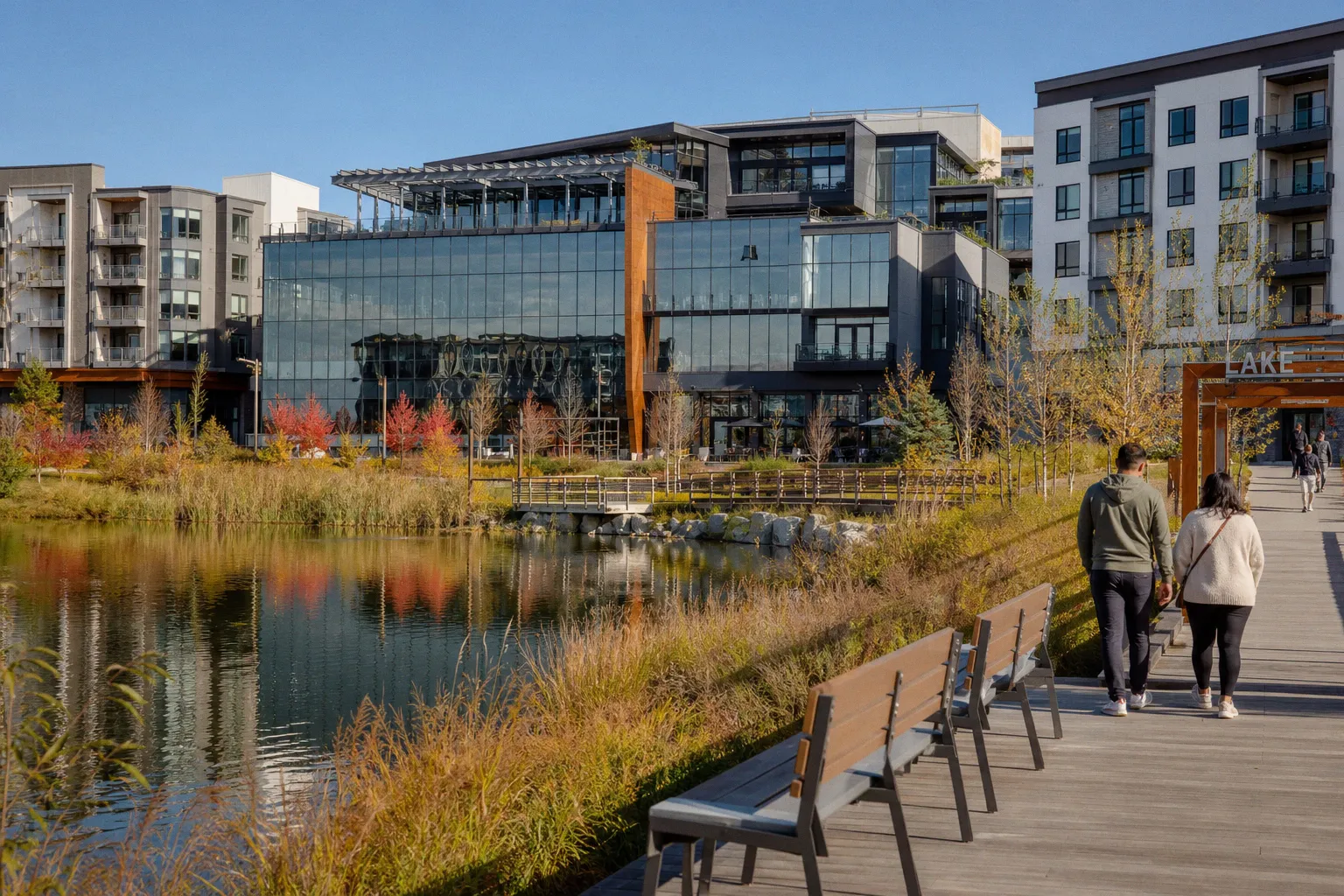
Stand at the corner of Totem Lake Boulevard and NE 124th Street today, and you'll see a Whole Foods glowing under a canopy of new mixed-use buildings, joggers crossing a pedestrian bridge toward a renovated wetland park, and the steady hum of light rail conversations that haven't yet turned into tracks. But rewind to 2015, and this same intersection told a very different story — a half-empty mall with a collapsed roof history, flooded parking lots, and a community that had largely written off the area as Kirkland's most stubborn dead zone. The transformation from that ghost to this hub is one of the most instructive redevelopment stories on the Eastside, and if you're scoping Totem Lake as a place to live, you need to understand the bones underneath the new facade.
The 1973 Legacy: Why the Original Mall Failed from the Ground Up
Totem Lake Mall opened in 1973 with a design concept that leaned into Pacific Northwest identity — hand-carved Northwest Coast Native American art, a longhouse-inspired architectural theme, and the confident energy of a suburban retail era that believed malls were permanent civic infrastructure. The site itself, though, carried a quiet warning from the start: it was built on reclaimed wetlands, a topographical choice that would haunt the property for decades.
The decline didn't arrive gradually. It arrived in two sharp blows. In 1996, the Pay 'n Save Corporation — the parent company behind key anchor tenants like Ernst Home & Nursery — filed for bankruptcy. When those anchors shuttered, foot traffic collapsed. Barely a year later, a heavy snowstorm in 1997 caused a partial roof collapse in the lower mall section, a structural failure that became both literal and symbolic. The property limped forward with discount tenants and a growing reputation as a place you drove through, not to.
By the mid-2000s, the surrounding area was growing — Kirkland's population was expanding, Google was planting its Kirkland campus nearby, and the broader Eastside tech corridor was heating up — but the mall sat inert at the center of it all. The wetland soils beneath the parking lots still flooded periodically. Sidewalks dead-ended into drainage ditches. The transit connections were so poor that the only practical way to arrive was by car, and once you parked, there was nowhere pleasant to walk.
The original Totem Lake Mall wasn't just a retail failure — it was a site-planning failure, a place where geography, drainage, and car-dependent design conspired to make every arrival feel like a compromise.
The 2015 Pivot: How a Joint Venture Saw Housing Where Retail Had Died
The real turning point came in 2015, when CenterCal Properties and PCCP, LLC — operating as Village at Totem Lake LLC — purchased the property with an ambitious vision: demolish the failing mall infrastructure and build a mixed-use urban center from scratch. Demolition of the lower mall began in 2016, and Phase 1 of The Village at Totem Lake opened in 2017, anchored by Trader Joe's as an early signal that the project was serious about daily-life retail rather than aspirational big-box anchors.
The numbers tell you the scale of the pivot. The redeveloped site now includes approximately 360,000 to 400,000 square feet of commercial, restaurant, and office space alongside over 850 residential units. Whole Foods Market joined as a second grocery anchor, and the tenant mix shifted deliberately toward services and food — the kind of retail that serves a residential community rather than drawing weekend destination traffic.
But the commercial square footage is only half the story. What makes Totem Lake a genuinely interesting case study is how the City of Kirkland invested in the surrounding public infrastructure to support the density. Without that public-private coordination, the Village at Totem Lake would have been just another isolated shopping center with apartments stacked on top.
Infrastructure as the Backbone: The Connector Bridge and Wetland Restoration
Here's where Totem Lake's redevelopment diverges from the standard "tear down the mall, build apartments" playbook. The city didn't just approve the project and walk away — it made its own infrastructure investments that fundamentally changed how the area connects to the broader Kirkland fabric.
The most visible piece is the Totem Lake Connector, a pedestrian and bicycle bridge that opened on July 8, 2023, spanning the intersection of Totem Lake Boulevard and NE 124th Street. This bridge does something deceptively simple but transformative: it links the Village at Totem Lake directly to the Cross Kirkland Corridor, a 5.75-mile multi-use trail that runs through the heart of the city on a former rail corridor. Before the connector, crossing that busy intersection on foot was an exercise in patience and risk. Now, you can walk from your apartment above Whole Foods to the trail system without waiting at a single traffic signal.
The second major investment is Totem Lake Park. The City of Kirkland renovated this 17-acre park and reopened it on July 2, 2021, with a new playground, a boardwalk through restored wetlands, and environmental rehabilitation of the very waterways that had caused so many drainage headaches for the original mall. It's a satisfying piece of circularity — the wetlands the 1970s developers tried to pave over are now a deliberate amenity, restored as part of a stormwater management strategy that actually works.
For residents, this means your daily geography is completely different from what existed even a decade ago. You can walk out your door, grab groceries at Trader Joe's, cut through the park on a boardwalk over restored wetlands, and hit a regional trail system — all on foot, all on paths that didn't exist before 2021. That sequence — from apartment to amenity to green corridor — is the walkability story that sells Totem Lake to the kind of buyer who prioritizes car-light living.
Housing Density and the Unfinished Challenge of Car Dependency
Now, let's be honest about what hasn't fully landed yet. The broader Totem Lake area has seen a staggering volume of residential construction: since 2019, approximately 4,648 residential units have been built, are under construction, or are in the planning pipeline. About 1,200 of those are designated as affordable housing units, which matters enormously in a King County market where median home prices have long outpaced regional income growth.
That density, though, comes with a structural tension. The development pipeline has also produced roughly 6,939 parking stalls — a ratio that local transit advocates point to as evidence that Totem Lake is still fundamentally designed around the automobile. The Village at Totem Lake alone is estimated to generate around 24,000 daily automobile trips, a figure that strains the area's surface streets and undercuts the walkability narrative.
The sidewalk network in South Totem Lake, in particular, remains spotty. You'll find stretches where a perfectly good pedestrian path simply ends at a parking lot entrance or a curb cut that was designed for vehicle throughput, not foot traffic. If you're walking from the Village to some of the older residential pockets west of I-405, you'll encounter gaps that remind you this is still a neighborhood in transition — the infrastructure hasn't fully caught up with the residential density.
Walkability in Totem Lake today is best understood as a half-finished bridge: the destination side is genuinely impressive, but the connecting paths still have missing planks.
This matters for anyone evaluating Totem Lake as a place to live because the experience varies dramatically by micro-location. An apartment within the Village complex or along the Cross Kirkland Corridor gives you a genuinely pedestrian-friendly daily routine. A unit in one of the newer developments south of NE 116th Street, by contrast, might require a car for even basic errands because the sidewalk grid doesn't connect cleanly to the commercial core.
What Living Here Actually Feels Like: Walking a Resident's Day
Let's move through what a typical day looks like if you're living in one of the newer Totem Lake units, because the texture of daily life is what no zoning map can capture.
You wake up in a mid-rise apartment complex — the kind with a ground-floor lobby that opens onto a landscaped courtyard rather than a parking garage entrance. Your morning walk to Whole Foods or Trader Joe's takes about five minutes on a sidewalk lined with young trees that haven't yet formed a real canopy but will in another decade. The commercial district has a clean, new-construction feel — lots of glass, metal accents, and the slightly sterile ambiance of a place that hasn't yet acquired the patina of a neighborhood with history.
By midday, if you're working from home — and many Totem Lake residents are — you might walk to Totem Lake Park for a break. The boardwalk through the restored wetlands is genuinely pleasant, and on a clear day you can catch filtered views of the Cascade Range through the tree line. The playground fills with families on weekend mornings, and the park has become a quiet social anchor for the community.
In the afternoon, you hop on the Cross Kirkland Corridor for a run or bike ride north toward Juanita or south toward downtown Kirkland. The trail is flat, well-maintained, and increasingly connected to the broader regional trail network. This is where Totem Lake's geography works in your favor — the former rail corridor runs through a natural low point in the topography, which means the grade is gentle and the route feels effortless.
Evening errands might take you to some of the light industrial and commercial areas west of I-405, where older retail and auto-service businesses still operate. This is the part of Totem Lake that hasn't been redeveloped yet, and it shows — the streetscape is rougher, the sidewalks less consistent, and the walkability drops off sharply. But it's also where you'll find some of the area's more affordable housing options and a grittier, less polished community fabric.
The Future: What's Coming and What to Watch
The Totem Lake Regional Growth Center designation, which Kirkland secured back in 2003, set the framework for exactly the kind of density we're seeing now. But the story isn't finished. Several key questions will shape the area's trajectory over the next five to ten years:
- Light rail access: Sound Transit's long-term planning has considered Eastside light rail routes that could eventually serve Totem Lake. If and when that happens, the area's transit story changes fundamentally — but timelines remain uncertain, and current bus connections are modest at best.
- The western parcels: The light industrial area west of I-405 is flagged for future integration into the growth center, but as of now, no concrete redevelopment timeline has been announced. This is where the next wave of housing and commercial density will likely emerge.
- Affordable housing delivery: Of the roughly 1,200 affordable units in the pipeline, the pace at which they actually get built and occupied will determine whether Totem Lake serves a broad economic range or skews toward tech-sector incomes.
- Sidewalk and bike infrastructure completion: The Totem Lake Connector was a major win, but filling the sidewalk gaps in South Totem Lake and connecting the neighborhood to the I-405 trail network are the pieces that will either complete the walkability story or leave it permanently partial.
Your Neighborhood Scouting Checklist for Totem Lake
If you're seriously considering Totem Lake, here's how to evaluate it on the ground:
1. Walk the exact route from your prospective unit to the nearest grocery store and park. Don't trust the map — actually walk it. Pay attention to where sidewalks end, where you're forced into a parking lot, and how many signal crossings you encounter.
2. Visit during rush hour and on a Saturday morning. The traffic patterns are very different, and Saturday mornings at the Village complex will give you the truest read on what the commercial district feels like when it's alive.
3. Check the Cross Kirkland Corridor access point nearest to your building. The trail is the area's greatest amenity, but access points vary — some are well-signed and direct, others require navigating around construction zones or through parking areas.
4. Look at the age of the landscaping. Young trees and fresh sod mean the building is new enough that the exterior is still settling in. This isn't a red flag, but it means you're buying into a neighborhood that's still forming its identity — expect construction noise, evolving retail tenants, and a streetscape that will look meaningfully different in five years.
5. Ask about flood history and drainage. The wetland soils beneath Totem Lake are managed but not eliminated. Ground-floor units in some of the older buildings near the park may have different moisture and drainage profiles than upper-floor units in newer construction.
6. Ride the bus from your building to downtown Kirkland or Bellevue. The transit experience in Totem Lake is improving but still car-first. If you're planning a car-light lifestyle, you need to know exactly what that commute looks like today — not what it might look like when light rail arrives.
Totem Lake is a neighborhood that has genuinely reinvented itself, and the bones of that reinvention — the trail connections, the wetland park, the mixed-use commercial core — are real and substantive. But it's still a place in progress, and the gap between the best-case pedestrian experience and the worst-case one is wider than in more mature Kirkland neighborhoods. Walk it, feel it, and decide whether the trajectory matches your timeline.