Spring District Bellevue: From Industrial Zone to Tech Hub
You're standing on 120th Avenue Northeast, and the first thing that hits you isn't the glass-and-steel apartment towers or the light rail station humming behind you. It's the mental math.
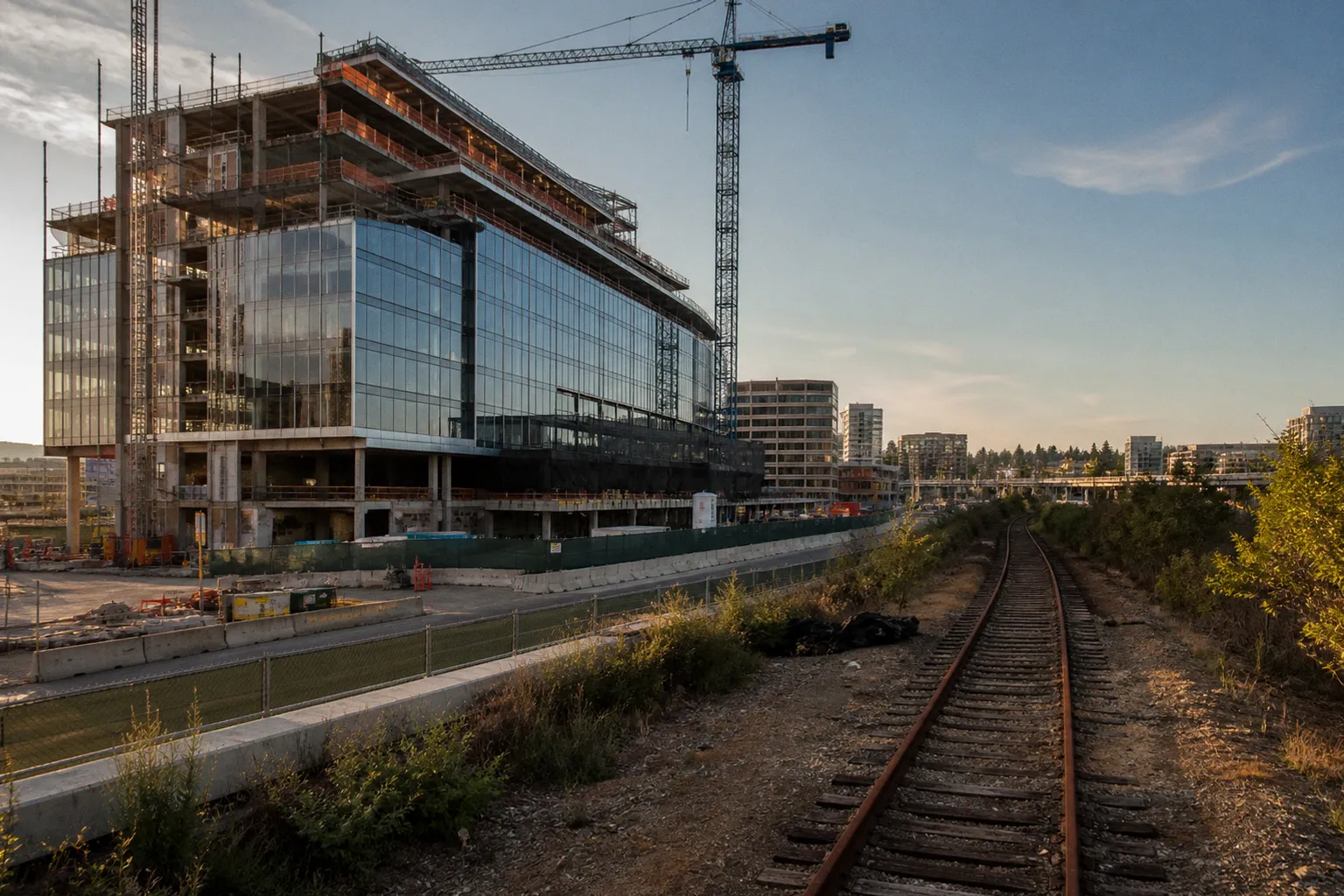
Spring District Bellevue: From Industrial Zone to Tech Hub
Fifteen years ago, this 36-acre site was a Safeway distribution center — loading docks, flat-roofed warehouses, and the faint diesel rumble of trucks idling along Bel-Red Road. Now a one-bedroom at the Sparc Apartments commands north of $2,400 a month, while Meta has listed 212,000 square feet of Class A office space for sublease at a campus it paid $390 million to acquire.
The cost-to-value transformation is staggering on paper. But for anyone running the numbers on a purchase here — a condo, a townhome hold, or a pre-sale renovation in the surrounding blocks — the Spring District's story has more moving parts than the marketing deck suggests. The returns are real. The risks are, too. What matters is separating the infrastructure and land-use gains that are already in place from the corporate assumptions that may no longer hold.
From Safeway Distribution Center to Urban Core: The 2007 Vision
The site math starts in May 2007, when Wright Runstad & Company, partnering with Shorenstein Properties, purchased the 36-acre Safeway distribution hub for $68 million. That's roughly $1.89 million per acre for flat industrial land in the Bel-Red corridor — a price that, in hindsight, looks like picking up a distressed property at estate-sale pricing before anyone realized the neighborhood was about to be rezoned.
And that's exactly what happened. The critical move came in 2009, when the Bellevue City Council upzoned the entire site to allow high-density mixed-use development. In pre-sale renovation terms, this was the equivalent of pulling permits on a full gut-and-rebuild: the land footprint stayed the same, but the asset class changed entirely. A depreciating logistics parcel became one of the highest-density residential and commercial plays on the Eastside — overnight, at least on paper.
The 2009 upzoning didn't just change a zoning code. It reclassified 36 acres of depreciating industrial asset into one of the highest-density mixed-use plays on the Eastside. That's the kind of land-use decision that moves entire market segments.
Demolition of the Safeway distribution center began in September 2013 and wrapped by January 2014. Construction on the first residential phase kicked off in June 2015. From teardown to first occupancy, the cadence was methodical — no rush-to-market scramble, but a phased rollout designed to absorb demand rather than flood it.
That sequencing is one of the most instructive parts of the Spring District's development plan. Wright Runstad did not build everything at once. The project delivered residential buildings first: the Sparc Apartments with 309 units, followed by the Arras with 279 units and AMLI Spring District with 204 units. Those buildings created a resident base before the district layered in commercial tenants, retail, and institutional anchors.
That is the same discipline you'd apply to a phased renovation: fix the livability first, establish the comp set, then stage for the premium buyer. A master plan can promise offices, restaurants, parks, and transit, but residents are the first people who have to test whether the place works on an ordinary Tuesday morning. They need a grocery run, a coffee shop, a dog-walking route, a reasonable trip to work, and a home that does not feel like it sits inside a construction zone indefinitely.
The total planned development footprint at full buildout is 5.3 million square feet across 16 blocks. That figure covers the district as a whole — residential, commercial, institutional, retail, and associated mixed-use space — rather than representing 5.3 million square feet of offices or other commercial space alone. We're roughly halfway through that pipeline, with significant delivery still ahead.
That distinction matters when you're evaluating the neighborhood. A large total development number does not automatically translate into a large inventory of office space, nor does every future square foot compete with existing apartments. The eventual mix will determine how much additional housing arrives, how much daytime employment the district supports, and whether future retail can be sustained by residents rather than by office workers alone.
The REI-Meta Pivot: How Corporate Strategy Shaped the Skyline
Here's where the Spring District narrative takes its sharpest turn, and it's worth understanding for what it says about risk concentration in mixed-use developments.
In 2020, outdoor retailer REI completed a 400,000-square-foot corporate headquarters campus on the district's eastern edge — timber-and-glass construction, ambitious sustainability targets, positioned as the commercial anchor that would put the Spring District on the corporate map. Except REI never moved in. The pandemic accelerated the co-op's remote-work pivot, and in September 2020, REI sold the unused campus to Meta for $390 million.
Think about that transaction for a moment. A 400,000-square-foot Class A headquarters changed hands before its intended tenant ever occupied a single desk — driven not by the building's quality but by pandemic-era pricing dislocations and a technology company's appetite for Eastside expansion. For anyone evaluating Spring District real estate, the lesson is structural: when a single corporate anchor accounts for a disproportionate share of the district's office presence, the neighborhood's fortunes become coupled to that tenant's headcount decisions.
That coupling was never visible in the initial renderings. The skyline suggested permanence. The leasing strategy was more conditional. Corporate real estate commitments can change faster than a mixed-use district can replace them, particularly when a project has been designed around one sector's hiring patterns.
And Meta's 2026 headcount decisions have not favored the Spring District.
In June 2026, Meta listed the 212,000-square-foot Block 13 building for sublease — the third property it has released from its local portfolio. Block 6 was already subleased to Snowflake, and the company continues to scale back its physical footprint here. This does not mean the district is hollowing out. Snowflake backfilled Block 6, and the institutional tenants remain anchored. But the commercial tenant mix is diversifying in ways the original master plan did not fully anticipate, and that recalibration has a real impact on lease rates, vacancy timelines, and the surrounding property premium.
| Factor | Original Vision | 2026 Reality |
|---|---|---|
| Anchor commercial tenant | REI headquarters, later acquired by Meta | Meta has released three buildings from its local portfolio; Block 13 was listed for sublease in June 2026 (final tenant not yet known); Snowflake backfilled Block 6 |
| Total planned development | 5.3 million square feet across 16 blocks, including residential, commercial, institutional, retail, and mixed-use components | Phased delivery continues; the balance among uses and the pace of absorption remain in flux |
| Primary economic driver | A technology-oriented corporate campus | A mixed district supported by academic activity, technology tenants, transit, and residential density |
| Transit connectivity | East Link to Redmond, with a future Seattle connection | Redmond and South Bellevue connections are operational; the Seattle timeline remains unconfirmed |
| Residential absorption | Steady phased delivery alongside new employment | Sparc, Arras, and AMLI are largely stabilized, with future density still being added |
The fix-up analogy holds: when you renovate a house expecting a specific buyer profile and that buyer walks, you adapt your staging and your price expectations. The Spring District is adapting. But the adaptation window means short-term commercial vacancy and longer lease-up timelines — factors that ripple into surrounding property values and should inform your offer pricing if you're buying, or your pre-sale investment strategy if you're selling.
For residential owners, the office situation is not a simple positive-or-negative variable. A busy corporate campus can support restaurants, services, and resale demand, but it can also add peak-hour congestion and put more pressure on local retail. A diversified district may produce steadier demand over time, even if it lacks the dramatic employment concentration that made the original story so easy to market.
That is why the Spring District's next phase deserves attention. The question is not whether every office floor will remain occupied by the first-generation technology tenant. The question is whether the district has enough housing, transit, public space, educational activity, and everyday services to function when office occupancy is uneven.
Transit-Oriented Living: The Role of the 120th Station and Link Light Rail
If there's a single infrastructure investment that justifies the Spring District's residential premiums, it's the Spring District/120th Station. The retained-cut light rail station on Sound Transit's Link 2 Line opened on April 27, 2024, connecting the neighborhood directly to South Bellevue and Redmond Technology Station. For residents, this is the curb appeal that never fades — a permanent access point to regional transit that fundamentally changes commute economics and property desirability.
The station also changes the way the neighborhood is experienced at street level. A resident does not need to treat every trip as a parking calculation. A worker can make a regular commute without keeping the car moving every day. Visitors can reach the district through a legible transit connection rather than navigating a corporate campus that was designed primarily around vehicle access. Those are practical benefits, but they also influence how buyers compare Spring District Bellevue apartments with homes in more car-dependent parts of the Eastside.
The cost-to-value ratio of living within walking distance of a Link light rail station in the Puget Sound region has been well documented across line extensions. Properties near stations consistently command premiums over comparable units in car-dependent neighborhoods. In the Spring District, where the station sits at the development's geographic center, that premium is embedded in pricing from day one — which means it's already reflected in what you'll pay, but also in what your unit may hold during a market correction.
Distance, however, needs to be measured honestly. "Near the station" is not a complete description. A unit may be close on a map but face a noisier edge, a future construction site, or a less convenient pedestrian route. A building on the wrong side of a major crossing can feel substantially less accessible than the raw walking distance suggests. For an owner-occupant, the daily path to the platform matters more than a marketing label. For an investor, the same detail affects how easily a future tenant understands the premium.
Here's the discipline check, though: the Seattle-bound connection across Lake Washington remains on an uncertain timeline. The Link 2 Line's extension into downtown Seattle — the connection that would transform the Spring District from an Eastside connector into a genuine urban-transit node — has faced repeated delays. Anyone pricing a purchase here on the assumption that the full line will be operational within a specific window is building equity on an unconfirmed permit.
Light rail proximity is the Spring District's most durable value asset — but pricing in the Seattle connection before it's delivered is speculative sweat equity, not a guaranteed return.
For buyers running the commute math today, here's where you actually stand:
1. Microsoft and Redmond campus commuters — Light rail is your best path. The 120th Station to Redmond Technology Station is a short, direct ride with no transfer. This is the strongest commute-value proposition in the district, especially for a household trying to reduce the number of daily car trips.
2. Downtown Bellevue workers — You can use buses or light rail with a transfer, depending on routing and destination. Walking distance to the downtown Bellevue core is roughly 25 to 30 minutes on foot — doable for some residents, but not a daily commute solution for most people, particularly in poor weather or when the workday does not align with a leisurely walk.
3. Seattle commuters — Light rail across the lake is not yet operational. Current options include driving on I-90 or SR-520, Sound Transit express buses, or a light rail-to-bus combination via South Bellevue. Factor the time, tolls, parking, and reliability of this workaround into your housing budget. Do not treat a future connection as if it were part of today's commute.
4. Remote-first residents — The district's walkable amenities, light rail access for errands and occasional trips, and residential density make it a strong lifestyle play regardless of the Seattle connection timeline. The value proposition is less about replacing every car trip and more about making many routine trips optional by car.
Transit-oriented living also creates a different set of residential tradeoffs. More density can mean better services and a broader range of housing, but it can also mean less privacy, construction activity, and more competition among similar units when several buildings are leasing at once. The station protects the district's location advantage; it does not guarantee that every apartment, view, floor plan, or finish package will outperform its neighbors.
Academic Integration and the Global Innovation Exchange
One of the Spring District's most underappreciated value anchors isn't commercial at all — it's institutional. The Global Innovation Exchange, a technology-focused graduate academic institute housed in the Steve Ballmer Building, opened in 2017 as a partnership between the University of Washington and Tsinghua University, backed by Microsoft.
Why does this matter for your property equation? Institutional tenants do not sublease in the same way a corporate office tenant does. They do not restructure after an earnings call or pivot their entire footprint in response to a change in remote-work policy. GIX brings a steady pipeline of graduate students, faculty, and visiting researchers into the district year-round — a demand floor for rental units that technology-sector volatility cannot erase.
That does not make academic demand immune to change. Student housing needs, program size, transportation preferences, and household budgets still shift. But an academic institution contributes a different rhythm from a corporate headquarters. It creates activity during the day, supports recurring local spending, and gives the neighborhood an identity that is not entirely dependent on one employer's office strategy.
From a neighborhood activation standpoint, academic institutions also catalyze the kind of ground-floor retail that makes a mixed-use district feel lived-in rather than staged. Coffee shops, co-working spaces, fast-casual dining, dry cleaners, fitness studios, and convenience services form the layer that residents actually use daily. Those businesses may not be glamorous anchors, but they are often what separates a development that photographs well from one that functions well.
For anyone holding residential property in the Spring District, that institutional presence is a hedge against the kind of commercial tenant churn that Meta's subleasing pattern illustrates. A renter may care about proximity to a major office campus, but they may care just as much about a short walk to transit, a reliable place to work outside the apartment, and a neighborhood where there is activity outside standard office hours.
The academic and residential pieces also reinforce each other. Graduate students and researchers create demand for smaller-format rentals, leased parking, and short-term furnished units that complement the long-term family-oriented occupancy in towers like Sparc and Arras. The mix of tenures and household types produces a more resilient rental pool than a district dominated by corporate relocations alone.
There's also a quiet valuation effect. Neighborhoods anchored by educational institutions tend to retain pricing power through cycles because the underlying demand — admissions, faculty hiring, conference travel, and family visits — moves on academic calendars rather than corporate earnings. For a buyer evaluating Spring District Bellevue apartments as a long-term hold, that rhythm is worth understanding. It smooths the absorption curve for new units, supports a baseline of foot traffic for retail tenants, and gives the district a more legible identity than "tech campus surrounded by housing."
The GIX program has not grown without friction. Program enrollment, partnership structures, and physical space needs have evolved since the 2017 launch. Institutional real estate decisions still depend on university-level priorities, donor input, and academic strategy. None of that is a reason to discount the institutional anchor, but it is a reminder that the anchor has its own planning horizon, separate from the residential developer's.
The 2026 Reality: Navigating Subleases and Future Density Plans
This is where the Spring District story stops being a marketing deck and starts being a market. Three dynamics define 2026: corporate sublease exposure, future residential density, and infrastructure that is operational versus infrastructure that is still promised.
On the corporate side, Meta's three released buildings tell a story the original master plan did not include. Block 13 listed for sublease in June 2026 joins Block 6 (now occupied by Snowflake) as part of a recalibrated footprint. The buildings themselves are not distressed assets — they are modern, well-located, and reasonably priced relative to the original acquisition cost. But the district's near-term office absorption now depends on a different tenant mix than the one REI was supposed to anchor. Sublease tenants typically negotiate shorter commitments, which can lengthen the cycle of churn and re-leasing through 2027 and 2028.
For prospective buyers, the practical question is what this means for resale values and rental demand in adjacent residential towers. The honest answer is that it depends on the asset type and the buyer profile. A one-bedroom facing the courtyard trades on different fundamentals than a two-bedroom corner unit on a high floor with a view corridor. The first is more sensitive to rental demand and lease-up speed; the second is more sensitive to capital values and view permanence. Both are affected by the broader district story, but in different ways.
On future density, the district is roughly halfway through its 5.3 million square foot pipeline. Future blocks include additional residential, retail, and possibly additional commercial space. The phasing matters because new supply affects pricing for existing units. A condo owner who bought at the peak of Phase 1 delivery is more exposed to new-construction competition than a buyer entering later in the cycle.
For anyone holding property here, the planning implication is straightforward: future density is a known variable, not a black swan. The Spring District master plan has been public since 2009, and the remaining blocks are identifiable. What is less predictable is the absorption pace of new residential supply, the lease-up speed for commercial tenants released by their original occupants, and the speed of any future Link extensions.
The Spring District is not a story of growth or decline — it is a story of substitution. The original anchor tenant changed. The institutional anchor remained. The transit asset is operational. The Seattle connection is not. Pricing reflects all of it, and the buyers who understand which variables are locked in and which are still in motion will hold the edge.
If you're running a renovation budget on a property adjacent to the Spring District, the discipline is qualitative, not arithmetic. Focus on the finish decisions that affect daily livability — kitchen function, bathroom condition, flooring underfoot, window operation, and storage. Skip the spec-driven upgrades that signal "premium" to a listing photo but rarely move resale numbers in a neighborhood where the surrounding new construction has already reset expectations. In a master-planned district with brand-new comps, the goal is not to out-renovate the new build; it is to make sure your unit does not feel tired next to it. The buyers who compete for a unit in this corridor are not comparing it against a 1990s starter home; they are comparing it against a building that delivered within the last few years, and your renovation should clear that bar without overspending to exceed it.
This is the trade-off that defines every hold strategy in the Spring District's orbit. You are not buying into a finished neighborhood — you are buying into a neighborhood that is still being written. The infrastructure is in place, the institutional anchors are durable, and the residential base is established. What changes year to year is the corporate tenant mix, the pace of new supply, and the regional transit map. Buyers who treat those variables as part of the asset rather than as externalities will price more accurately and hold longer. Everyone else is making a bet on a render.