Royal Palace of Madrid: visitor access before and after booking
The practical difference between arriving at the Royal Palace of Madrid with a ticket already in your phone and arriving without one is not that one visitor is waved straight through while the other is swept into the palace.
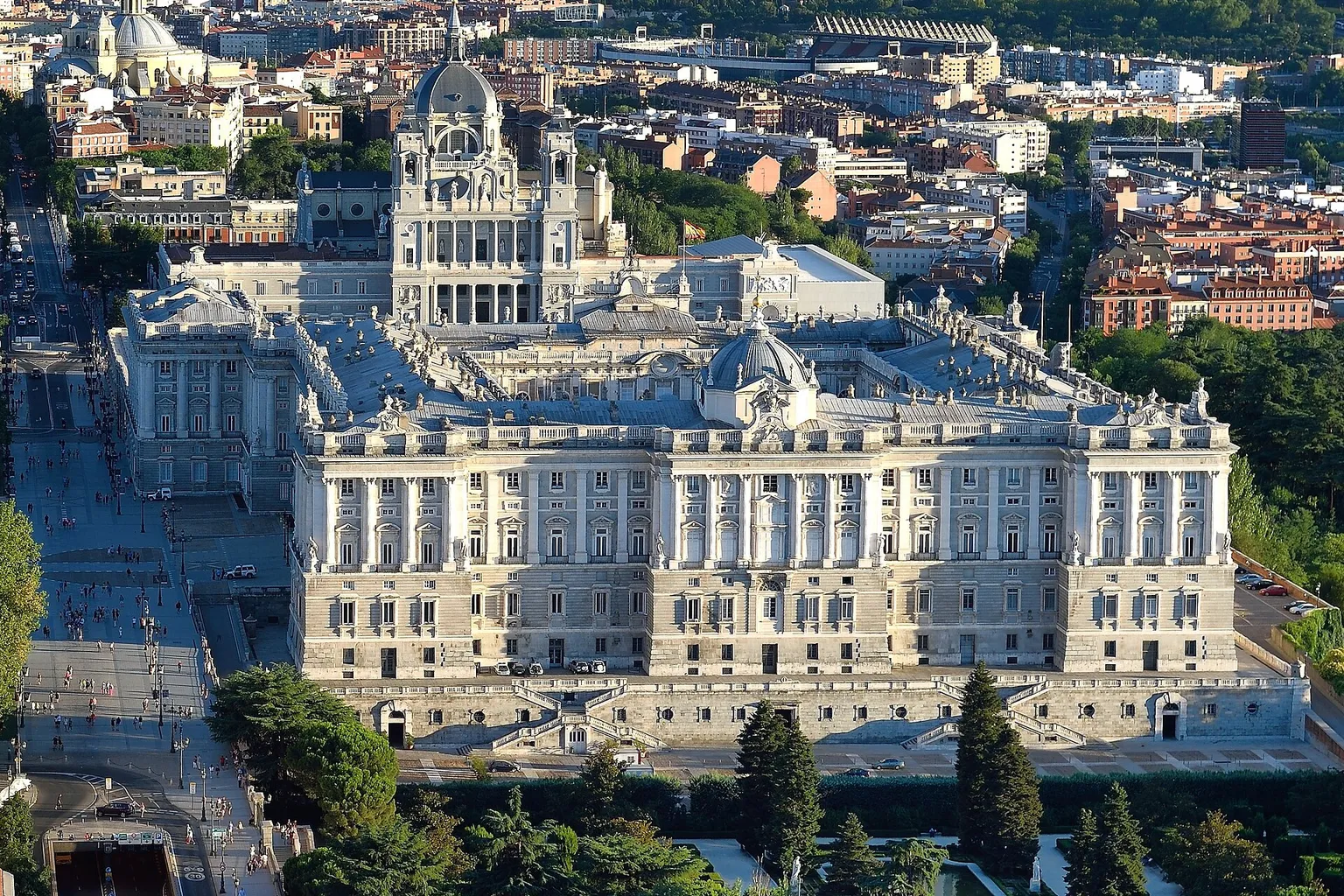
Both still pass the same essential security screening, and both must show valid identification. The real change happens earlier: a pre-booked visitor has already dealt with the ticket-office queue and can arrive at the correct entrance with the visit arranged around a specific time and season.
Tickets and prices
Royal Palace of Madrid
I
Save
Box office and online booking
- Adult €8
€8
Official websiteII
skip-the-line
Skip-the-line guided tour with walking tour · 2 hours
Features a guided walking tour of local highlights followed by a skip-the-line guided tour of the interior over 2 hours.
III
entry ticket
Entry ticket · Fast track
Get fast-access admission to explore the site and learn about the monarchy.
€22
Book ticketsThat distinction matters at Palacio Real de Madrid because the building is not a small stop that you can casually fold into a walk across central Madrid. The palace occupies an immense footprint, the approach opens through the Almudena Cathedral Esplanade and Plaza de la Armería, and the visit itself commonly takes around one and a half to two hours. Add the surrounding transitions through Plaza de Oriente, the cathedral precinct, or the gardens, and a loose plan can quickly become an afternoon.
If you want to book tickets for the Royal Palace of Madrid, the most useful question is not simply whether advance admission is available. It is how booking changes the route from pavement to palace—and what it does not change once you reach the door.
The booking window: why timing changes the whole visit
Official advance tickets can be booked online up to 90 days ahead through the Patrimonio Nacional ticket portal, with a maximum of 12 tickets in one transaction. That window is long enough to help with a carefully planned Madrid itinerary, but short enough that you should not expect to reserve a visit many months before a major trip.
The official website is the right place to begin because it gives you the clearest route to the admission you are actually buying. Depending on the date and the available format, visitors may encounter standard admission, guided-tour options, or fast-access products. The wording can vary, but the logistical principle is steady: a reservation removes the need to begin your visit at the ordinary ticket-purchase queue.
A visitor without a pre-booked ticket has one more stage to negotiate before reaching the monument: finding the ticket office, joining the appropriate queue, and securing admission for the available visit. That may be manageable on a quiet day, but it creates uncertainty in a city where the palace sits among several high-interest landmarks and where your afternoon may already have a fixed shape.
With an advance booking, you can build the visit in a more realistic sequence:
1. Choose a date while planning the rest of your Madrid route.
2. Select an available entry option through the official booking channel or a reputable ticket platform.
3. Keep the QR ticket accessible on your phone, or print it if you prefer a paper backup.
4. Arrive at the visitor entrance with your original physical photo ID.
5. Join the access flow for booked visitors, then pass the mandatory security screening.
The booking is therefore a queue-management tool, not a private entrance into the palace. It buys predictability at the front end. It does not turn the building into an on-demand attraction where every stage can be skipped.
A Royal Palace of Madrid skip-the-line ticket skips the ticket-office queue—not the security screening, and not the need to prove who you are.
What to do if you are planning for a group
For a family or small group, the 12-ticket transaction limit is easy to overlook. If your party is larger, the booking needs to be organized in more than one transaction, and the group should be prepared to keep the corresponding tickets and identification together.
Every visitor needs a valid ticket, including children. There is no useful shortcut in assuming that a very young traveler can simply enter under an adult’s booking. Each person must have an admission ticket, whether it is displayed digitally or carried in printed form.
That detail is especially important when the visit includes several generations. One adult may hold all the QR codes, but the names, ticket details, and physical IDs still need to be available when requested. A phone with a dim screen, a nearly empty battery, or a collection of screenshots buried in a messaging thread is not the kind of small problem you want to solve in the palace entrance queue.
Finding the entrance: the palace begins at the Plaza de la Armería
The visitor entrance for individual and group access is at the Almudena Cathedral Esplanade, also identified with the Plaza de la Armería. This is the side of the complex to orient yourself toward—not simply the most photogenic façade or the nearest point you happen to reach while walking through the historic center.
The geography here is generous but not confusing once you name the right landmarks. The Royal Palace stands beside Almudena Cathedral, and the open space of the Plaza de la Armería provides the approach to visitor access. If you are coming from Plaza de Oriente, allow a little mental reset: the palace may appear close on the map, but large monumental complexes often make the final approach less direct than a short line suggests.
For a smoother arrival, treat the entrance as a destination in its own right. Do not plan to arrive at the last possible minute after a restaurant reservation or a museum visit on the other side of the center. You will need time to locate the correct side of the complex, gather your group, have tickets and identification ready, and pass screening.
The palace is also best understood as part of a larger, walkable cluster rather than an isolated stop. Almudena Cathedral is next door, Plaza de Oriente opens the city-facing side of the complex, and the gardens offer a different rhythm from the formal interior rooms. But these neighboring spaces should be used to frame the day, not as an excuse to cut your arrival time close.
A simple way to organize the approach
- Start with the entrance name: Almudena Cathedral Esplanade / Plaza de la Armería.
- Use the cathedral as a visual reference: it is more useful than relying only on a map pin.
- Keep the booking open before you reach the queue: avoid searching through email or messages at the entrance.
- Separate ticket access from security access: a booked ticket gets you past the ticket-purchase stage, but screening remains compulsory.
- Leave room for the interior visit: a self-guided visit generally takes around 1.5 to 2 hours.
What changes after booking—and what remains exactly the same
The phrase “fast access” can create the wrong mental picture. At the Royal Palace, booking ahead changes the beginning of the experience. It does not eliminate the basic conditions of entry.
Here is the clearest comparison:
| Part of the visit | Arriving without an advance ticket | Arriving with a pre-booked ticket |
|---|---|---|
| Ticket purchase | You may need to join the ticket-office queue before admission is secured | The admission has already been arranged online |
| Ticket presentation | You present the ticket once purchased or issued | A digital QR code is acceptable if it is clearly legible; a printed ticket also works |
| Security screening | Mandatory | Mandatory |
| Photo identification | Required | Required |
| Entrance location | Visitor access is through the Almudena Cathedral Esplanade / Plaza de la Armería | The same visitor access point applies |
| Planning certainty | Depends on availability and the time needed to buy admission | The date and selected admission are arranged in advance |
| Children | Each child needs a valid ticket | Each child still needs a valid ticket |
This is why “skip the line” should be read precisely. You are bypassing the ticket-office queue, not every queue and not every control. Security screening applies to all entrants, regardless of age or ticket type.
That distinction is not merely a technicality. It changes how you schedule the day. A pre-booked visitor can be confident that the ticket itself is waiting, but should still arrive with enough margin for screening and for the movement of other visitors through the entrance. The palace is a working heritage site with institutional responsibilities, not a turnstile attraction.
Identification is not optional, even when your QR code is digital
The entry requirement that most often catches visitors by surprise is the physical identification rule. Your ticket may live on your smartphone, but your identity document must be an original physical photo ID.
Accepted documentation includes a DNI, passport, or equivalent official physical photo identification. A photograph of the document on your phone is not the same thing as carrying the original. Nor does a digital QR ticket replace the identification requirement.
The most reliable arrangement is uncomplicated:
- Keep the original physical photo ID with you.
- Open the QR ticket before joining the entrance flow.
- Increase your phone brightness if the code is difficult to scan.
- Carry a printed copy if your group’s phones are unreliable or battery levels are low.
- Make sure every child has both a valid ticket and the required documentation available.
For a group, one person should not assume that holding the booking means holding responsibility for everyone’s documentation. Give each traveler a clear role: one adult can manage the QR codes, while another keeps the group’s physical IDs accessible. This prevents the familiar entrance shuffle in which bags open, phones unlock, and the people at the front of the queue discover that the necessary passport is somewhere at the bottom of a backpack.
The process is straightforward when treated as part of the visit rather than an interruption. The QR code confirms the admission; the physical ID confirms the visitor. Both belong in your arrival plan.
The digital ticket is convenient, but the identity check is deliberately physical: bring the original document, not just an image of it.
Opening hours, last admission, and the shape of a Madrid day
The Royal Palace follows seasonal hours, and the seasonal change is substantial enough to affect your route through Madrid.
From October through March, standard hours are generally 10:00 to 18:00 from Monday to Saturday. From April through September, Monday-to-Saturday hours extend to 19:00. The last admission is allowed one hour before closing, so the closing time is not the same as the final moment when you can begin the visit.
Sundays follow a shorter schedule, with visitor hours extending only to the afternoon. This is the kind of detail that can quietly undo an otherwise sensible itinerary: a traveler sees the palace open in the morning, fills the day with other stops, and arrives expecting the same evening flexibility available on a weekday.
A better approach is to plan backward from the final admission time, then add your arrival margin. If you want the palace to be the anchor of the day, a morning or early-afternoon booking gives you room to move through the state rooms without turning every subsequent stop into a race. If you are pairing the palace with Almudena Cathedral or the surrounding historic center, let the interior visit establish the day’s fixed point.
The building’s scale rewards that patience. The Royal Palace is associated with a floor area of approximately 135,000 square meters and contains 3,418 rooms, even though a visitor does not move through anything close to the entire complex. The numbers explain why the visit can feel more substantial than a quick glance at a ceremonial room: you are entering a large architectural and institutional world, not a single gallery.
Exceptional closures and official functions
The palace may close exceptionally for official royal functions or institutional events. These closures are not something a visitor can solve by arriving earlier or choosing a faster ticket. If the palace is closed for one of these reasons, Patrimonio Nacional offers a date change or a full ticket refund.
That policy makes it sensible to keep booking information easy to retrieve until after the visit. Save the confirmation email, note the booking date, and avoid treating an online reservation as the final word if your travel plans change. Official functions are not part of the ordinary daily rhythm, and the exact schedule of closures for a future calendar year may not be published in full far in advance.
Free admission windows: useful, but not automatically simpler
There are free-admission periods from Monday through Thursday in the late afternoon for EU citizens, residents, and citizens of Ibero-American countries who can present valid supporting documentation. The window runs from 17:00 to 19:00 during the summer schedule and from 16:00 to 18:00 during the winter schedule.
There are also free-admission days on May 18, International Museum Day, and October 12, Spain’s National Day.
Free entry changes the calculation, but it does not erase the practical requirements. Visitors still need a valid ticket, and all entrants still pass security screening. The qualifying documentation also matters; arriving during the correct hours without proof of eligibility does not create an automatic right of admission.
For some travelers, the free window is a graceful way to place the palace late in the day. For others, it may compress the visit into the same period when many people are trying to do exactly that. The most comfortable choice depends on your priorities:
- Choose an earlier timed visit when you want a calmer, more spacious day around the palace.
- Consider the free period if your itinerary naturally brings you to the area late in the afternoon and you meet the eligibility requirements.
- Avoid assuming that free admission means instant entry; ticketing and screening still form part of the process.
- Treat May 18 and October 12 as especially popular planning dates, without relying on an unverified visitor-cap figure.
The exact daily maximum number of visitors under safety regulations is not established in the available information, so it is wiser to plan around the published hours and booking availability than to build your day around a supposed capacity threshold.
A practical route through the visit
The Royal Palace is best approached as a sequence of small decisions rather than one grand booking moment.
Before you leave
Confirm the season and weekday schedule. Check the last admission time, not only the closing time. Reopen the ticket and make sure the QR code is visible. Put the original physical photo ID somewhere reachable. If you are traveling with children, verify that each child has a ticket.
On the way to the palace
Aim for the Almudena Cathedral Esplanade / Plaza de la Armería. Leave enough time to cross the surrounding monumental spaces without rushing. If your route begins at Plaza de Oriente or another central landmark, use the walk as an approach to the palace, not as the final five minutes before entry.
At the entrance
Follow the visitor-access signs and keep your booking ready. The pre-booked ticket should remove the need to purchase admission at the ticket office, but it will not remove the security screening. Expect the screening, cooperate with the process, and do not interpret it as a problem with your reservation.
Inside
Give yourself the full visit window rather than treating the palace as a quick photo stop. The ceremonial interiors, the Royal Armoury, and the palace’s relationship with the surrounding royal complex reward a slower pace. If you are considering a guided tour, decide whether you want historical interpretation to shape the visit from the beginning or prefer the flexibility of a self-guided route.
Before finalizing the day
Leave the palace with enough time for the next stop. The nearby Almudena Cathedral, Plaza de Oriente, Sabatini Gardens, and Campo del Moro each create a different continuation: formal, open, shaded, or garden-like. You do not need to force all of them into one itinerary. The strongest day is often the one that lets the palace remain the central experience instead of turning it into one hurried item among many.
The most dependable Royal Palace of Madrid plan is modest in its promises: reserve within the 90-day window, enter through the correct plaza, carry physical ID, keep the QR code readable, and allow security screening to be part of the visit. Booking changes the queue and improves predictability, but it does not replace the rhythms of a working monument.
Once those details are settled, the palace becomes much easier to read geographically. You arrive through the cathedral esplanade, pass from open civic space into controlled access, and then spend the afternoon moving through rooms whose scale makes Madrid’s surrounding streets feel newly arranged. The practical work happens before the threshold; the reward is having enough time and attention left when you cross it.
Practical info
Currency: EUR
Driving: on the right
Emergency number: 112
Key facts
Built: 1735
Architect: Filippo Juvarra
Heritage status: bien de interés cultural
Official website: patrimonionacional.es
FAQ
Do I need to print my Royal Palace of Madrid ticket?
Can I use a photo of my ID to enter the palace?
Do children need their own tickets for the Royal Palace?
What happens if I arrive after the last admission time?
Is there a limit to how many tickets I can buy in one transaction?
Photo: Tim Adams / CC BY-SA 4.0 — Wikimedia Commons