Paradox Museum Miami tickets: how to choose your entry option
The ticket decision at Paradox Museum Miami is less about finding a single lowest price and more about matching the booking type to your group, date, and tolerance for schedule risk.
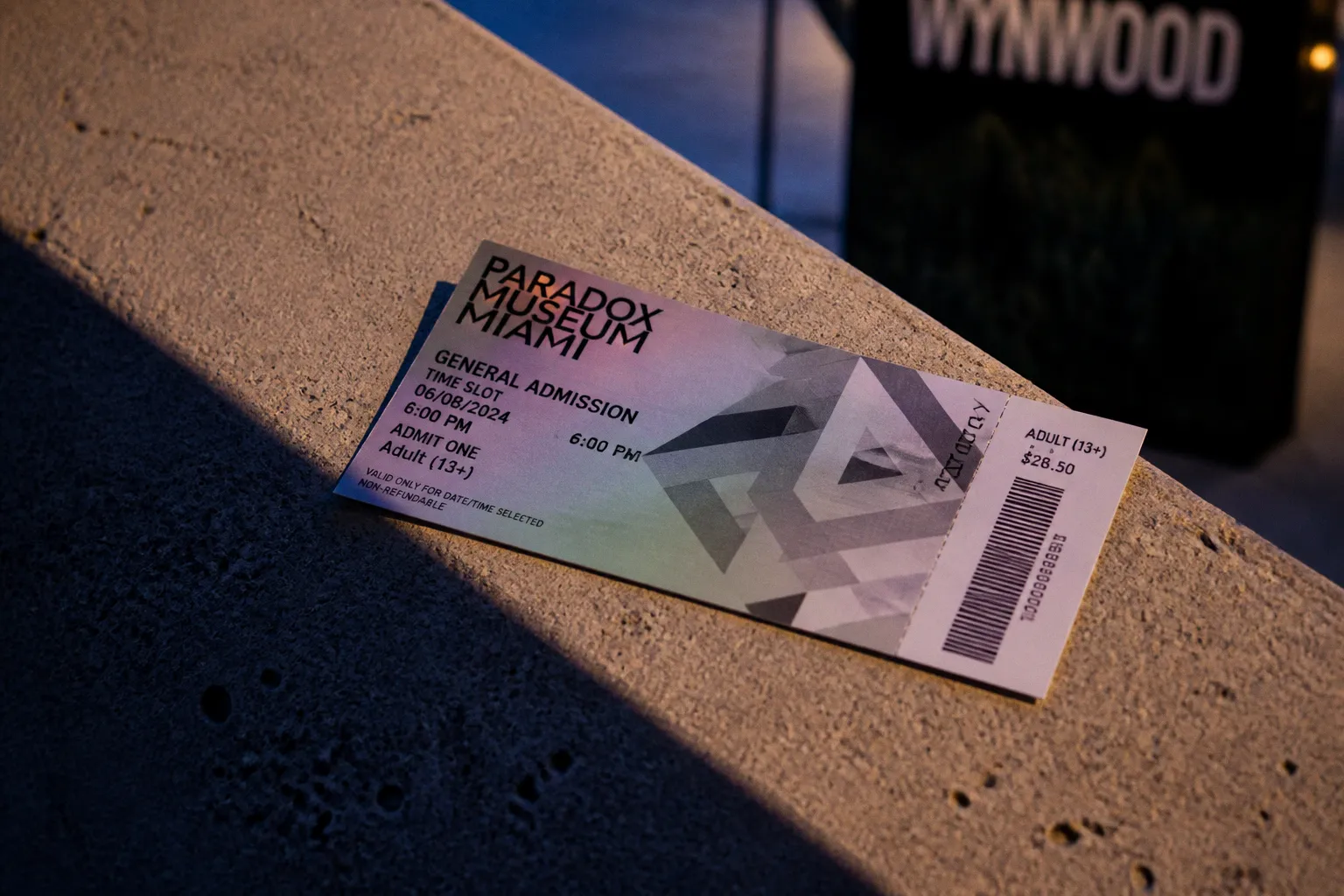
The museum uses timed entry, and ticket rates can change by weekday, weekend, booking platform, and purchase timing.
Tickets and prices
Paradox Museum Miami
I
Save
Box office and online booking
- Adult USD26
- Child USD21
USD26
Official websiteII
entry ticket
Entry ticket — interactive experiences for all ages
This entry ticket gives you access to interactive experiences for all ages and allows you to take pictures.
USD32.64
Book ticketsThe operating model is straightforward. You select an available entry window, arrive at the Wynwood location, and move through more than 70 interactive illusion installations inside an 11,000-square-foot, air-conditioned venue. Most visits take 60 to 90 minutes. The main variable is not the length of the experience. It is the structure of the ticket you buy before arrival.
This guide compares the available Paradox Museum Miami ticket options, explains when a family bundle makes economic sense, and shows how to manage timed entry without turning a short indoor attraction into a scheduling problem.
How Paradox Museum Miami timed entry works
Paradox Museum Miami is located at 2301 N Miami Ave in Wynwood, near The Oasis and Mister O1 Extraordinario Pizza. The venue is indoors and air-conditioned, which gives the visit a relatively stable operating profile even when Miami’s heat, humidity, or rain makes outdoor plans inefficient.
The admission system is based on scheduled entry rather than unrestricted access throughout the day. The booking page presents available dates and time slots. Your ticket is tied to the selected window, so the correct comparison is not simply ticket A versus ticket B. It is:
- Which date has the right inventory?
- Does the entry time fit the rest of the itinerary?
- Is the ticket refundable if the schedule changes?
- Does the group qualify for a bundle or discounted category?
- Is the booking channel showing the same admission conditions?
The museum’s format creates a predictable throughput issue. More than 70 exhibits cannot be experienced at the same pace by every visitor. Some installations take seconds. Others require photographs, repositioning, or a short wait while another group completes the setup. A 60-minute visit is possible for a fast-moving visitor. A 90-minute visit is a more realistic planning assumption for families, groups taking photographs, or anyone who does not want to move through the exhibits at maximum speed.
Timed entry controls the start of the visit. It does not guarantee that every exhibit will be available without a queue.
That distinction matters when building a Miami itinerary. A 10:00 entry does not necessarily mean the group exits at 11:00 on the dot. The museum should be treated as a fixed appointment with a variable completion time, not as a transaction that occupies exactly one hour.
The practical effect of the entry window
A timed ticket is most useful when the surrounding schedule has clear boundaries. For example, it can fit between a morning activity and a later reservation in Wynwood. It is less forgiving when placed immediately before an airport transfer, a cruise departure, or a reservation with no margin for delay.
For planning purposes, allocate:
- The scheduled arrival window.
- Approximately 60 to 90 minutes inside the museum.
- Additional time for arrival, ticket retrieval, photographs, and movement to the next stop.
- A buffer if the group includes young children, older visitors, or anyone who moves slowly.
The venue’s indoor setting removes weather exposure from the equation, but it does not remove traffic, parking, rideshare delays, or the time required to locate the correct entrance in Wynwood.
Comparing Paradox Museum Miami ticket options
The standard product is General Admission with timed entry. Depending on the booking channel and date, visitors may also see family bundles, discounted categories, or flexible booking conditions.
The ticket labels can appear similar while producing different value for different groups. A solo visitor does not need the same structure as a family of four. A Florida resident may have access to a rate that is not relevant to an out-of-state visitor. A weekend booking can also carry a different rate from a comparable weekday slot.
| Ticket type | Best fit | Main advantage | Main limitation |
|---|---|---|---|
| Single General Admission | One visitor or a small group buying individually | Simple booking structure and direct timed entry | The combined total may be less efficient for a larger group |
| Family bundle | A group of four eligible guests | Can reduce the combined cost compared with separate admissions | The bundle may be less useful if the group size does not match the offer |
| Child admission | Families with children within the eligible age range | Separates child pricing from adult admission | Age rules and displayed conditions can vary by platform |
| Senior rate | Eligible older visitors | May reduce the adult-equivalent admission cost | Eligibility requirements apply |
| Military rate | Eligible military visitors | Targeted discount for qualifying guests | Proof of eligibility may be required |
| Florida resident rate | Visitors who meet residency conditions | May offer a lower rate than standard admission | Residency restrictions can limit who qualifies |
| Flexible or cancellable booking | Visitors with uncertain plans | Reduces the financial risk of a schedule change | Flexibility may depend on the provider and cancellation deadline |
| Walk-up purchase | Visitors arriving without advance planning | Removes the need to select a slot in advance | Availability and price may be less favorable than online booking |
The central decision is group composition. A family bundle is not automatically the best option because it uses the word family. It should be evaluated against the number of guests, their eligibility, and the price displayed for the exact date and time.
Single admission
Single General Admission is the cleanest choice when the group is small or when each visitor’s category differs. It is also useful when one person is joining the group late, when a traveler is uncertain about attending, or when the booking platform does not display a suitable bundle.
For a party of two or three, compare the total of individual tickets with any available group offer. The decision should be based on the complete checkout total, not the headline label on the first booking screen.
Single admission is also the least complicated route for visitors who want to avoid category disputes. You select the number of adults and children, choose a time, and receive confirmation for the selected session. That simplicity has operational value. A small saving is irrelevant if the wrong bundle creates a problem at entry.
Family bundles
Family passes are designed for a larger group, commonly four guests. Their value depends on the difference between the bundle total and the equivalent number of separate admissions for the same slot.
The calculation is basic:
1. Select the exact date and time.
2. Record the total for individual adult and child tickets.
3. Record the family bundle total, if displayed.
4. Compare the final totals after any platform fees or conditions.
5. Confirm that every member of the group fits the bundle’s eligibility rules.
A family bundle can be the efficient option for two adults and two children. It may not be the correct choice for two adults, one child, and one guest who falls under a different discounted category. It may also be unnecessary for a group that has already separated its booking by different arrival times.
Do not assume that a family bundle includes every possible discount. Group pricing and resident, senior, military, or child rates may not be combinable. The booking conditions decide the result.
Child admission and age thresholds
The available material indicates that very young children may enter free, but the displayed age threshold can differ by booking platform. Some listings refer to children under three years old, while others use an infant range. That is a material difference for a family calculating its total.
The correct procedure is to enter the child’s age as requested by the booking page and review the final ticket breakdown. Do not rely on a general statement about free admission if the platform presents a narrower eligibility rule.
The issue is not only price. The child count affects the family bundle comparison, the number of tickets issued, and the group’s movement speed through the museum. A family with younger children should also avoid placing the visit inside a schedule with no recovery time. A 60-minute estimate is not a service-level guarantee.
The best way to buy Paradox Museum Miami tickets
There are three practical purchase routes: advance online booking, a third-party activity platform, and walk-up purchase at the venue.
Advance online booking is usually the strongest default because it exposes the available time slots before the visitor commits to the trip. It also allows a direct comparison between standard admission and any visible bundles or special categories. The value is inventory control, not just price discovery.
Third-party booking platforms can be useful when visitors are already managing several Miami activities through one account. They may display standard timed entry, flexible cancellation, family options, or combination products. The trade-off is that ticket names, age rules, refund language, and price presentation can differ between providers.
Walk-up purchase is the least controlled option. It may work when the visitor is already in Wynwood and has no fixed schedule. It creates more exposure to sold-out or inconvenient time slots, and the walk-up rate may not match the online rate.
A decision matrix is more useful than a universal recommendation:
| Booking route | Inventory visibility | Price control | Flexibility | Best use |
|---|---|---|---|---|
| Official or direct online booking | High | High | Depends on terms | Visitors with a fixed date and preferred time |
| Major third-party platform | High to moderate | Moderate | Often clearly stated | Travelers consolidating activities or requiring platform support |
| Walk-up purchase | Low | Variable | Immediate, but not guaranteed | Visitors with an open schedule and no preferred slot |
The ticket page should be treated as a live inventory screen. Rates are not fixed across all dates. Weekday and weekend demand can produce different prices. Online and walk-up purchase can also produce different results. A visitor who needs a specific time should prioritize availability. A visitor with flexible dates can compare weekday slots before selecting the final booking.
Cancellation and refund terms
Standard ticket listings commonly offer free cancellation up to 24 hours before the scheduled entry for a full refund. That condition is useful, but it is not a substitute for reading the terms attached to the actual purchase.
The operative details are:
- The exact cancellation deadline.
- The time zone used for the deadline.
- Whether the policy applies to the selected ticket type.
- Whether special or combination products follow different rules.
- Whether a no-show receives a refund.
- Where the cancellation must be processed.
A flexible ticket has a measurable value when the itinerary is exposed to flight delays, weather disruptions, or uncertain group availability. It has less value when the visitor already knows the schedule is fixed and the flexible option carries a material premium.
The booking confirmation should be saved immediately. It should show the date, time, number of guests, ticket category, and cancellation conditions. This is basic transaction control. It prevents the common failure mode in which the purchaser remembers the attraction but not the selected time.
How to choose the right date and time
The museum’s estimated visit duration is 60 to 90 minutes. The booking decision should therefore be based on the full time block, not the entry time alone.
A useful planning model is:
- Fast visit: approximately one hour inside.
- Standard visit: approximately 75 minutes.
- Unhurried family visit: up to 90 minutes or more if the group pauses frequently.
The most efficient time depends on the rest of the day. A visitor with a restaurant reservation in Wynwood may prefer a slot that ends before the reservation window, with enough margin to walk or drive between locations. A visitor using public transportation or rideshare should not choose a slot that requires an exact exit time.
Weekday versus weekend
Weekdays generally provide more scheduling flexibility because the available inventory is spread across a less concentrated demand pattern. Weekends can be more constrained, particularly around midday and during school or holiday travel periods. The fact is operational rather than emotional: fewer open slots reduce the value of improvisation.
For a weekend visit:
1. Select the preferred date early.
2. Compare morning, midday, and afternoon availability.
3. Review the cancellation deadline before payment.
4. Avoid placing the museum directly against a non-movable reservation.
5. Build the rest of the itinerary around the ticketed entry, not the reverse.
For a weekday visit, a flexible traveler may have more room to compare time slots and booking channels. That does not mean a walk-up purchase is risk-free. The available inventory is still finite.
Weather and indoor planning
Paradox Museum Miami’s air-conditioned indoor facility makes it a practical response to heat or rain. The weather advantage is real, but the ticket remains time-bound. A storm may change outdoor plans while leaving the museum reservation intact. That can create a useful backup activity, provided the visitor has already booked a suitable slot.
The reverse problem also occurs. A visitor may move the museum earlier or later because of weather and then discover that the original ticket is not transferable to the new time. Flexible cancellation or amendment terms become relevant at that point.
The strongest itinerary uses the museum as an anchor during the most weather-sensitive part of the day, while retaining enough margin before and after the visit for transport and changes.
The lowest-friction booking is the one that protects both inventory and schedule. Price is only one line item in that calculation.
What the visit includes: more than 70 installations in a controlled footprint
The museum occupies approximately 11,000 square feet and presents more than 70 interactive, paradox-based installations. The format is not a passive gallery with a fixed viewing route. It is an active environment built around perspective changes, optical effects, and photographs.
Two highlighted installations illustrate the operating logic:
- Reverse Room: designed to make visitors appear to walk on ceilings.
- Camouflage Wall: uses visual patterning and positioning to alter how the visitor appears in the scene.
These exhibits are not interchangeable with conventional wall displays. The experience depends on where a visitor stands, how the camera is positioned, and whether another group is using the same installation. A visitor who wants photographs should allow more time than someone treating the museum as a rapid walk-through.
The 60-to-90-minute estimate is therefore a planning range, not a performance benchmark. The number of exhibits creates density. The interactive format creates variable dwell time. A group that photographs every major installation will consume more of the available window than a visitor who moves through without extended stops.
Photography and group movement
The museum’s core appeal is visual, so photography is part of the practical calculation. Group size affects the time spent at each installation. A party of four can rotate through an exhibit efficiently, but it can also create longer pauses when everyone wants an individual image and a group image.
The most disciplined approach is to divide the visit into two passes:
1. Move through the museum once, identifying the installations that justify a longer stop.
2. Return to the preferred exhibits if time and traffic permit.
This avoids spending the first half of the visit on one installation and discovering later that the group has not seen the rest of the venue. It also reduces the pressure to photograph every exhibit equally.
Visitors should follow the venue’s current rules for personal belongings, food, and beverages. Outside food and drinks are restricted inside the exhibition areas. That makes a pre-visit or post-visit meal in Wynwood more practical than trying to integrate food into the museum stop.
Special rates: Florida residents, seniors, and military visitors
Discounted admission categories can materially change the comparison, but eligibility is narrower than the label suggests. Florida resident, senior, and military rates should be considered only after the group confirms that the relevant documentation and conditions apply.
Florida residents
A Florida resident rate is relevant to visitors who can satisfy the provider’s residency requirements. It should not be selected merely because the trip is taking place in Florida. A tourist visiting Miami does not become eligible through hotel location or temporary stay.
The booking page may specify acceptable proof. If documentation is required, the visitor should have it available before arrival. The economic value of the lower rate is lost if the category cannot be validated at the entrance.
Seniors
Senior pricing can apply to an age-defined category. The exact threshold and proof requirements should be taken from the selected booking channel. A group should not assume that a senior rate automatically combines with a family bundle or another promotion.
For mixed-age parties, calculate the total under three structures:
- Individual adult and child tickets.
- Individual tickets with the senior category.
- Any family bundle shown for the same slot.
The cheapest structure can change depending on the number of eligible guests.
Military visitors
Military rates are usually tied to eligibility verification. The relevant documentation may vary by provider. The ticket buyer should review the terms before payment rather than treating the discount as an informal adjustment at the door.
Military admission can also complicate a family calculation if only one member qualifies. Compare the discounted individual ticket with the total family offer. A family bundle may still be more efficient, or the individual discount may produce the lower total. The displayed checkout amount is the only reliable basis for the decision.
A booking sequence that minimizes errors
The booking process does not require complex analysis. It requires the correct order of operations.
1. Fix the date before comparing ticket categories.
Prices and inventory vary by date. A family bundle on one weekday is not a direct comparison with individual tickets on a different weekend.
2. Estimate the group by eligibility, not by household label.
Separate adults, children, infants, seniors, military guests, and Florida residents according to the booking form’s definitions.
3. Compare individual admission with the family option.
Use the final displayed total for the same time slot. Do not compare a headline bundle rate with an individual ticket from another date.
4. Select the entry window with the full visit duration in mind.
Reserve at least 60 to 90 minutes for the museum, plus transportation and transition time.
5. Review cancellation terms before payment.
A 24-hour free-cancellation condition is common for standard listings, but the actual ticket rules control.
6. Save the confirmation and ticket details.
Keep the date, time, guest count, and provider information together. This is particularly useful when several Miami attractions are booked through different platforms.
7. Recheck the itinerary after purchase.
The museum should now be treated as a fixed appointment. Adjust meals, transport, and nearby activities around it.
This sequence prevents the most common errors: selecting the wrong age category, assuming a bundle is automatically cheaper, and creating a schedule that cannot absorb a 90-minute visit.
Online platform versus walk-up purchase
The best way to buy Paradox Museum Miami tickets depends on the visitor’s priority.
Choose advance online booking when:
- The group needs a specific date or entry time.
- The visit falls on a weekend or during a busy travel period.
- The itinerary includes another timed activity.
- A family bundle or special rate needs to be compared in advance.
- Cancellation protection has value.
Consider walk-up purchase only when:
- The schedule is open.
- The group can accept a later or less convenient entry time.
- The visitor is already nearby.
- The price and available inventory have been confirmed at the venue.
The walk-up option offers flexibility in one narrow sense: the visitor does not commit before arrival. It sacrifices flexibility in another: the visitor may have fewer time slots and less control over the total cost.
Third-party platforms occupy the middle position. They can make booking convenient and may offer customer support or cancellation terms that fit the itinerary. They also require more attention to the exact product description. A standard timed-entry ticket, a combination activity, and a flexible ticket are not equivalent products.
Where the museum fits in a Wynwood itinerary
The location at 2301 N Miami Ave places the museum within Wynwood’s broader activity area. Nearby references include The Oasis and Mister O1 Extraordinario Pizza, which gives visitors practical options for pairing the museum with food or another stop. The exact sequence depends on the ticket time and the rest of the day’s transportation.
A 90-minute museum visit can function as:
- A weather-controlled midday activity.
- A pre-meal stop before a Wynwood reservation.
- A short indoor block between neighborhood visits.
- A family-friendly alternative when outdoor heat becomes inefficient.
The error is compressing it into a narrow gap that assumes perfect movement. The museum itself may take 60 to 90 minutes. Parking, rideshare arrival, and post-visit movement add time. The attraction is short enough to fit into a larger itinerary, but not so short that it can be treated as a 20-minute filler activity.
Final projection: choose certainty or accept variance
For visitors with a fixed Miami schedule, the correct decision is advance timed entry with a cancellation policy that matches the itinerary. That option protects access to the preferred slot and gives the booking a defined cost structure, subject to the selected date and platform.
For visitors with an open schedule, walk-up or later online booking can work. The trade-off is clear: lower commitment in exchange for less control over inventory, timing, and potentially the displayed rate.
The binary projection is simple:
- Fixed itinerary: book online, compare individual admission with the family bundle, and preserve cancellation flexibility where available.
- Open itinerary: retain schedule freedom, but accept that the best slot or most efficient ticket structure may no longer be available.
Paradox Museum Miami is a 60-to-90-minute indoor experience with more than 70 interactive exhibits. The ticket decision should reflect that operating reality. Select the entry window first, match the ticket category to the actual group, and treat the price as variable inventory rather than a permanent published number.