Kenilworth Castle and Elizabethan Garden: before and after booking
Booking tickets for Kenilworth Castle and Elizabethan Garden is not merely an administrative step before a day out.
It changes the practical shape of the visit: when you arrive, how much you pay, whether you park or travel by train, and how easily you can fit the castle into the rest of your day in Kenilworth.
Tickets and prices
Available at short noticePrices checked on August 28, 2026 · current price on the partner page.Free cancellation
- Day trip · 2 hoursBestseller2 hr · 4.8 · 108 reviewsfromGBP13.73
- Official ticket · MembersfromGBP0
Official website — crazyaboutcastles.com
- Time to spend: 2–3 h
- Best time to visit: morning
Prices are indicative and may change — confirm the price and availability on the partner page.
Partner link — GetYourGuide ticketsThe site is large enough to reward planning. You are not visiting a single preserved room with a short route around it, but more than 900 years of layered history: the Norman keep associated with Geoffrey de Clinton, the medieval siege of 1266, Robert Dudley’s Tudor magnificence for Elizabeth I, and the later dismantling of the castle’s outer defences after the Civil War. The recreated Elizabethan Garden adds another distinct landscape, with its formal geometry and Tudor theatricality set against the rugged stone of the ruins.
That contrast is part of the pleasure, but it also means that a rushed arrival or poorly chosen ticket route can flatten the experience. Before you book, decide whether you want the certainty and potential saving of an online ticket, the flexibility of arriving by public transport and using the Good Journey discount, or the particular benefits available to English Heritage members and Kenilworth residents.
What changes when you book Kenilworth Castle and Elizabethan Garden online
For many visitors, advance booking is the cleanest option. English Heritage offers online discounts of up to 15% compared with the full-price admission available on the day at the gate. Advance morning bookings can have a smaller discount, up to 10%, so the exact saving depends on the type and timing of the booking available for your chosen date.
The distinction matters because the cheapest-looking option is not always the best fit for the day you are planning. If you are driving from elsewhere in Warwickshire and have built the castle into a fixed itinerary, booking ahead gives you a clearer arrival plan. If you are staying nearby and want to let the weather, lunch, or the pace of the town decide your morning, walk-up admission may feel more natural.
Online booking is particularly useful when:
- you are travelling on a specific day and want admission arranged before leaving home;
- you are coordinating several people with different arrival times;
- you want to take advantage of the available advance discount;
- you are building a wider itinerary around Kenilworth rather than making the castle your only stop;
- you would rather not stand at the entrance sorting out admission after the journey.
The tickets are valid throughout the day during regular opening hours. That all-day validity gives you useful breathing room: you can arrive at the castle when the site opens, leave time for lunch in town, or make a slower circuit of the buildings and garden without treating the first hour as a race against the clock.
The practical point is easy to miss. Booking online does not mean you have to arrive at one narrow appointment time and move through the castle on a fixed route. During regular operating hours, you can arrive at any point and remain until closing. The booking removes one uncertainty, but it does not turn the visit into a tightly managed timed tour.
The best ticket is the one that matches your route into Kenilworth, not simply the one with the largest headline discount.
What to check before completing the booking
Ticket availability can vary by date, and future prices are shown through the booking system rather than fixed permanently in a visitor guide. Select your intended day first, then look at the available admission options. If the visit is part of a holiday itinerary, do this before committing to non-refundable transport or accommodation arrangements.
Keep the practical details together:
1. Confirm the date and the number of visitors in each category.
2. Check the opening hours shown for that day, especially if you are visiting during a seasonal period.
3. Save the booking confirmation where you can access it without relying on a weak mobile signal.
4. Note whether your chosen ticket is an advance online admission or a walk-up option, since the discounts are not interchangeable.
5. Allow enough time for the walk from the car park if you are driving.
The standard operating pattern is typically 10:00 AM to 5:00 PM, with last entry 30 minutes before closing, at 4:30 PM. Opening arrangements can change, so the date-specific information should take priority over a general timetable.
Walk-up admission and the Good Journey option
Booking ahead is not the only sensible way to enter Kenilworth Castle. Visitors travelling by train, bus, or bicycle can receive a 20% discount on walk-up admission at the gate through the Good Journey partnership, provided they present the relevant travel evidence: a valid train or bus ticket, or a bicycle helmet.
This is a different route to a saving, and it should not be folded casually into the online-booking calculation. The car-free discount applies to walk-up tickets at the gate and cannot be assumed to combine with an advance online discount. If you have already booked online, do not arrive expecting the Good Journey reduction to be added afterwards.
For visitors coming from nearby towns, this can make the journey feel more connected to the geography of Kenilworth. The town is not simply a car-park destination: Kenilworth railway station, local bus routes, and cycling approaches place the castle within a wider sequence of streets, green edges, and everyday town life. Travelling without a car also removes the final parking decision, which can be welcome on a busy day.
The Good Journey option suits you if:
- your route is already built around rail or bus travel;
- you prefer to keep the morning flexible;
- you are cycling and can present the required evidence at the entrance;
- you are comfortable paying at the gate rather than securing an advance ticket;
- the walk-up terms are more useful to you than the online discount.
There is a particular rhythm to arriving this way. You can step off the train or bus, orient yourself in the town, and approach the castle without first locating a large visitor car park. For some visitors, that makes the approach feel less like an isolated attraction and more like part of a day in Kenilworth.
The trade-off is certainty. Advance booking gives you an arranged admission route; walk-up entry gives you flexibility, but the applicable discount depends on the evidence you bring and the admission terms available on the day.
English Heritage members and Kenilworth residents
English Heritage membership changes the booking question altogether. Members receive free entry to Kenilworth Castle and Elizabethan Garden, as well as free on-site parking. You may still need to follow the relevant member-entry process, but the basic admission cost is not the calculation that it is for a non-member planning a single visit.
That difference becomes more meaningful if you are exploring several English Heritage properties during a wider trip. Kenilworth is not a compact stop that can be fully understood in ten hurried minutes, and members can return without treating every revisit as a separate admission decision. A first visit might focus on the Tudor story and Leicester’s Building; a later one could take more time with John of Gaunt’s Great Hall, the gatehouse, and the Elizabethan Garden.
The site’s major historical layers are easier to appreciate when you allow them to remain distinct:
- the medieval stronghold and its defensive logic;
- the exceptional Tudor presentation created under Robert Dudley, Earl of Leicester;
- the royal visit of Elizabeth I in 1575, when the castle became the setting for 19 days of elaborate festivities;
- the post-Civil War dismantling that left the ruins with their open, interrupted character;
- the modern presentation of the garden as an interpretation of Elizabethan spectacle.
Local residents have a separate route through the Kenilworth Castle Resident’s Pass. Residents of Kenilworth Parish aged 16 and over can apply for a pass with a £6 administration fee. It provides free entry for 10 years and includes free entry for up to six accompanying children aged 15 and under.
For a local family, this is not just a discount mechanism; it changes how the castle can fit into ordinary life. You can visit for an hour rather than reserving the whole day, bring visiting relatives, or return in different seasons to see how the garden and the surrounding canopy alter the atmosphere of the ruins.
When using a resident pass, carry the required proof of local eligibility and check the application arrangements before arriving. The value lies in repeated access, so a little preparation at the beginning is worthwhile.
Planning a group visit without losing the site’s scale
Groups of 15 or more paying visitors can receive a 10% discount when paying in a single transaction. One tour leader and one coach driver can enter free under the group arrangement.
The single-transaction requirement is the operational detail that can determine whether the discount works smoothly. A group should decide in advance who is coordinating payment, which visitors are included as paying members, and whether the tour leader and coach driver are being counted correctly. Leaving these decisions until the entrance creates a queue at exactly the point where the group needs to spread out and begin moving.
Kenilworth is not best experienced as one dense cluster. Once inside, people naturally separate according to interest: some will linger over the architecture and the scale of Leicester’s Building, while others will move towards the garden or spend time in the spaces associated with courtly display. A group leader should therefore establish a meeting point before everyone disappears into the ruins.
The following arrangement usually keeps the day manageable:
1. Gather everyone before admission and confirm the single payment.
2. Give the group a clear first destination, such as the principal Tudor buildings or the garden.
3. Set a later meeting point rather than expecting everyone to remain together.
4. Allow slower walkers time to cross the site without turning the visit into a march.
5. Keep the final gathering outside the most congested entrance areas.
The castle’s historic fabric is one reason groups should avoid overloading the schedule. Uneven surfaces, exposed stone, changes in level, and the open character of the ruins mean that a walking tour needs a more generous pace than a museum with a single flat gallery. Do not promise a rapid circuit simply because the group has a fixed departure time.
If you are organising transport, factor in the distance between the car park and the entrance. On-site parking is approximately 300 metres from the castle entrance. That is a modest distance for many visitors, but it becomes more noticeable with children, mobility limitations, heavy bags, or a coach group arriving in wet weather.
Parking, arrival time, and the final 300 metres
The car park sits around 300 metres from the castle entrance, and non-members pay a £2 parking fee. Parking is free for English Heritage members.
That short walk is part of the practical texture of the visit. You are not stepping directly from the car into the ruins; you have a small transition between vehicle and site, and it is worth treating it as part of the arrival rather than as an inconvenience to be eliminated. Wear shoes that can handle a mixture of paved and historic surfaces, and avoid arriving with more baggage than you need for several hours outdoors.
For drivers, an advance ticket helps separate two decisions that are often made in a rush:
- how you will enter the site;
- where and when you will leave the car.
Once those are settled, you can begin the visit with attention on the landscape rather than on the next payment point. The castle rises through a sequence of perspectives: walls, towers, open ground, and the more controlled geometry of the Elizabethan Garden. The famous Tudor buildings are especially effective when you can stop and look at their proportions rather than simply moving from one sign to the next.
Leicester’s Building, with its Tudor towers reaching around 18 metres, gives the site a different vertical presence from the lower, more fragmented ruins. John of Gaunt’s Great Hall offers another change of scale, bringing the domestic and ceremonial life of the castle into view. Leicester’s Gatehouse, meanwhile, helps explain how access and display could be combined in a residence designed to impress as much as defend.
Arrive too late and these distinctions blur. A final-entry arrival may technically allow admission, but it leaves little space for the garden, the key buildings, or the pauses that make the site legible. If your day allows it, arriving near opening time gives you more freedom to move gradually through the complex and take a break without calculating every remaining minute.
The standard pattern of 10:00 AM to 5:00 PM is generous enough for a considered visit, but last entry at 4:30 PM is not the same as a full hour inside. Treat the last-entry time as a firm boundary, particularly outside the longer days of summer.
How to shape the visit after admission
The most rewarding route is not necessarily the shortest one. Kenilworth’s story is distributed across its buildings and spaces, and the transition from defensive castle to Tudor courtly residence is easier to understand when you move through the site rather than reading about it in isolation.
A practical sequence might look like this:
1. Begin with the broad setting. Take in the castle from the approach and allow the scale of the site to register before entering the individual buildings.
2. Move towards the major Tudor structures. Leicester’s Building and the tall Tudor remains show how Robert Dudley reshaped the castle as a setting for royal hospitality and performance.
3. Spend time at John of Gaunt’s Great Hall. Its surviving architecture helps anchor the medieval story before the later Tudor transformation takes over.
4. Continue through Leicester’s Gatehouse. This provides a useful bridge between controlled entry, residence, and spectacle.
5. Leave room for the Elizabethan Garden. Its formal arrangement is not a decorative afterthought; it is central to understanding the kind of experience Dudley wanted to stage for Elizabeth I.
6. Return to the open ruins. After the garden’s order and colour, the broken fortifications and exposed stone carry a different emotional weight.
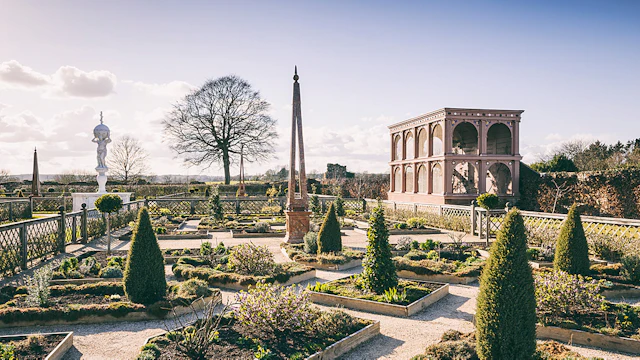
The reconstructed garden works because it is not presented as an independent ornamental display. It is tied to the 1575 festivities hosted by Robert Dudley for Elizabeth I, when the castle became a theatre of hospitality over 19 days. The garden’s formality makes more sense when you see it as part of that ambition: not simply a place to grow plants, but a designed environment for movement, viewing, surprise, and status.
The contrast between garden and ruin is one of the site’s strongest practical lessons. One space gives you symmetry, clipped structure, and visual control; the other shows the erosion of power through partial walls, open sky, and missing rooms. Plan enough time for both, even if you are more drawn to architecture than horticulture.
Timing your route around the weather
The garden and the castle ruins are both weather-dependent in different ways. Bright weather brings out the colour and geometry of the Elizabethan Garden, while lower light can make the stonework feel more substantial and reveal the depth of the surviving openings. Rain changes the footing and can make the exposed sections feel much less forgiving.
A flexible all-day ticket is helpful here. You can begin with the more exposed areas while the weather is comfortable, pause for refreshments, then return to the buildings and garden rather than treating the entire visit as one continuous circuit. The ability to arrive at any point during regular hours also helps if you are staying nearby and want to wait for a passing shower.
Do not build the day around a single perfect photograph. Kenilworth is a place of shifting lines: the tower against the sky, the garden’s ordered beds beside rough stone, the long view across Castle Green, and the way the ruins change character as you move between enclosed and open spaces. The most useful planning leaves room for those changes instead of trying to compress them into a fixed sequence.
Choosing between the main entry routes
The options become clearer when placed beside one another:
| Entry route | Best suited to | Main benefit | Detail to remember |
|---|---|---|---|
| Advance online booking | Visitors with a fixed date or wider itinerary | Up to 15% discount compared with full-price gate admission | The discount applies to advance online tickets, not automatically to walk-up entry |
| Advance morning booking | Visitors booking close to the day of travel | Potential saving of up to 10% | Availability and terms depend on the selected date |
| Walk-up admission | Flexible visitors who prefer to decide on the day | No advance commitment | Pay the applicable gate rate and check whether a travel discount applies |
| Good Journey walk-up entry | Train, bus, and bicycle travellers | 20% discount at the gate | Bring a valid travel ticket or bicycle helmet; do not assume it combines with online discounts |
| English Heritage membership | Repeat visitors and people visiting several properties | Free entry and free on-site parking | Follow the member-entry process and carry membership details |
| Kenilworth Resident’s Pass | Eligible local residents | Free entry for 10 years | A £6 administration fee applies; local eligibility is required |
| Group booking | Groups of 15 or more paying visitors | 10% discount in one transaction | One tour leader and one coach driver can enter free |
This is less a hierarchy than a map of different visiting habits. The online route favours certainty, the Good Journey route rewards car-free flexibility, membership supports repeat access, and the resident pass makes the castle part of local life rather than an occasional attraction.
A practical plan before you set out
Before booking, look at the day as a whole. Kenilworth Castle and Elizabethan Garden can comfortably occupy a substantial part of the day, but it also sits within a town with its own rhythm. Decide whether you want a focused castle visit, a slower day that includes time in Kenilworth, or a tightly scheduled stop between other destinations.
Then work through the details that most often cause friction:
- Choose online booking if the date is fixed and the advance discount matters to you.
- Choose walk-up admission if flexibility is more valuable and you are comfortable with the day-of-visit terms.
- If travelling by train, bus, or bicycle, bring the evidence required for the Good Journey discount.
- If you are an English Heritage member, have your membership information ready and remember that on-site parking is free.
- If you live in Kenilworth Parish, investigate the Resident’s Pass before treating each visit as a separate admission.
- For groups of 15 or more paying visitors, arrange the single payment and identify the tour leader and coach driver in advance.
- Allow for the approximately 300-metre walk from the car park to the entrance.
- Use the typical 10:00 AM to 5:00 PM opening pattern as a guide, but verify the hours for your chosen date.
- Treat 4:30 PM as the usual last-entry point, not as the beginning of a final full hour.
- Wear footwear suited to historic surfaces, outdoor paths, and changing weather.
- Leave enough time for both the Elizabethan Garden and the principal castle buildings.
The old walk-up habit still has a place at Kenilworth, particularly for visitors arriving by public transport or bicycle and using the Good Journey offer. But advance booking is now the more deliberate choice when your day has a fixed shape. It can reduce the admission cost, remove uncertainty at the gate, and give you the confidence to spend your attention on the site itself.
Kenilworth rewards that small amount of preparation. Once the ticket question is settled, the castle opens as a sequence rather than a checklist: medieval strength, Tudor ambition, royal spectacle, Civil War damage, and a garden restored to suggest how power once staged itself in colour and form. Plan the practicalities before you arrive, then let the ruins and garden set the pace.
Practical info
Currency: GBP
Driving: on the left
Emergency number: 112