Bellevue school district homes: 4 ways to find the right area
A listing can promise Bellevue schools and still leave you outside the Bellevue School District.
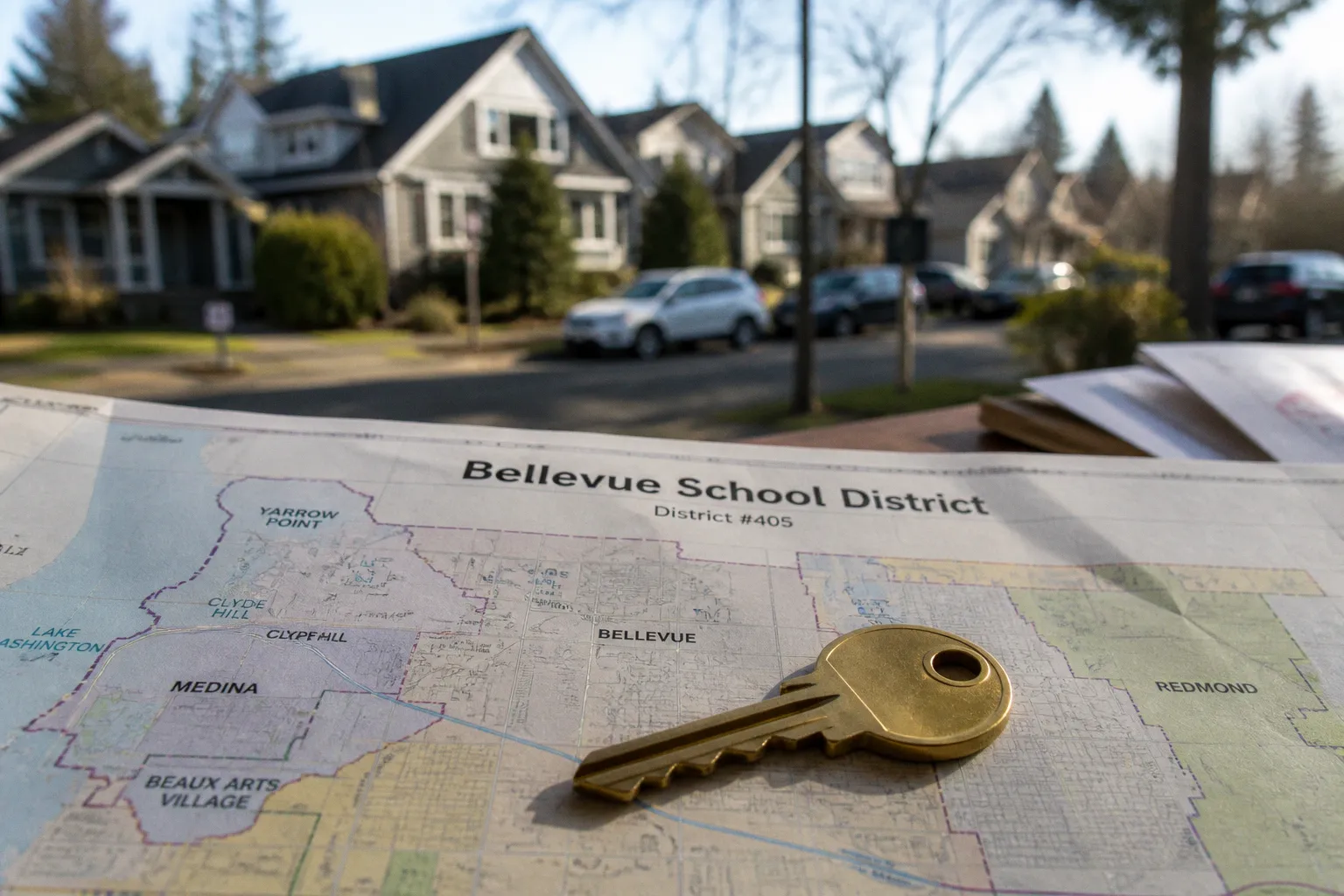
That mismatch is not a minor detail to discover after you have toured the kitchen, planned the commute, and started mentally placing your child in a particular classroom. It can affect the value of the home to your family, the schools available to you, and the timing of your entire purchase.
Bellevue School District and the City of Bellevue do not share the same boundaries. The district extends into several separate municipalities, while some homes inside Bellevue city limits belong to neighboring districts. BSD earned Niche’s #1 Best School District ranking in Washington for 2026—its third consecutive year at the top—and serves more than 19,000 students in grades PK–12, with an average student-teacher ratio of about 18:1. The schools are worth pursuing. But the address has to actually be in the district, and a seat at the school you want is not yours by default.
1. Map the True Boundaries: Beyond Bellevue City Limits
The first mistake many buyers make is treating a city name as a school assignment. In the Bellevue area, those are two different maps.
Bellevue School District, District #405, covers more territory than the City of Bellevue. It includes several high-value communities on the Eastside that have their own municipal identities. At the same time, certain areas within Bellevue city limits are assigned to other school districts. The line can move from one neighborhood to the next, and in some cases the relevant distinction is not obvious from the mailing address.
BSD includes:
- Most of the City of Bellevue, subject to address-level verification
- Beaux Arts Village
- Clyde Hill
- Hunts Point
- Medina
- Yarrow Point
- A portion of Redmond
- A small portion of Kirkland
That list matters because buyers often search by city first and school district second. Someone looking in Medina, Clyde Hill, Hunts Point, or Yarrow Point may be intentionally paying a premium for access to Bellevue schools. The address may indeed be inside BSD—but it is outside Bellevue city limits. That difference can affect property taxes, municipal services, utilities, emergency services, and the practical feel of the neighborhood.
The reverse problem is just as important. Some homes technically located within Bellevue are assigned to Lake Washington School District, Issaquah School District, or Renton School District, depending on the exact location. Areas around Factoria, parts of Eastgate, and stretches near the I-90 and I-405 interchange can require closer inspection than the city name suggests.
A Bellevue mailing address is therefore useful for finding a property, but it is not proof of school eligibility. Neither is a listing headline that says “Bellevue schools.”
Quick reference: BSD versus the City of Bellevue
| Area | In Bellevue city limits? | In BSD? |
|---|---|---|
| Beaux Arts Village | No | Yes |
| Clyde Hill | No | Yes |
| Hunts Point | No | Yes |
| Medina | No | Yes |
| Yarrow Point | No | Yes |
| Portion of Redmond | No | Yes |
| Portion of Kirkland | No | Yes |
| Parts of Bellevue city | Yes | Verify the specific address |
The last row is the one buyers should take seriously. It is easy to assume that a Bellevue address means Bellevue schools, especially when several nearby homes feed into BSD. But a district boundary is not a neighborhood mood or a marketing category. It is an administrative line attached to a particular parcel.
The city name gets you into the search. The exact address gets you into the district.
There is another layer after district eligibility: the assigned attendance area. Two homes inside BSD can feed into different elementary, middle, and high schools. That distinction matters if your search is driven by a specific school rather than by the district as a whole.
A home may be attractive because it is close to a school, sits in a familiar neighborhood, or appears beside BSD properties on a real estate map. None of those facts establishes the assignment. The same is true of phrases such as “near top-rated schools,” “served by Bellevue schools,” or “school information deemed reliable.” Those descriptions may be broadly accurate, outdated, or simply copied from another listing. They are not a substitute for district verification.
2. Verify Attendance Zones with the Official BSD Locator
Real estate portals are excellent for narrowing a search. They are not the final authority on school boundaries.
Listing data can come from MLS feeds, county records, previous listings, or manual entry. A school field may be carried forward even after a boundary change. A nearby property may have a different assignment because the district line follows a street, parcel, or attendance-zone boundary rather than a broad neighborhood label. Even when the listing is entered in good faith, the school information can be incomplete.
The Bellevue School District School Locator is the place to verify the assignment for a particular home. Run the search before you make an offer, and preferably before you become emotionally committed to the property.
A practical sequence looks like this:
1. Open the official BSD School Locator on the district website.
2. Enter the complete property address, including the house number, street, and ZIP code.
3. Check the assigned elementary, middle, and high school shown for that address.
4. Save a screenshot or PDF of the result with the date of the search.
5. Compare the result with the listing, the property flyer, and anything your agent has told you.
6. Contact the district directly if the locator conflicts with the listing or if the result is unclear.
The screenshot is not a legal guarantee that an assignment will never change. It is a record of what the district locator showed when you made the decision. That distinction is useful when several properties are competing for your attention and you need to remember why one address made the shortlist.
If the listing says one school and the BSD locator says another, stop treating the listing as evidence. Verify the discrepancy with the district.
Your agent’s confidence is not evidence, even when the agent knows the Eastside market well. Boundary questions are easy to misread when a property is close to a district line or when neighboring homes have different assignments. The official locator takes less time than a second showing. Use it every time.
Read the result as an assignment, not a promise
The locator tells you which schools are associated with the address under the district’s current information. It does not guarantee admission to a choice program, a particular class, a transportation arrangement, or a future boundary. It also does not mean that the school you prefer will be available through Open Transfer.
That distinction is where many otherwise careful buyers lose the thread. They verify that a house is in BSD and then quietly convert “inside the district” into “access to the school we want.” Those are separate questions:
- Is the address inside Bellevue School District?
- Which neighborhood schools are assigned to the address?
- Is the desired school a neighborhood school or a choice program?
- If it is not the assigned school, is there an application path?
- Does that path depend on residency, employee eligibility, a lottery, capacity, or a deadline?
If the assigned school is not the right fit, the cleanest answer may be to remove the home from consideration. A different option is to pursue Open Transfer, understanding that it is not guaranteed. A third is to decide that the home’s price, condition, location, or layout still makes sense even with a different school assignment. That can be a reasonable decision, but it should be made with the actual assignment in view—not with the hope that a later correction will solve the problem.
3. Navigate Choice Schools and Specialized Language Programs
Bellevue School District operates four specialized choice programs alongside its regular elementary schools. These programs are not simply alternate attendance zones. Admission is handled through a separate process, and living inside BSD makes a child eligible to apply; it does not guarantee a place.
The four programs include:
| Program | Focus | Grade levels | Entry method |
|---|---|---|---|
| Jing Mei Elementary | Mandarin dual language | K–5 | Lottery for eligible BSD residents and eligible BSD employees’ children |
| Puesta del Sol Elementary | Spanish immersion | K–5 | Lottery for eligible BSD residents and eligible BSD employees’ children |
| Bellevue Big Picture School | Project-based, individualized learning | 6–12 | Lottery for eligible BSD residents and eligible BSD employees’ children |
| International School | International Baccalaureate curriculum | 6–12 | Lottery for eligible BSD residents and eligible BSD employees’ children |
The important qualification is eligibility. BSD residents generally have access to the relevant choice-school lottery, and children of eligible BSD employees may also qualify under the district’s rules. That employee exception matters. “Residents only” is too broad, and “non-residents cannot apply” leaves out a documented category of eligible applicants. For everyone else, buying outside the district is not a shortcut into these programs.
Even when a family is eligible to apply, the application is not an entitlement. Seats are limited, and the lottery remains a lottery. A home inside BSD gives you the right to pursue the process; it does not put your child at the front of the line or reserve a seat before you close.
That difference should change how you search for a home. If your primary objective is a Mandarin or Spanish dual-language program, buying the most expensive house in the right general area does not solve the admissions problem. If your target is the International School or Big Picture, the same logic applies. The property needs to work if the lottery does not.
Build the home search around the fallback, not only the preferred program
For a kindergarten applicant targeting Jing Mei or Puesta del Sol, identify the assigned neighborhood elementary school before you submit an offer. Ask whether you would be comfortable there if the choice-school application does not result in a seat. The same exercise applies to families considering International School or Big Picture for middle or high school entry.
This is not pessimism. It is basic transaction planning. A lottery outcome can arrive after you have paid for inspections, committed to a closing timeline, or made arrangements around a move. The house is a long-term obligation; the choice-school application is a separate, uncertain decision.
The relevant questions are concrete:
- What school is assigned to this address if the choice application is unsuccessful?
- Which grade is the child entering, and is the desired program available at that entry point?
- Is the application available to this family based on residency or eligible BSD employment?
- What documentation will the district require?
- When must the application be submitted?
- What happens if the family is placed on a waitlist?
- Would the home still make sense if the child attends the assigned school for at least the first year?
A family moving from outside BSD should be especially careful with timing. Eligibility depends on the district’s residency and enrollment rules, not merely on having an accepted offer. Closing, establishing residency, and completing the application are separate events. If the move is planned around a particular school year, confirm the sequence directly with BSD rather than assuming the purchase contract creates immediate eligibility.
For an eligible BSD employee family, the same principle applies in reverse: the employee exception may create an application path, but it does not turn a choice-school lottery into a guaranteed placement. Confirm the current rules and documentation requirements before treating the exception as part of your housing strategy.
4. Manage Open Transfer Applications and Waitlist Timelines
Open Transfer is the route for resident students who want to attend a school outside their assigned attendance zone. It can matter when a family is satisfied with BSD generally but wants a different school, when a choice-school application does not work out, or when the assigned campus is not the right fit.
It is also the point at which the school calendar becomes a real estate constraint.
For the 2026–2027 school year, the draft schedule identifies these dates:
- December 15, 2025: Open Transfer and Choice School application window opens
- January 22, 2026: Waitlist applications open
- February 12, 2026: New student enrollment announcements
These dates are not decorations on a district calendar. They can determine whether a family is making an informed purchase or closing first and hoping the school process catches up.
If your closing date falls after the relevant application or announcement window, the district does not hold a seat because a transaction is in progress. A pending purchase is not the same as an established enrollment situation, and a seller’s statement that “the buyers will be able to transfer” is not a school placement.
The house and the school application run on different clocks. Put both calendars on the table before you write the offer.
Match the purchase timeline to the school timeline
If your child needs a specific BSD school for fall 2026, work backward from the application and announcement dates. An offer must be accepted, inspected, financed, and closed on a schedule that leaves room for the district’s requirements. That does not mean every family must close by one particular date, but it does mean that a late closing can reduce the options available for the coming school year.
A useful way to think about the timing:
- Before submitting an offer: verify the district, assigned schools, choice-school eligibility, and relevant deadlines.
- During inspection and review: confirm that the school plan still works if the preferred transfer or lottery result does not happen.
- Before closing: collect the residency and enrollment documents the district requires and confirm where the application stands.
- After an unsuccessful lottery or transfer request: ask about waitlist status, capacity, and the next available process rather than assuming the result will change automatically.
The waitlist deserves its own dose of realism. A place may open because another family moves, declines a seat, or changes plans, but availability is tied to the specific school and grade. A waitlist is a possibility, not a backup plan with a known delivery date. If the home only works if a waitlist seat opens, the purchase is carrying more risk than the listing language may suggest.
For families shopping for the 2027–2028 school year or later, verify the boundaries again. A search performed months ago is not permanent proof of a future assignment. District boundaries can be updated, and the school shown for an address today may not be the one available when your child reaches a later grade. Re-run the locator during an extended search and contact BSD if the result changes or if the property sits near a boundary.
Mid-year moves require a different approach. Open Transfer may not be the immediate lever, and the assigned school may be the practical starting point. Mid-year changes depend on capacity and district rules. Families moving outside the summer enrollment cycle should ask about the current process before making the home purchase part of a school-switching plan.
What to settle before you write the offer
The right Bellevue school district home is not simply the one with the best school name in the listing. It is the home whose exact address, assigned schools, application options, and timing all work for your family.
Before you make the offer, answer four questions:
1. Is the property actually inside BSD? Check the complete address in the official locator, even if the listing says Bellevue schools.
2. Which neighborhood schools are assigned? District membership alone does not identify the elementary, middle, and high schools.
3. Is the desired program a guaranteed assignment or a separate lottery? Choice programs require their own eligibility and application analysis. Eligible BSD employees’ children may qualify under a documented exception, but that still does not guarantee a seat.
4. Can the transaction keep pace with the district calendar? Open Transfer, waitlist, and enrollment dates may arrive before your closing.
The buyer’s advantage is not a clever interpretation of a listing. It is refusing to confuse nearby with assigned, eligible with admitted, or pending with enrolled.
Bellevue School District’s boundaries do not follow Bellevue’s city line. Choice schools are lotteries, not entitlements. Open Transfer depends on capacity and deadlines. Verify the address, save the locator result, and call the district when the information conflicts. Then decide whether the house still works on the facts—not on the most flattering sentence in the marketing copy.