Things to do in Dubai: a streamlined visitor itinerary
Dubai does not hide its attractions behind charming side streets and serendipitous discovery.
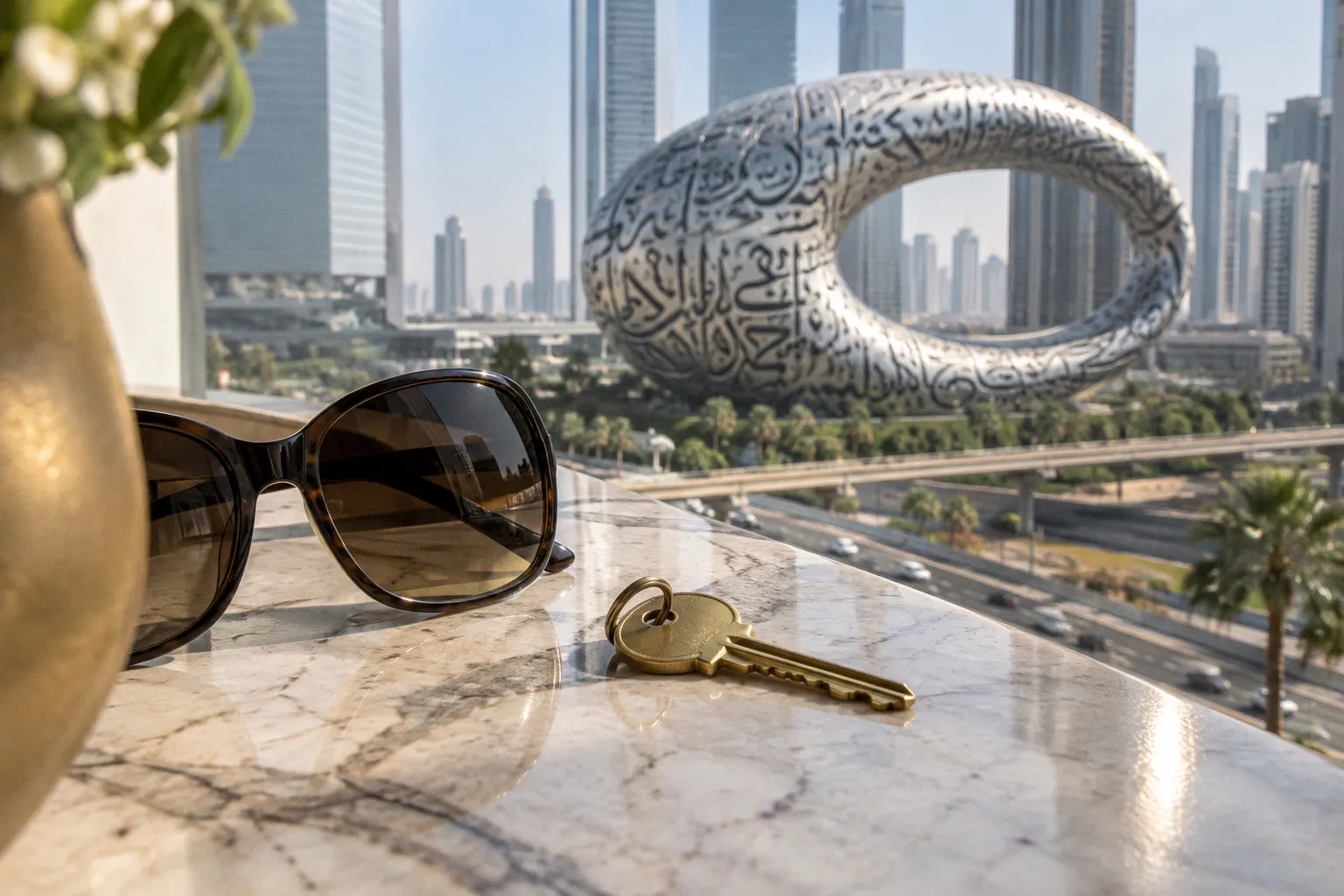
It announces them at full scale: a 77-meter torus sheathed in calligraphic steel, a permanent aqua-theatre holding nearly three million liters of water, an indoor ski mountain where the desert outside can reach 45°C. The challenge for any visitor is not finding things to do. It is sequencing them without wasting half the trip in taxi transfers and heat exposure between stops.
Top attractions and activities in Dubai
Think of a Dubai itinerary the way you would think through a pre-sale renovation: every hour has a cost, every transit gap is dead time, and the return on your effort depends on how well you cluster the scope before you break ground.
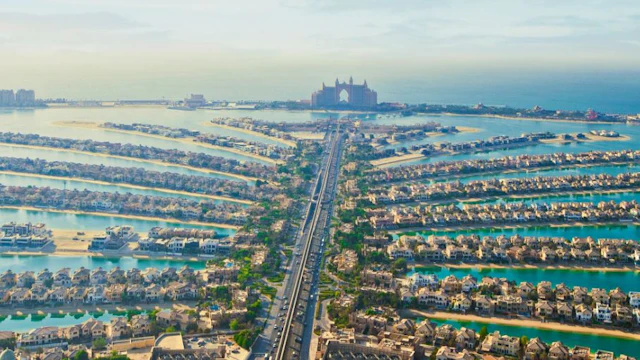
Dubai sprawls along a roughly northeast-to-southwest corridor, and its headline attractions do not sit in a walkable historic core the way European capitals obligingly arrange theirs. The Sheikh Zayed Road spine — the city's main artery — runs inland from the coast and anchors the business and cultural district around Emirates Towers and the World Trade Centre. Head south along it and you reach the Mall of the Emirates in Al Barsha. Move east toward the coast and you reach Downtown Dubai and the Burj Khalifa cluster, which sit a few kilometers inland rather than on the open Gulf. The Palm Jumeirah extends westward into the sea as an artificial island built from reclaimed land, its trunk anchored to the mainland and its fronds and crescent breakwater reaching out over the water.
That geography matters because your daily transit budget — both in dirhams and in minutes — will eat you alive if you plan point-to-point instead of in clusters. The map makes the city look compact, but major roads, interchanges, summer heat, and the distance between metro stations and individual venues quickly turn a supposedly simple hop into a proper logistical segment.
Three practical transit rules:
1. The Dubai Metro's Red Line covers the Sheikh Zayed Road corridor from the airport area through several major districts. It is clean, reliable, and far cheaper than taxis for solo travelers or pairs. Trains run roughly every five to seven minutes during peak hours.
2. Taxis and ride-hailing are the default for anything off the metro line. Several of the highest-value attractions sit just far enough from a station to make walking impractical in the heat. Budget for this rather than treating every transfer as a short walk. A taxi from the Museum of the Future to Al Habtoor City runs about fifteen minutes depending on traffic, while a trip to the Palm requires a more deliberate commitment.
3. The Palm Jumeirah requires deliberate routing. The Palm Tower and its connected Nakheel Mall sit at the trunk of the Palm; the monorail runs the length of the island but does not connect to the metro system. Treat a Palm visit as a self-contained block, not a quick add-on between two inland attractions.
The useful distinction is not simply between north, south, east, and west. It is between attractions that naturally share a transport corridor and attractions that demand a separate outing. Museum of the Future, Downtown, and Al Habtoor City can form a practical inland sequence. Ski Dubai belongs with Mall of the Emirates. The View at The Palm belongs with the Palm itself. That is how sightseeing stays efficient without turning the trip into a succession of car doors opening and closing.
Architectural Innovation at the Museum of the Future: Navigating the Torus
If you have one full day in Dubai and want the maximum architectural and experiential return, anchor it around the inland cultural corridor rather than trying to add the coast. The sequence works because each stop has a different energy: a designed cultural experience in the morning, the high-volume spectacle of Downtown in the afternoon, and a performance venue after dark.
The Building as the Opening Argument
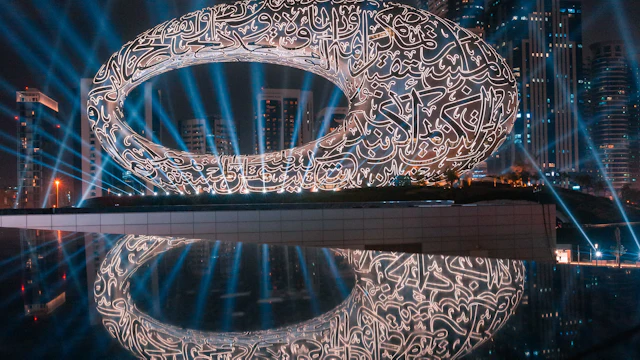
The Museum of the Future on Sheikh Zayed Road opens the day as a statement piece — not a quiet gallery easing you in. The building itself, a torus-shaped structure standing 77 meters tall with a stainless-steel façade cut through with Arabic calligraphy that doubles as windows, is worth the visit before you even step inside.
The engineering is the first exhibit: more than 1,000 uniquely shaped façade panels and seven storeys built around the torus geometry without internal columns interrupting the floor plates. If you have a structural bone in your body, you will spend ten minutes just circling the exterior. Even visitors who are less interested in construction usually need a few minutes to read the building as an object before moving toward the entrance. It is not a neutral container for exhibits; it is the opening argument.
Inside the Experience
Inside, the experience runs across immersive installation levels rather than traditional display cases. This is not a museum of artifacts behind glass. It is a future-focused environment built around scenarios, immersive rooms, and interactive encounters. Plan for two to two-and-a-half hours inside, including any entry queue.
Book tickets in advance. Walk-up availability is inconsistent, and you do not want to burn morning hours standing in a ticket line that could be spent elsewhere. The museum is most useful as a scheduled anchor, not as a place to visit only if the day happens to leave a spare hour.
The museum sits next to Emirates Towers, directly on the Red Line metro at Emirates Towers station. From there you can reach Downtown Dubai — and the Burj Khalifa and Dubai Mall complex — in roughly ten minutes by taxi or a few metro stops. That becomes your afternoon block without a major transit penalty.
Cluster Logic: Downtown as the Afternoon Extension
The Dubai Mall and Burj Khalifa observation deck occupy the same broad complex, but they should not be treated as one quick stop. The mall itself can absorb as much time as you allow, while the observation deck operates on timed entry slots. Decide in advance whether Downtown is primarily a view, a meal, a retail stop, or a general spectacle. Without that decision, the complex tends to expand until it consumes the entire day.
If the Museum of the Future was your architectural and intellectual investment, Downtown is the visual payoff: scale, fountain shows, retail volume, and the vertical drama of the Burj Khalifa. The observation deck's sunset window books out faster than other time blocks. If that window matters to you, lock it down at the same time you book the Museum.
The order also matters. A morning museum slot followed by a flexible lunch and mall period gives you room to absorb delays. A late-afternoon observation booking creates a hard deadline, so allow enough time for the transfer from the museum, security, finding the correct entrance, and the internal walking distances inside Dubai Mall.
Dubai rewards early booking the way a renovation rewards a locked scope. Decide your non-negotiables first — timed entries, performance tickets, observation decks — and build the rest of the day around what remains flexible.
La Perle by Dragone: Logistics for the Aqua-Theatre Experience
Evening entertainment in Dubai runs the full gamut, but if you want a single high-production anchor for one night, La Perle by Dragone at Al Habtoor City is the clearest fit.
Format and Venue
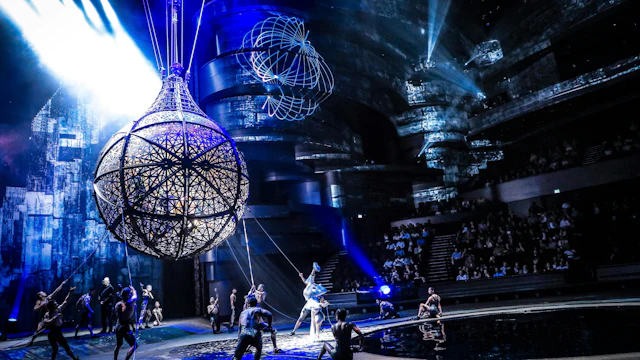
The show runs 90 minutes in a custom-built aqua-theatre with seating for 1,288. The stage center is a 2.7-million-liter pool that floods and drains within the performance itself, and the cast of 65 international performers works across acrobatics, diving, and theatrical staging that uses the water as both set piece and performance surface.
The key point is not just that the show is spectacular. It is that the format is unusually easy to place inside a tightly planned day. You are committing to a defined performance block rather than an open-ended dinner, club, or attraction that may take twice as long as expected.
Placement in Your Day
Al Habtoor City sits along the Dubai Water Canal, a short taxi ride from both the Downtown cluster and the Business Bay and Sheikh Zayed Road corridor. If your day ran Museum of the Future in the morning and Downtown in the afternoon, Al Habtoor City is a natural evening extension without doubling back across the city.
Show times are typically evening slots, often with multiple performances on certain days and a quieter weekly schedule on others. Check the schedule for your specific dates. Treat the performance as the fixed point and make dinner the flexible element.
Ticketing and Audience Considerations
- Age restrictions apply. Children under two are not permitted at La Perle. The policy is enforced at the door, so confirm directly with the box office if you are traveling with very young children.
- Seating categories affect sightlines significantly. In an aqua-theatre, action moves vertically, across the pool, and above the audience, so a position with a clear view of the full stage makes a real difference. The most expensive seat is not automatically the best seat, but back-of-house and far-side sections can lose important visual elements.
- Book in advance. Premium sections fill faster than the back rows, especially during peak tourist season and major holiday weeks.
Ninety minutes is a clean block — short enough that you can still have a late dinner at one of the Al Habtoor City restaurants afterward without the evening collapsing into a logistical scramble. If you are trying to fit several attractions into one day, that predictability has genuine value.
Ski Dubai: Managing Indoor Alpine Conditions and Equipment
Dubai's most counterintuitive attractions are the ones that invert the climate entirely. You are in a desert city where summer outdoor temperatures make midday walking a liability, and the solution on offer is a permanent indoor winter. That makes Ski Dubai a deliberate daytime anchor in the hottest months and a novelty stop in cooler ones.
What the Rental Includes (and What It Does Not)
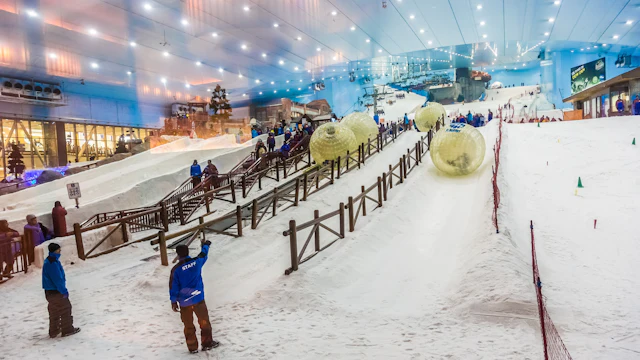
Ski Dubai sits inside the Mall of the Emirates in Al Barsha — a 22,500-square-meter indoor ski facility with an 85-meter internal mountain, five slopes, and a longest run of 400 meters. The internal temperature holds between -1°C and -4°C year-round.
The standard slope pass bundles the heavy lifting of logistics: winter trousers, jackets, boots, skis or snowboards, and helmets are all provided with the rental. What is not included — and what catches a surprising number of visitors off guard — is gloves and a warm hat. Bring your own or purchase them on-site.
That small detail can shape the whole experience. Cold-weather gear is not difficult to obtain, but discovering the gap only after you have arrived means another purchase, another queue, or an uncomfortable session with cold hands. It is the kind of minor omission that regularly surfaces in visitor feedback and is easily avoided with five minutes of preparation.
Time Allocation and Skill Matching
Plan two to three hours if you want to ski or snowboard with any seriousness. The facility also offers snow park experiences — tubing, snow caves, tobogganing, and a penguin encounter program — that run on separate pass categories. If you are not a skier and simply want the novelty of snow in a desert, the snow park is usually the better cost-to-experience ratio.
Do not assume that a slope pass is automatically the right choice for everyone in the group. Beginners may spend a meaningful portion of the session learning the equipment and managing the cold rather than making repeated runs. A snow park visit is easier to share across different ages and ability levels, while slope access makes more sense for visitors who specifically came to ski or snowboard.
Transit and Time-of-Day Notes
The Mall of the Emirates sits on the Red Line metro, which makes it one of the easiest major attractions to reach without a car. From the Palm Jumeirah or the Marina, a taxi is still faster; from the central corridor, the metro removes one variable from your day. Once inside the mall, allow additional time to reach the attraction itself rather than treating the metro exit as the venue entrance.
If you are pairing Ski Dubai with The View at The Palm in the same day, ski in the late morning through early afternoon. It is the slot where outdoor sightseeing is most punishing and indoor novelty is at its highest.
The View at The Palm: Strategic Timing for 240-Meter Panoramas
The View at The Palm occupies the 52nd floor of the Palm Tower at 240 meters, offering a 360-degree panoramic perspective over Palm Jumeirah, the surrounding coastline, and the open Gulf. It connects directly to Nakheel Mall at the trunk of the Palm.
Time-of-Day Windows
The critical planning variable is time-of-day pricing, which the venue splits into non-prime and prime windows:
| Time Block | Window | Typical Crowd Level |
|---|---|---|
| Non-prime morning | 9:00 AM – 3:30 PM | Lower foot traffic and clearer midday light |
| Prime sunset | 4:00 PM – 6:30 PM | Highest demand and golden-hour views |
| Non-prime evening | 7:00 PM – 9:00 PM | City lights and cooler temperatures |
The differences between these windows are not just price. Each one changes what you are actually looking at. The morning non-prime slot gives you the cleanest reading of the Palm's geometry from above, when the sun is high and shadows are short and the water reads blue against the fronds. The evening non-prime slot trades that for a transformed cityscape, with the road network, towers, and coastline shifting from daylight geometry into a field of city lights.
The Sunset Slot and What It Actually Shows
The sunset slot books out first and costs more, but it also delivers the most dramatic visual payoff of the observation experience: the sun descending toward the Gulf horizon at the far end of the Palm's fronds, with the island's crescent breakwater and the open water beyond it catching the golden-hour light. That is the orientation The View was designed around — west, over the fronds, out to sea — and it is what the prime window exists to capture.
If your budget and timing allow one premium observation experience in the city, this is where to spend it. If you are visiting in summer, however, weigh the premium against the heat. Standing outside for the post-sunset photographs or for the rooftop elements of the venue is more comfortable at 9 PM than at 5 PM, and the non-prime evening slot is a defensible alternative that costs less and runs cooler.
Plan the View the way you would plan a deck pour: pick the window, lock the access time, and don't try to slot it between two other inland stops. It is an island visit, not a detour.
Routing To and From the Palm
The Palm Monorail connects the trunk to Atlantis at the crescent, but it does not link to the metro. The most efficient approach is to taxi or ride-hail to Nakheel Mall, take the direct connection up to The View, and then either ride the monorail down the Palm for a beachside dinner or taxi back to the mainland.
Treat this as a self-contained evening block rather than trying to sandwich it between other inland stops. The Palm is not a convenient detour from Downtown simply because the two areas look close on a map. The access roads, island layout, and return journey all reward a dedicated window.
Critical Path: Lead Times, Seasonality, and Heat Management
In project-management terms, these are the pieces with the longest procurement windows and the highest risk of unavailability if you delay:
1. La Perle by Dragone tickets. Performance dates are fixed, seating categories are finite, and the strongest sightline tiers can sell out days ahead during peak tourist season.
2. Museum of the Future entry slots. Timed entry means your preferred morning window may not be available if you wait until arrival.
3. The View at The Palm sunset slots. Prime-time capacity is limited by floor space and elevator throughput. Same-day availability during peak months is unreliable.
4. Ski Dubai slope passes. These are more flexible than the options above, but if you want a specific time block — especially on a Friday or Saturday weekend slot — advance booking removes the risk of a wasted trip to the Mall of the Emirates.
Everything else — general Dubai Mall access, fountain shows, beach visits, and neighborhood wandering — operates on open entry or requires less rigid planning. Keep those pieces flexible. They are useful for absorbing delays, weather changes, and the inevitable moment when the group wants food before the itinerary says it is time to eat.
Season-by-Season Adjustments
Dubai's tourist season runs roughly from October through April, when daytime temperatures fall into the twenties and low thirties and outdoor exploration is viable for extended hours. The summer months, from June through September, push daytime temperatures well above 40°C, which flips the priority order: air-conditioned indoor anchors first, outdoor observation last.
A few specifics that do not always show up in generic travel guides:
- Summer queue behavior. Indoor attractions are noticeably busier in summer because outdoor alternatives are limited. Book earlier slots, not later ones — late morning crowds tend to be heavier than the first entry of the day.
- Transitions between venues. The air-conditioning gap between Ski Dubai and the Mall of the Emirates, or between the Museum of the Future and Downtown, can produce a sharp temperature shift. A light layer makes that changeover less jarring, especially for older travelers and children.
- Sunset timing. Dubai's sunset shifts from roughly 5:30 PM in December to nearly 7:00 PM in June. If your itinerary locks a sunset observation window in winter, check the actual time before booking so you are not watching the sun set an hour behind the window you paid for.
Book your timed attractions before you book your restaurant reservations. A dinner slot can flex around a show time; a museum entry slot will not rearrange itself for your convenience.
The streamlined itinerary is not about seeing more. It is about deciding what is non-negotiable, locking those pieces early, and letting the rest of the trip absorb the friction that the city — and the climate — will inevitably introduce. Done well, a Dubai visit does not need to be a march between checkpoints. It just needs a scope that respects the distance between them.