Seattle sewer scope inspections: A five-step testing plan
A sewer lateral repair in Seattle can cost approximately $7,500 when damage is limited, and more than $40,000 when excavation reaches beneath a street.
The exposure exists because the property owner is financially responsible for the private side sewer line all the way to the city main connection, including sections beneath sidewalks, parking strips, and streets.
A standard home inspection does not normally include a sewer camera inspection. The buyer must order it separately, usually during the inspection contingency period in the NWMLS purchase process. The sewer scope cost is relatively small—typically $150 to $400—compared with the liability it can identify.
The correct approach is not to treat a sewer scope as an optional add-on. In Seattle, it is a targeted infrastructure inspection with a defined purpose: determine whether the underground lateral is serviceable, repairable, or a transaction risk.
Why the sewer lateral deserves separate analysis
A general home inspection evaluates visible and accessible components. It may identify slow drains, backups, standing water, or other symptoms. It does not ordinarily send a camera through the underground pipe from the house to the public sewer main.
That distinction matters. A lateral can function normally during a brief inspection and still contain:
- Root intrusion that has not yet caused a full blockage.
- Offset joints where pipe sections no longer align.
- Structural cracks or collapsed segments.
- A belly, or low section, where wastewater and sediment remain after flow stops.
- Deteriorated material that is approaching failure.
- Obstructions that reduce the effective diameter of the pipe.
- A lateral connection that cannot be fully reached with the camera.
The visible evidence inside the house is therefore incomplete. Drainage performance is an operating result. A camera inspection examines the asset producing that result.
Seattle’s exposure is also different from a simple private-yard repair. The side sewer may cross a parking strip, sidewalk, or public street before reaching the municipal main. The owner’s responsibility does not automatically stop at the property line. The location of the defect can determine whether the repair is a controlled excavation in a yard or a much more complex project in the public right-of-way.
The relevant question is not whether wastewater is flowing today. It is whether the entire lateral can continue carrying wastewater without imposing an unpriced repair on the buyer.
The five-step Seattle sewer scope inspection
A useful Seattle sewer scope inspection checklist follows the actual testing sequence. Each step produces information needed for the next decision. A video file without location data is weaker evidence than a report that identifies the defect, its distance, and its likely position relative to the structure and street.
1. Establish access to the lateral
The inspector first locates a usable access point. This may be:
- An exterior cleanout.
- A basement or crawl-space access point.
- A roof vent, if no more practical cleanout is available.
- Another opening that provides entry into the side sewer.
Access is not a minor logistical detail. It affects the direction of the inspection, the length of pipe that can be reached, and the quality of the resulting evidence.
A cleanout close to the building often provides the most direct path. A roof vent may require additional setup and may not provide the same control as a dedicated cleanout. If access is blocked, buried, damaged, or incorrectly identified, the inspector may not be able to evaluate the full lateral.
The buyer should ask a direct question before authorizing the work: will the camera reach the city main connection, or only a partial length of pipe? A partial inspection can still identify serious defects, but it cannot support the same conclusion as a complete run.
2. Insert the waterproof camera and activate the live feed
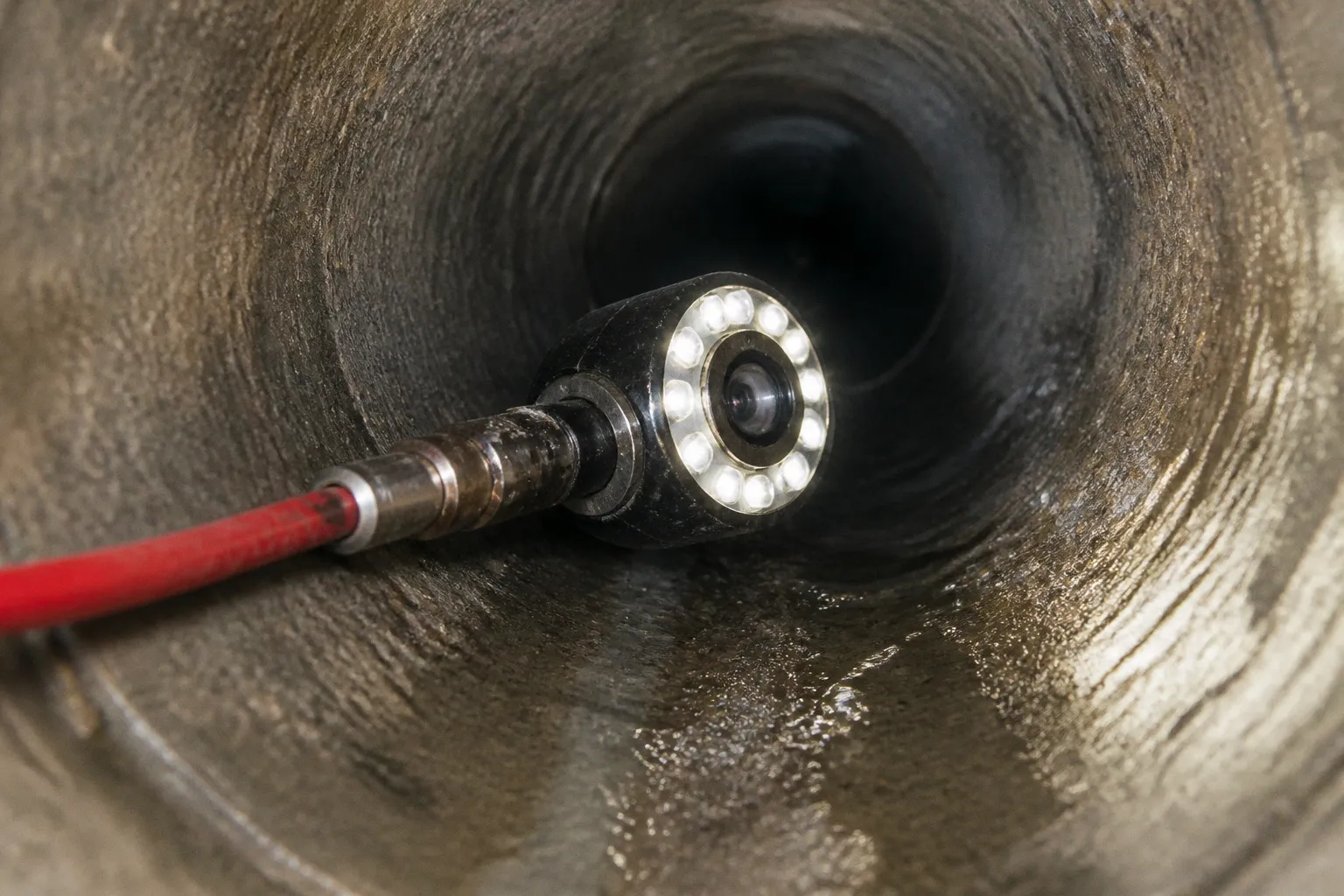
The inspection uses a high-resolution, waterproof camera mounted on a flexible cable. The camera is inserted into the lateral while the inspector monitors a live video feed.
The objective is not simply to produce a recording. The inspector must interpret the pipe as the camera advances. Changes in pipe material, standing water, root intrusion, displaced joints, and obstructions are all relevant. A clear feed allows the operator to distinguish a surface stain from a structural defect and a temporary obstruction from a failed section.
The camera head generally includes location technology. That allows the inspector to estimate the distance and depth of an observed problem from the access point. The result is more actionable than a statement that the line has a defect somewhere underground.
3. Push the camera through the full lateral
The camera is advanced through the private side sewer toward the city main. The target is the full lateral, not merely the first accessible section near the house.
This is the point at which many weak inspections lose value. A line can appear intact for much of its length and then fail near the street. Conversely, a visible defect near the house may be easier and less expensive to address than a defect beneath a paved public area.
The inspector should document:
- Whether the camera reached the city main or wye connection.
- The approximate total distance inspected.
- Any sections that could not be traversed.
- Changes in pipe material.
- The location of defects by distance from the access point.
- The estimated depth or position where available.
- Whether roots, sediment, water, or debris prevented a full view.
If the camera stops at an obstruction, that is not the same as a clean inspection. The line beyond the obstruction remains unverified.
4. Analyze defects and locate their position
The fourth step converts video into transaction information. The central issue is not whether the pipe looks old. Age and material can affect risk, but a transaction decision requires a more specific finding about condition and consequence.
Root intrusion
Roots can enter through joints, cracks, or deteriorated connections. Minor intrusion may be serviceable after cleaning, but repeated growth indicates an access point for future infiltration. The key variables are the extent of intrusion, the condition of the surrounding pipe, and whether the camera can pass beyond it.
A root mass that narrows the pipe but leaves structurally sound walls presents a different risk from roots entering through a cracked or offset section. Those conditions should not be grouped under one generic label such as sewer problem.
Offset joints
An offset occurs when adjoining pipe sections are no longer aligned. The camera may show a step, gap, or obstruction at the joint. Small offsets can affect flow. Larger offsets can trap solids, admit roots, or prevent cleaning equipment from passing.
The report should state whether the camera passed the offset and whether the condition is localized or repeated along the lateral.
Bellies
A belly is a low section where water remains after the rest of the line has drained. The camera may move through standing water, making the pipe wall difficult to evaluate. Persistent water can collect sediment and reduce the line’s functional capacity.
A short section of standing water is not automatically equivalent to a collapsed pipe. But it reduces certainty. The buyer should distinguish between a confirmed structural failure and a condition that prevents reliable visual inspection.
Cracks and collapse
A crack can range from a limited fracture to a major structural defect. Collapse is more direct: the passage is materially restricted or closed. The location governs the probable repair method and cost exposure.
A defect under a yard may be excavated with comparatively limited site disruption. A defect beneath a sidewalk or street introduces additional coordination, surface restoration, and potentially more complex permitting requirements. Exact municipal permit costs vary by jurisdiction and project conditions. They should be verified rather than estimated from a generic repair number.
Incomplete access
An inspection that does not reach the city main is incomplete by definition. That does not make it useless. It changes the conclusion from a full-condition assessment to a partial observation.
The buyer should not allow a clean first segment to stand in for the uninspected remainder. If the camera cannot pass because of an obstruction, the next step may involve cleaning, a second scope, or a repair evaluation. The appropriate response depends on the obstruction and the transaction timeline.
5. Retrieve the camera and obtain the evidence package
The final step is retrieval of the camera and delivery of the inspection materials. A useful package normally includes the video recording and a written report describing the observed conditions.
The buyer should retain both. The video permits later review by a contractor, inspector, or attorney. The report provides the concise record needed for negotiation and contingency decisions.
At minimum, the report should make clear:
- The access point used.
- The direction of travel.
- The approximate length inspected.
- Whether the camera reached the city main.
- Defects observed.
- Distance and depth information.
- Pipe material, where identifiable.
- Sections obscured by water, debris, or obstruction.
- Whether further evaluation is recommended.
A verbal statement that the line is fine is not equivalent to a recorded inspection with a defined endpoint.
How to read the result during a purchase
The sewer scope should be integrated into the inspection contingency, not handled as a separate afterthought. The buyer’s decision is usually binary at the transaction level: proceed with the identified risk or seek a change in price, credit, repair obligation, or other contract term.
The technical finding should be separated from the negotiation position.
| Sewer scope finding | Technical meaning | Transaction implication |
|---|---|---|
| Camera reaches the city main; no material defects observed | The inspected lateral shows no visible failure at the time of inspection | Lower immediate uncertainty, but not a guarantee of future performance |
| Minor roots in otherwise intact pipe | Intrusion is present but the pipe may remain serviceable | Request maintenance information or a focused repair estimate if needed |
| Offset, belly, or recurring obstruction | Flow and future access may be compromised | Obtain a contractor evaluation before assigning a dollar value |
| Crack or major root intrusion | Structural or infiltration risk is present | Treat as a defined defect, not as routine maintenance |
| Camera stops before the city main | A portion of the lateral remains unknown | Require further inspection, a scope extension, or a deliberate acceptance of uncertainty |
| Defect beneath sidewalk or street | Repair may involve public-right-of-way work | Analyze location, access, restoration, and permitting exposure separately |
The inspection does not itself establish the final repair cost. It establishes a condition and a location. A contractor then translates that condition into a repair method, expected disruption, and estimate.
Possible responses can include:
1. Proceed without a concession. This is rational only when the buyer understands the condition and accepts the expected maintenance or repair exposure.
2. Request a seller credit. A credit transfers some economic value without requiring the seller to select a contractor before closing.
3. Request repair before closing. This can reduce immediate risk but creates questions about scope, workmanship, permits, warranty, and completion standards.
4. Renegotiate the purchase price. A price reduction may be preferable where the repair timing is uncertain, but it does not provide the same cash-flow effect as a credit.
5. Use the inspection contingency according to the agreement. The specific rights and deadlines depend on the purchase contract and the buyer’s elected terms.
A buyer should not assume the seller will accept a particular remedy. The inspection provides leverage only within the contract’s deadlines and procedures.
Seller disclosures and the pre-listing decision
For sellers, a sewer scope can reduce uncertainty before listing. It can also expose a condition that may need to be addressed in the seller disclosure process. Washington seller disclosure requirements and the treatment of known property conditions should be reviewed with the appropriate real estate and legal professionals. The practical point is straightforward: a seller who knows about a material sewer defect has a different disclosure position from a seller who has never investigated the line.
That does not mean every seller should order a scope automatically. The decision depends on the property’s age, visible drainage history, prior repairs, landscaping, and the likely effect of discovering a defect before marketing.
A pre-listing scope may be useful when:
- The home has a history of backups or repeated drain cleaning.
- The sewer line passes under a paved area or public street.
- Prior records show repairs but do not document the full lateral.
- The seller wants to remove a major unknown before setting a price.
- A buyer is likely to order a scope and use any defect to reopen negotiations.
The seller should avoid commissioning a report merely to generate a positive marketing phrase. The useful output is an actual video and a defensible condition assessment. If the inspection identifies a defect, the seller must then decide whether to repair, disclose, price around it, or present the information directly during negotiations.
Cost analysis: small inspection, asymmetric liability
The Seattle sewer scope cost—typically $150 to $400—is a small line item relative to the property price and the potential repair exposure. That comparison is not a complete investment calculation, but it explains why the inspection has positive risk-management value.
The economics become more severe when the defect is hidden. An undetected issue may initially present as a slow drain or intermittent backup. The eventual repair can require excavation, pipe replacement, surface restoration, and work in a public right-of-way. Deep street excavation can push costs above $40,000. The average repair figure of approximately $7,500 is useful as a broad reference point, not as a quote for a specific property.
The cost range is affected by factors such as:
- Defect type.
- Pipe material and diameter.
- Distance from the structure.
- Soil and site access.
- Depth of the line.
- Presence of pavement, sidewalks, or landscaping.
- Whether the line can be repaired by trenchless methods.
- Need for engineering, permits, traffic controls, or restoration.
- Whether the entire lateral or only a section requires work.
Do not convert an inspection finding directly into a negotiation demand without a scope of work. A camera identifies the problem. It does not price the excavation.
Timing and inspection frequency
The inspection typically takes 15 to 30 minutes. The transaction schedule is longer. The buyer needs enough time to receive the video, review the report, obtain a second opinion where necessary, and act before the relevant inspection contingency deadline.
The sequence should be scheduled early, not at the end of the contingency period. A scope that occurs one day before the deadline leaves little room to investigate a camera stoppage or obtain a repair estimate.
For owners who are not currently buying or selling, a sewer scope may be repeated every three to five years, particularly where the property has mature trees, prior root intrusion, recurring backups, or an older lateral. The interval is not a substitute for responding to symptoms. A sudden change in drainage performance warrants evaluation regardless of the calendar.
The inspection covers underground side sewer laterals. It does not assess interior fixtures, water supply pipes, or internal drain stacks. Those systems require separate inspection methods and should not be treated as covered because a sewer camera produced a clean recording.
The binary market projection
For a Seattle buyer, the decision is binary.
If the camera reaches the city main and the report shows no material defect, the sewer lateral moves down the immediate risk register. It remains an aging underground asset, but the transaction contains less unknown exposure.
If the camera cannot reach the city main or identifies a defect, the buyer must assign a value to that uncertainty before the contingency deadline. Proceed with a defined concession, obtain a repair commitment, renegotiate, or exit under the contract terms. Ignoring the result is not a neutral position. It is acceptance of the potential liability at full cost.
The five-step plan is operationally simple: establish access, run the camera, reach the main, locate and classify defects, then preserve the video and report. In Seattle, the economics justify the process. The inspection is inexpensive. The liability is not.