DomQuartier Salzburg: ticket options for every visitor profile
The correct way to buy tickets for DomQuartier Salzburg depends on one variable: what kind of access you need. The museum is not operating at full capacity while the Residenzgalerie remains closed for renovation until autumn 2027.
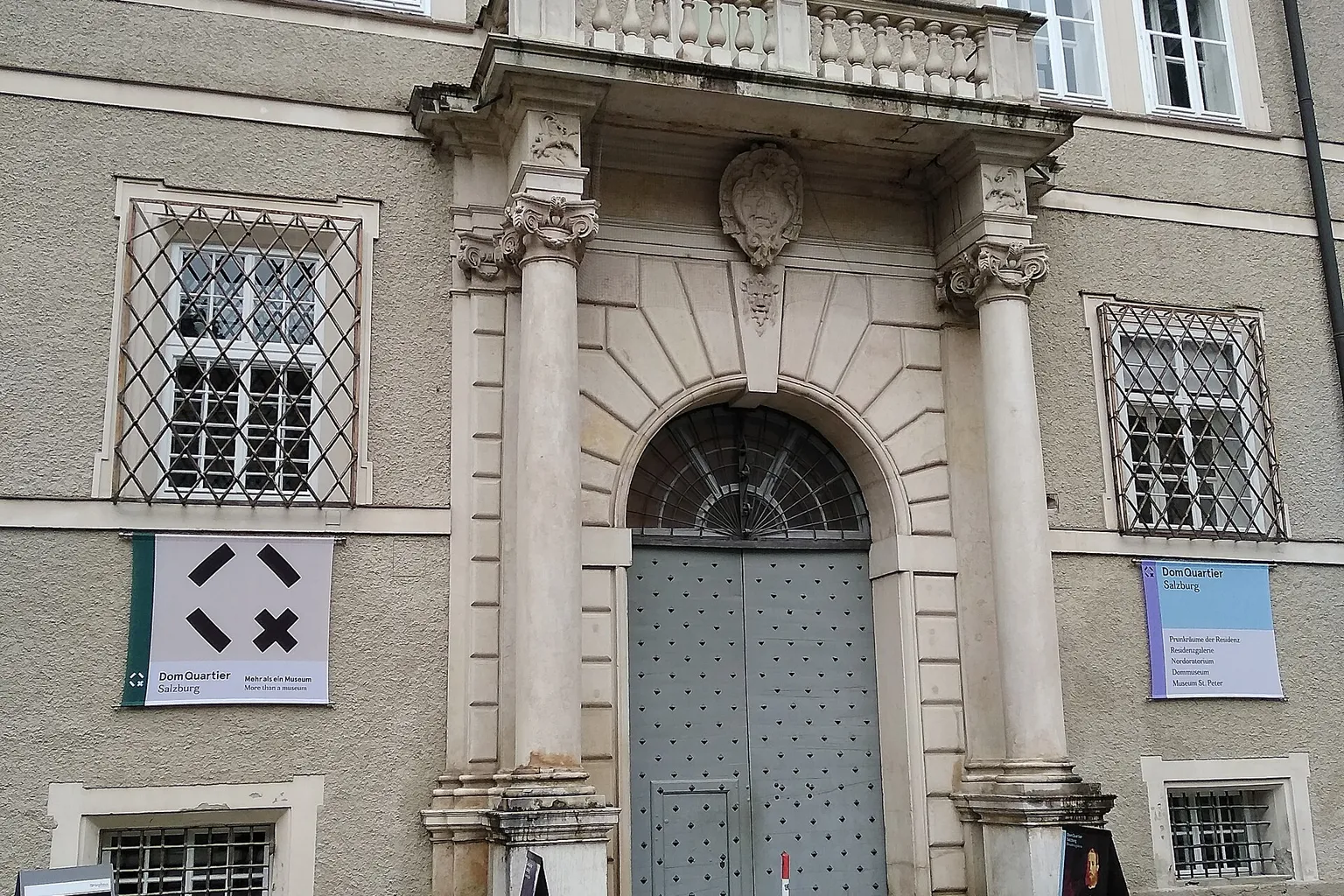
As a result, visitors currently choose between full-route and reduced partial-access admission, with different categories for adults, families, students, seniors, groups, and Salzburg Card holders.
Tickets and prices
DomQuartier Salzburg
I
Save
Box office and online booking
- Adult einmaliger Gratiseintritt
- Child €32
- Reduced €5
einmaliger Gratiseintritt
Official websiteII
other
Chamber music concert · 45 minutes
Listen to a 45-minute Mozart chamber music concert performed by two to four musicians in state rooms.
€28
Book ticketsThe pricing structure is simple once the closure is factored in. The operational mistake is assuming that every ticket provides access to every gallery. It does not. The Residenzgalerie renovation changes both the route and the admission category.
DomQuartier is currently a route-planning problem before it is a ticket-buying problem.
The current admission structure: full access versus partial access
DomQuartier Salzburg combines several historic institutions in one connected museum route. The visit covers the former residence of Salzburg’s prince-archbishops, the state rooms of the Residenz, views toward Salzburg Cathedral, and sections connected with St. Peter’s Archabbey. The route extends across three levels and covers approximately 1.3 kilometers.
The central pricing distinction is between:
- Full-access admission, covering the areas currently available on the standard museum route.
- Partial-access admission, reflecting the reduced route during the Residenzgalerie renovation.
The Residenzgalerie is expected to remain closed until autumn 2027. That date controls the reduced admission structure. It should also control your expectations. A full-access ticket does not mean that every historic collection normally associated with DomQuartier is open during the renovation period.
Ticket availability and current rates can change with exhibitions, seasonal operations, or institutional policy. For that reason, the final amount should be checked at the point of purchase. The category, however, can be selected in advance.
Which ticket category matches your visit?
| Visitor profile | Appropriate admission route | Planning implication |
|---|---|---|
| Individual adult | Full or partial access | Select according to the route shown for your visit date |
| Senior visitor | Reduced full or partial access | The reduced category applies from age 65 |
| Student or young visitor | Youth and student admission | The category covers visitors from age 7 through 25 |
| Family | Family admission | Designed for parents travelling with children |
| Group | Group admission | The reduced group category applies to groups of at least 10 |
| Salzburg Card holder | One-time free admission | Use the card for the included museum entry |
| Child aged 0–6 | Free admission | The child still counts in practical planning for the visit |
| Visitor seeking interpretation | Admission plus audio guide or tour | These are add-ons, not automatic inclusions |
The distinction between full and partial access is not a technical footnote. It is the main reason to read the ticket description before payment. If the Residenzgalerie is the primary reason for your visit, the renovation schedule changes the value proposition. If your focus is the Residenz State Rooms, baroque architecture, cathedral views, and the historical connection between the residence and Salzburg’s ecclesiastical institutions, the remaining route still has substantial scope.
How to buy tickets for DomQuartier Salzburg without choosing the wrong category
The safest sequence is operational rather than complicated.
1. Check the renovation status for your intended date.
The Residenzgalerie remains closed until autumn 2027. Do not treat older itinerary pages or archived visitor advice as current confirmation of full gallery access.
2. Identify the visitor category before selecting the route.
Adult, senior, student, family, group, and pass-holder access are handled differently. The museum uses age and group-size thresholds rather than a single universal ticket.
3. Confirm whether you want a standard visit, an audio guide, or a public tour.
The audio guide is a separate paid addition. Public guided tours also require a surcharge. Neither should be assumed to be included in the basic admission product.
4. Check the operating day and seasonal schedule.
DomQuartier is generally closed on Tuesdays outside special seasonal periods. July and August have extended daily hours from 10:00 a.m. to 6:00 p.m. December 24 is a closure date.
5. Complete the final price check at checkout.
Renovation-related reductions and temporary ticket conditions can change. The purchase screen is the controlling source for the amount charged.
This sequence removes the most common failure point: buying a ticket based on an old description of the museum and only discovering the route limitation after arrival.
The difference between a ticket and an access method
A standard DomQuartier admission ticket answers one question: whether you can enter the museum route. It does not automatically answer whether the visit will be guided, interpreted in your preferred language, or bundled with another Salzburg attraction.
There are four distinct access methods:
- Standard individual admission. Suitable for a visitor who wants to move through the route independently.
- Reduced-category admission. Available to qualifying seniors, students, young visitors, and larger groups.
- Salzburg Card entry. Provides one-time free admission as part of the card’s benefits.
- Organized or enhanced access. Includes an audio guide, a public tour, or a themed experience booked separately.
Separating these products makes the purchase decision clearer. A pass is not the same as a discount ticket. An audio guide is not the same as a guided tour. A themed event is not the same as general museum admission.
Families, students, seniors, and groups
The museum’s category structure is favorable to visitors who plan around eligibility rather than defaulting to an adult ticket.
Families
The family ticket covers parents and children under the museum’s family admission format. It is the most efficient structure for a household travelling together, particularly when children fall into different age bands.
Children from birth through age six enter free. Visitors aged seven through 25 fall into the youth and student category, subject to the applicable conditions. That means a family with teenagers should not assume that every child belongs inside the same pricing logic. The family product and youth category may produce different outcomes depending on the composition of the group.
The practical sequence is:
- Count every child by age.
- Separate children aged 0–6 from those aged 7–25.
- Compare the family option with the applicable youth admissions.
- Confirm whether the selected ticket covers the same full or partial route.
This takes less than a minute at the booking stage. It prevents an avoidable mismatch between the family composition and the ticket type.
Families should also budget time rather than only admission. The route is long enough to require a deliberate pace, and the building is not organized like a compact single-gallery museum. Three levels and a route of roughly 1.3 kilometers create a different operational profile from a short collection visit.
Students and younger visitors
Visitors aged 7 through 25 qualify for the youth and student admission category. The category is unusually broad by conventional student-ticket standards because it includes young visitors as well as students.
A recurring promotional format, Students-Wednesday, offers entry in the reduced student category and includes a lemonade at Café Kaffee [Kunst]. This is useful if the visit can be scheduled around the museum’s operating calendar. It is not a reason to ignore the normal schedule or assume that every Wednesday has identical conditions. Check the current information before making the day part of a fixed itinerary.
Students should carry whatever proof of eligibility the museum or booking channel requests. The age range is explicit, but the practical documentation requirement can vary by sales channel. That is a verification issue at checkout, not a reason to purchase the wrong adult product in advance.
Seniors
The senior category begins at age 65. It applies to both full and partial admission structures. The correct selection still depends on the route available during the visit.
Senior visitors should also account for the physical format of the museum. The route crosses three levels and involves a substantial amount of walking. The issue is not the distance alone. Historic interiors, stair transitions, visitor flow, and the absence of a simple linear exit can affect the pace of the visit.
A shorter partial-access visit may be preferable for visitors who want to limit walking, but it should not be selected solely because it is cheaper. The partial route is defined by current museum access, not as a bespoke mobility product.
Groups of 10 or more
Groups of at least 10 qualify for a reduced group category. This can apply to organized travel parties, educational groups, associations, or extended families travelling together.
Group booking requires more coordination than individual entry:
- Confirm the final headcount before selecting the ticket category.
- Establish whether the group will enter together.
- Decide whether the group needs a public tour or an independent visit.
- Allow time for ticket collection, meeting-point coordination, and movement through the entrance.
- Check whether the booking channel imposes its own reservation conditions.
The group threshold matters. A party of nine should not be treated as a group of 10 simply because additional people may join later. The clean approach is to finalize the count before purchase or use the booking channel’s amendment policy if one is available.
A group also changes the economics of interpretation. A public tour surcharge may be useful when the objective is context rather than speed. An audio guide may be more efficient when participants have different interests or need to move at separate speeds.
Salzburg Card benefits: when free entry is the better route
Salzburg Card holders receive one-time free admission to DomQuartier Salzburg. This is a pass benefit, not a normal reduced ticket.
The decision depends on the rest of your itinerary. The Salzburg Card is designed for visitors using several participating attractions and transport or access benefits during the validity period. If DomQuartier is the only major museum on your schedule, buying a separate admission may be operationally simpler. If the card is already part of the trip, using its included DomQuartier entry normally avoids paying twice.
The relevant questions are:
- Is the Salzburg Card already active on the intended visit date?
- Has the one-time DomQuartier entry been used?
- Does the card provide access to the route available during the renovation period?
- Are timed reservations or capacity controls required for that date?
- Will the card be used at enough other attractions to justify its total cost?
The museum entry is one component of the card’s value. Do not assess the pass solely against the standalone DomQuartier admission. Assess the complete itinerary.
The Salzburg Card is valuable when it replaces several separate admissions. It is not automatically efficient when used for one museum alone.
The same logic applies to annual passes. DomQuartier offers individual and family annual-pass formats. These are relevant for residents, repeat visitors, and travellers making multiple Salzburg visits within the pass period. A single holiday visit usually requires a different calculation.
Annual-pass value is a yield calculation:
- Estimate the number of visits.
- Include whether each visit will use the same access conditions.
- Consider whether temporary closures reduce the value of the route during the holding period.
- Compare the pass with the number of individual admissions actually expected.
- Exclude hypothetical visits that are not already plausible.
A pass does not create value through ownership. It creates value through realized visits.
Audio guides, public tours, and themed experiences
DomQuartier’s route contains institutional history that is difficult to reconstruct from interiors alone. The building connects the Salzburg Residenz, ecclesiastical authority, court culture, art collections, and the spatial relationship between Residenzplatz, Domplatz, Salzburg Cathedral, and St. Peter’s Archabbey.
Visitors have three practical interpretation choices.
Audio guide
The audio guide is available in multiple adult languages, including German, English, Dutch, Italian, French, Spanish, Russian, Mandarin, Korean, and Japanese. A children’s version is available in three languages.
It is a separate paid rental. The standard admission does not include it automatically.
An audio guide is the efficient option when:
- You want to control the pace.
- You are visiting without a fixed tour time.
- You prefer selective interpretation rather than a continuous lecture.
- Members of the group speak different languages.
- You want to pause at architectural details or move quickly through less relevant sections.
The guide is less efficient when several visitors want to discuss the route together or when the objective is a structured explanation from a specialist.
Public guided tour
Public tours require an additional surcharge on top of admission. They are better suited to visitors who want a defined narrative and the opportunity to hear explanations in real time.
The trade-off is schedule rigidity. A public tour creates a fixed start time. That affects the rest of the day, especially during July and August when Salzburg’s central attractions operate at high visitor volume.
A tour is the better choice when the visit is primarily educational. Independent admission is better when the museum is one stop inside a dense city itinerary.
Themed experiences
DomQuartier also appears in themed cultural products, including chamber music experiences connected with the Residenz and Mozart. These products should be treated as separate bookings. The existence of a themed experience does not convert a normal museum ticket into a concert ticket, and a concert-related reservation should not be assumed to include unrestricted museum access unless the product description says so.
This distinction matters for timing. A visitor attending a performance needs to confirm:
- The performance start time.
- The meeting or entry point.
- Whether museum admission is included.
- Whether access is available before or after the event.
- Whether the ticket is transferable between the experience and the general museum route.
Planning the arrival: hours, timing, and route logistics
The best time to visit DomQuartier depends on the interaction between opening hours, city traffic, and the length of the route.
Seasonal schedule
July and August have extended opening hours, with the museum open daily from 10:00 a.m. to 6:00 p.m. Outside the summer period, Tuesdays are generally closed except during special seasonal operations. December 24 is closed.
These are not minor calendar details. A Tuesday arrival can invalidate an otherwise efficient itinerary. The seasonal exception rule means that the date should be checked directly rather than inferred from a general weekly pattern.
Morning versus afternoon
A morning visit gives you the largest scheduling margin. It allows time for:
- The full museum route.
- An audio guide taken at a controlled pace.
- A public tour.
- A second attraction in the old town.
- Delays at the entrance or in the central Salzburg pedestrian area.
An afternoon visit can work, but it has lower schedule tolerance. If you arrive late, the choice becomes binary: move quickly through the route or reduce the number of other activities. The museum’s three-level layout is not designed for a rushed ten-minute stop.
Combining DomQuartier with nearby attractions
DomQuartier is positioned within Salzburg’s historic center. Visitors commonly combine it with Salzburg Cathedral, Residenzplatz, Domplatz, and St. Peter’s Archabbey. The proximity is efficient, but the sequence should be planned around opening times and fixed-entry products.
A practical order is:
1. Start with the attraction that has the strictest entry condition.
2. Use DomQuartier as the longer indoor block.
3. Leave flexible outdoor spaces, including the squares around the cathedral, for the period before or after the museum.
4. Place any timed chamber music or guided experience separately from the general museum visit.
5. Leave a buffer rather than scheduling consecutive admissions with no transition.
This is especially relevant in peak summer. Dense itineraries fail at the handoff between attractions, not necessarily inside the attractions themselves.
What to bring and what to verify
Before leaving for the museum, verify:
- The selected date and operating status.
- Whether the ticket provides full or partial access.
- Proof for student, youth, senior, or other reduced categories.
- The validity of the Salzburg Card, if used.
- The language and availability of the audio guide.
- The start time and location of any public tour.
- Whether a themed event includes museum admission.
- Whether your group has the required number for group admission.
These are administrative details, but they determine whether the ticket performs as expected. The museum itself is not the source of most avoidable problems. The errors occur earlier, when visitors select a category without matching it to the route, date, or pass conditions.
The decision in binary terms
Choose standard or reduced admission if DomQuartier is a single planned museum visit and you want control over the pace.
Choose Salzburg Card entry if the card is already part of a multi-attraction itinerary and the one-time benefit has not been used.
Choose family or group admission when the household or party meets the relevant composition or headcount threshold.
Choose an audio guide when you need multilingual, self-directed interpretation.
Choose a public tour when you want a scheduled expert narrative and can accept a fixed start time.
Choose a themed experience only after confirming whether it includes general museum access. Treat the event and the museum route as separate products until the booking terms establish otherwise.
The current renovation makes one conclusion unavoidable. Visitors who plan around the closed Residenzgalerie and select the ticket according to their actual profile will have a predictable visit. Visitors who buy the first available adult ticket and assume that historic access is unchanged will carry unnecessary cost and reduced route certainty.
Practical info
Currency: EUR
Driving: on the right
Emergency number: 112
FAQ
Is the Residenzgalerie open for visitors?
What age range qualifies for the youth and student admission?
At what age does the senior discount apply?
How many people are required for a group ticket?
Does the Salzburg Card include admission to DomQuartier?
Are audio guides included in the price of a standard ticket?
Photo: Maskaravivek / CC BY-SA 3.0 — Wikimedia Commons