Roman City of Carnuntum Tickets: Options for Every Visitor
The most common Carnuntum mistake happens before anyone reaches the ticket desk: visitors assume one ticket covers every Roman site in Petronell-Carnuntum. It does not. The paid day ticket covers the Roman Quarter and Museum Carnuntinum.
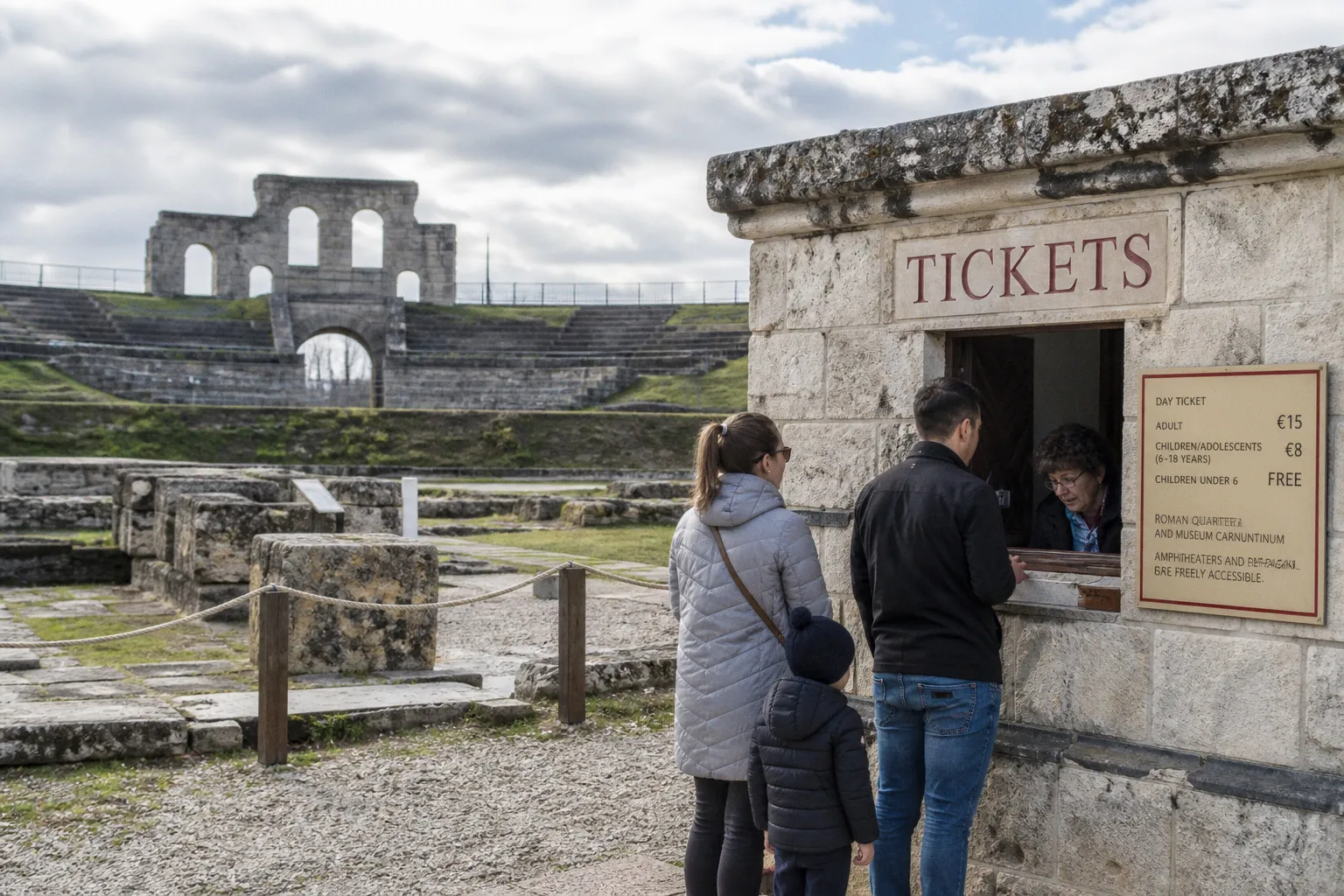
The amphitheaters and the Pagan Gate are free to visit, so buying a ticket just to see those outdoor monuments would be paying for a service you do not need.
Tickets and prices
Book tickets — from €15| Option | Type | From |
|---|---|---|
| Bath: Roman Baths Entry Ticket with Audio Guide | entry ticket | from €27 |
| Colosseum, Roman Forum & Palatine Hill Guided Tour | guided tour | from €49 |
Prices checked on August 15, 2026 · current price on the partner page.
Prices are indicative and may change — confirm the price and availability on the partner page.
Partner link — GetYourGuide ticketsThat distinction changes the whole plan. If you want the reconstructed Roman houses and the museum, budget for admission. If you are making a shorter stop for the amphitheaters or the Pagan Gate, you can visit those sites without paid entry. If you hold a NÖ-Card or Vienna Pass, your cost may drop to zero for one visit per season—but only for standard admission, not every group or special program.
Here is how to buy tickets for the Roman City of Carnuntum without letting a vague ticket page or a rushed day trip make the decision for you.
Understanding the Carnuntum ticket structure: paid versus free sites
Carnuntum is not one enclosed attraction with one gate and one all-purpose admission fee. It is an archaeological area spread across several locations, with different access rules.
The day ticket is valid for:
- The Roman Quarter, including the reconstructed houses on their original sites.
- Museum Carnuntinum in Bad Deutsch-Altenburg.
The following sites are freely accessible:
- The amphitheaters.
- The Pagan Gate.
That means your first move is not to ask, What is the cheapest Carnuntum ticket? Ask what you actually intend to see.
If you want the reconstructed houses and the museum, buy the day ticket. If you only want the free outdoor monuments, do not buy one.
The Roman Quarter is the part of Carnuntum that most visitors imagine when they hear about the site. The reconstructed buildings are not generic theme-park scenery dropped onto an empty field. They stand on their original sites and are designed to show how Roman life worked in the early fourth century AD. The houses include details such as underfloor heating and functional kitchens, which make the visit more useful than a walk past disconnected stone walls.
The museum gives you a different kind of information. It is housed in a building constructed in 1904 in the style of a Roman country villa and adds context to the settlement, its objects, and its role in the Roman world. You get the buildings in the Roman Quarter; you get the broader story in the museum.
The amphitheaters and Pagan Gate work differently. They are outdoor sites and can be visited without the paid ticket. That makes them useful for a quick visit, an arrival-day stop, or a low-cost itinerary. But free entry does not mean every site is interchangeable. If your goal is to understand domestic Roman life, skipping the Roman Quarter leaves out the most hands-on part of the experience.
The practical choice
Use this simple split:
1. You have half a day and want the main reconstructed experience. Buy the day ticket and focus on the Roman Quarter. Add the museum if transit and opening hours fit.
2. You are interested in Roman military architecture or monuments and have limited time. Visit the free amphitheaters and Pagan Gate.
3. You are traveling with a pass. Confirm that you are using it for standard admission, not a group program or another restricted activity.
4. You are traveling with a dog. Dogs on leashes are permitted in the Roman City Quarter and both amphitheaters. Plan the museum portion separately.
Roman City of Carnuntum ticket options and prices
The standard adult day ticket costs €15. Children and adolescents from 6 to 18 years pay €8. Children under 6 enter free.
There are also reduced categories listed for concessions and groups of 20 or more, priced at €14. Families using the Familienland-Pass can access a family admission priced at €12. The wording matters here: do not assume every family combination, school party, or organized group fits the same category. Ticket rules are not a buffet. Use the category that matches your party and the pass you actually hold.
| Visitor category | Price | What it covers |
|---|---|---|
| Adult day ticket | €15 | Roman Quarter and Museum Carnuntinum |
| Concession or group of 20+ | €14 | Paid admission for eligible visitors |
| Children and adolescents, ages 6–18 | €8 | Paid admission |
| Children under 6 | Free | Admission under the stated age limit |
| Familienland-Pass family admission | €12 | Family admission under the pass conditions |
| NÖ-Card or Vienna Pass holder | Free once per season | Standard admission, subject to pass conditions |
The day ticket is the cleanest option if you intend to visit both paid locations. It removes the need to make two separate admission decisions and gives you access to the Roman Quarter and Museum Carnuntinum within the applicable visiting period.
Online booking and on-site purchase are both available routes for the Roman City of Carnuntum booking process. If you already know your travel date, buying in advance can make the arrival smoother. If your plans depend on weather, rail connections, or the stamina of a small child, on-site purchase gives you flexibility. Just do not confuse flexibility with unlimited opening hours. A ticket is not a time machine.
What your ticket does not do
A paid ticket does not automatically include every possible program, group activity, or special experience. The NÖ-Card and Vienna Pass, in particular, provide free admission to the Roman city of Carnuntum once per season, but they are not valid for group programs.
You also should not treat the standard day ticket as a guarantee that every outdoor structure is open in the same condition. The Amphitheatre in the Military City may be affected by renovation. The free-access rule remains important, but the condition or availability of a specific site can change.
NÖ-Card and Vienna Pass: when the entry cost disappears
If you have a NÖ-Card or Vienna Pass, check that pass before paying for a standard ticket. Holders receive free admission to the Roman city of Carnuntum once per season.
That is the obvious saving. The less obvious point is the limit: once per season means you should not assume repeated standard admission is covered. And free admission applies to the normal visitor experience, not to group programs.
Bold warning: do not queue for a €15 ticket before checking your pass. But do not wave a Vienna Pass at a group-program desk and expect the same rules to apply.
The best use of a regional or city pass depends on the shape of your day:
- If Carnuntum is your main paid attraction, the pass benefit is straightforward: use it for standard admission and keep your ticket budget for transport or another stop.
- If you are combining Carnuntum with several museums and attractions in Vienna or Lower Austria, save the pass for the location where it gives you the strongest practical value.
- If you are traveling as part of a large organized group, verify the group terms before arrival. The pass does not automatically cover group programs.
- If you have already used the benefit during the season, budget for the regular ticket category instead of counting on a second free entry.
The same discipline applies to children. A child under 6 enters free under the stated admission rules, while ages 6 through 18 fall into the €8 category. Do the arithmetic for your actual group rather than assuming a family pass will always beat individual tickets. A family price can be useful, but only when your party qualifies for it.
Carnuntum ticket logistics: trains, stations, and walking time
Carnuntum is close enough to Vienna for a day trip, but close does not mean door-to-door. You still need to choose the correct station for the part of the site you want to visit.
The regional express REX 7 takes about 45 minutes from Vienna. For the Roman Quarter, get off at Petronell-Carnuntum. The walk from the station to the Roman Quarter takes about 15 minutes.
For Museum Carnuntinum, use Bad Deutsch-Altenburg. From that station, the walk to the museum takes about 20 minutes.
| Destination | Train connection | Station | Approximate walk |
|---|---|---|---|
| Roman Quarter | REX 7 from Vienna | Petronell-Carnuntum | 15 minutes |
| Museum Carnuntinum | REX 7 from Vienna | Bad Deutsch-Altenburg | 20 minutes |
This is where many otherwise sensible itineraries get sloppy. Visitors arrive at one station, discover that the next site is in another direction, and then spend the day negotiating transport instead of looking at Roman architecture.
If/Then planning for the route
If the Roman Quarter is your priority, use Petronell-Carnuntum as your target station. Start there, because the reconstructed houses are the most location-specific part of the paid experience.
If the museum is your priority, travel to Bad Deutsch-Altenburg. Do not get off at Petronell-Carnuntum just because it sounds like the main station. The Roman Quarter and Museum Carnuntinum are separate destinations.
If you want both paid locations, check the train schedule and opening hours before committing to the order. The sites are close enough to combine in a broader day plan, but they are not the same entrance and are not served by the same station.
If you are bringing an e-bike, charging stations are available at the Roman Quarter and local train stations. Nextbike rental bicycles are also available at the Roman Quarter and local stations, which can make the gap between sites less irritating than a badly timed walk.
The transport plan also affects your ticket choice. A day ticket makes sense when you are deliberately visiting both the Roman Quarter and Museum Carnuntinum. If the train schedule gives you only a narrow window, buying a ticket for both does not magically create more hours. Choose the site that matches your time.
Opening hours and the 2026 visiting season
The available 2026 schedule is divided into two periods:
- July 4 through September 6, 2026: open daily from 9 a.m. to 6 p.m.
- September 6 through November 15, 2026: open daily from 9 a.m. to 5 p.m.
That one-hour difference matters if you are traveling from Vienna and trying to fit in both the Roman Quarter and Museum Carnuntinum. A late departure can turn a comfortable visit into a race between the train platform and the closing time.
Plan the paid sites first. The amphitheaters and Pagan Gate are free, so they are easier to place around the edges of the day. The Roman Quarter and museum have the stronger dependence on opening hours and ticketed access.
For an early-season or winter visit beyond the dates listed above, do not invent certainty. The available schedule does not specify the exact opening hours and dates after November 15, 2026. Check the current visitor information before you travel. This is not bureaucratic overkill; it is the difference between a Roman history day and a train ride to a locked gate.
A free site can rescue a flexible itinerary. It cannot rescue an itinerary built on the wrong opening hours.
What the Roman Quarter gives you for the price
The ticket value is not just the number of buildings you can enter. It is the quality of the reconstruction and the way the site explains ordinary Roman life.
The Roman Quarter focuses on fully reconstructed houses from the early fourth century AD. The original-site location gives the buildings archaeological weight, while features such as Roman underfloor heating and working kitchens make the layout legible. You can see how rooms connected, how heat was managed, and how food preparation shaped the house. That is a more useful experience than collecting photographs of standing walls without understanding what they were used for.
This also changes how long you should allow. If you move through the Roman Quarter in a hurry, you will still see the structures, but you will miss the practical details that justify the paid admission. Read the layout. Look at how the rooms relate to one another. Pay attention to the systems hidden under the floor and behind the walls. Roman engineering is not improved by rushing past it.
The museum then gives you the supporting evidence and wider context. Its 1904 building, designed in the style of a Roman country villa, is part of the experience rather than a neutral box for exhibits. Treat the two paid locations as complementary:
- Roman Quarter: reconstructed spaces, domestic architecture, heating, kitchens, and an on-site sense of Roman life.
- Museum Carnuntinum: artifacts, interpretation, and a broader framework for understanding Carnuntum.
If you have children with you, the reconstructed houses usually provide the more immediate entry point because rooms and household features are easier to understand than a sequence of display cases. If you are traveling as an adult history-focused visitor, the museum may be the part that turns visual impressions into a coherent picture of the settlement.
A sharper way to choose your Carnuntum admission
Use this decision sequence before you leave Vienna:
1. Name the priority site. Roman Quarter, Museum Carnuntinum, amphitheaters, or Pagan Gate. Do not call the entire archaeological area one attraction when the ticket rules are split.
2. Check your pass. A NÖ-Card or Vienna Pass can provide free standard admission once per season.
3. Count the group correctly. Adults, children ages 6–18, children under 6, concessions, groups of 20 or more, and Familienland-Pass families do not all use the same price.
4. Match the station to the destination. Petronell-Carnuntum is for the Roman Quarter; Bad Deutsch-Altenburg is for the museum.
5. Build around the closing time. The listed 2026 schedule closes at 6 p.m. in the earlier period and 5 p.m. in the later period.
6. Keep the free sites as your pressure valve. If the timetable slips, the amphitheaters and Pagan Gate can still anchor the visit without another ticket purchase.
7. Do not assume renovation status. The Amphitheatre in the Military City may be affected by renovation, so confirm its current access before making it the centerpiece of the day.
The commercial decision is simple once the site is separated into parts. Buy tickets for the Roman City of Carnuntum when you want the Roman Quarter, Museum Carnuntinum, or both. Skip the paid ticket when the free outdoor monuments are enough for your itinerary. Use a pass when it covers standard admission, and do not let a discounted category tempt you into ignoring the conditions attached to it.
Carnuntum rewards a clean plan. Pick the site, pick the station, pick the ticket category, and move. The hard rule is this: never pay for the entire Carnuntum experience until you know which parts of Carnuntum you are actually entering.
Practical info
Currency: EUR
Driving: on the right
Emergency number: 112