Seattle condos vs townhouses: market trends for buyers
Seattle's 2026 attached-housing market has split into two distinct pricing systems. The NWMLS condo category has been accumulating inventory and losing median value, with buyers gaining leverage in the process.
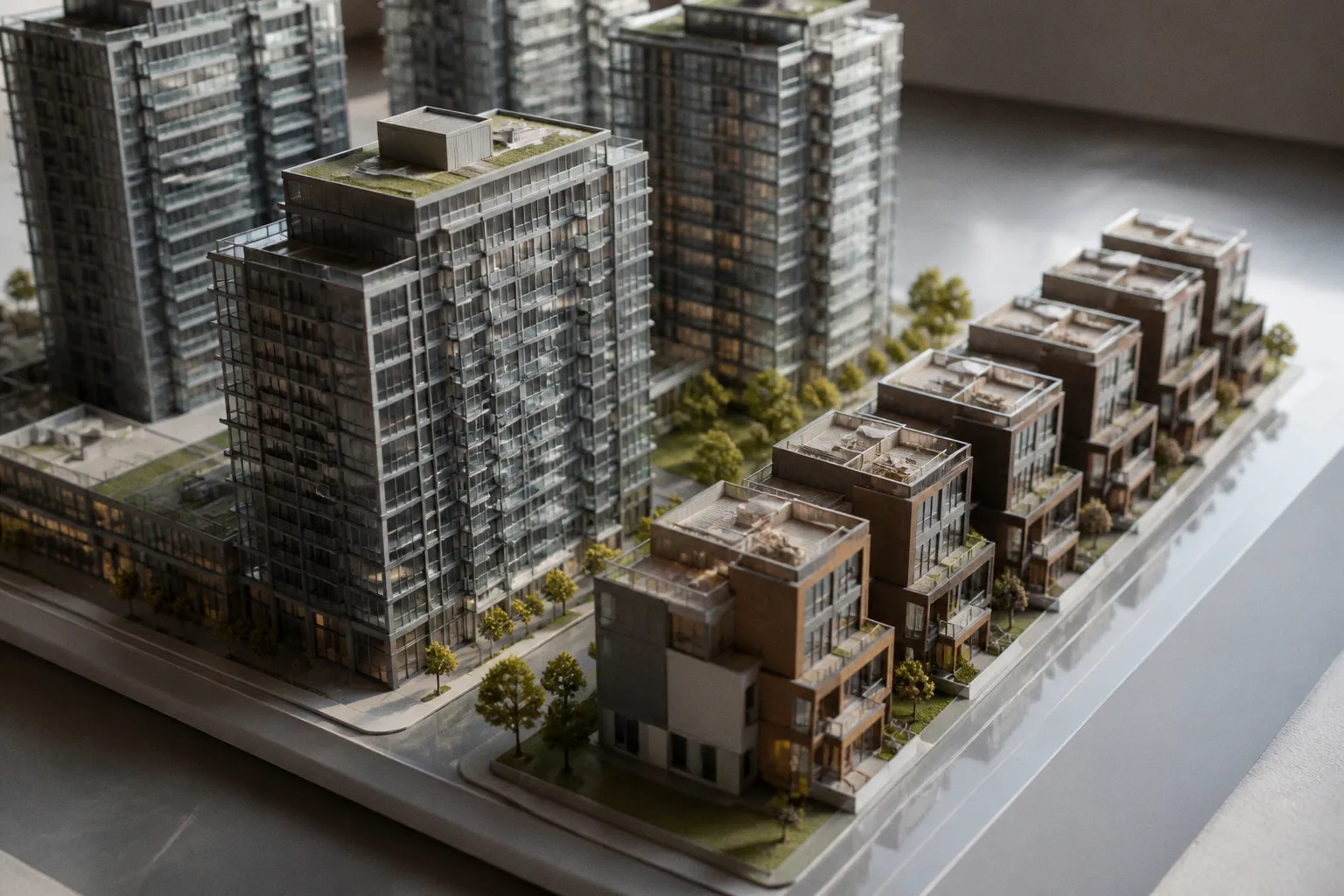
Townhouses and newer attached homes remain materially more expensive, but their pricing has shown greater resistance.
Compare car rental deals in United Kingdom
See available offersPartner link — DiscoverCars comparisonThe headline numbers tell the story. The Seattle condo median tracked by the Northwest Multiple Listing Service fell to $557,475 in June 2026, a 5.4% year-over-year decline and a 1.6% monthly decline. That figure is now six consecutive months into annual decreases. The median for townhouses and new-construction condos reached approximately $577,000 in February. In January, the broader category of non-traditional condos recorded a median of $775,000, despite a 5.8% annual decline.
Within that citywide figure, the traditional condo subsegment is moving faster than the rest. The Seattle traditional condo median reached $445,000 in early 2026, down 12.9% year over year.
That divergence defines the current Seattle condo vs townhouse price trends. The market is not moving as one asset class. It is repricing buildings, ownership costs, construction type, and location separately.
The NWMLS classification trap: "condo" does not always mean a flat
A basic comparison between "condos" and "townhouses" becomes unreliable when the underlying data uses a broader definition of condominium ownership.
The Northwest Multiple Listing Service includes several property types under the condominium label:
- Traditional apartment-style condo units.
- Townhomes held under a condominium structure.
- Accessory dwelling units, or ADUs.
- Detached accessory dwelling units, or DADUs.
- Parking spaces.
- Boat moorage.
This classification has direct consequences for median-price analysis. A report showing a $557,475 Seattle condo median does not describe one uniform product. It combines properties with different square footage, land arrangements, HOA structures, and buyer profiles.
In January 2026, non-traditional condos represented 37.1% of all Seattle condo sales. Their median selling price was $775,000. That figure cannot be used as a proxy for the typical downtown condo flat. It reflects the inclusion of townhomes, ADUs, and other higher-priced attached or separately situated properties.
The February numbers make the distinction more visible:
| Property category | Early 2026 median | Annual movement | Typical market characteristics |
|---|---|---|---|
| Traditional Seattle condos | $445,000 | -12.9% year over year | Apartment-style units, recurring HOA dues, concentrated in dense buildings |
| Townhouses and new condos | Approximately $577,000 | Not isolated in the available data | More space, often multiple levels, stronger substitution demand |
| Non-traditional condos | $775,000 in January | -5.8% year over year | Townhomes, ADUs, DADUs, and other properties grouped under the NWMLS condo category |
| Seattle condos overall (NWMLS category) | $557,475 in June | -5.4% year over year; -1.6% month over month; sixth consecutive month of annual declines | Mixed category covering materially different property types |
The conclusion is not that one statistic is wrong. The conclusion is that the statistic must be segmented before it becomes useful.
For buyers, the practical question is not simply whether Seattle condos are cheaper than townhouses. It is whether the unit being evaluated belongs to the part of the market where inventory is rising and resale demand is weakening.
A "condo" median in Seattle is a mixed instrument. Traditional flats and townhouse-style properties should not be read as one market.
The citywide condo category has logged six straight months of annual declines
Seattle's NWMLS condo median reached $557,475 in June 2026. That was a 5.4% year-over-year decline and a 1.6% monthly decline. It also marked the sixth consecutive month of annual price decreases for that composite category.
The same composite includes townhomes, ADUs, DADUs, parking spaces, and boat moorage, so the headline figure cannot be read as a traditional-condo indicator by itself. The data does show, however, that the traditional condo subsegment is doing most of the pulling. The traditional condo median fell to $445,000 in early 2026, down 12.9% year over year, while non-traditional condos posted a comparatively milder 5.8% annual decline in January.
Traditional condo-heavy neighborhoods are carrying the bulk of the weakness
Downtown and Belltown recorded a 15.6% year-over-year median drop in June. Queen Anne declined 10%. Northeast Seattle declined 17.6%.
These are not small statistical adjustments. A 15.6% annual reduction on a $600,000 property represents roughly $93,600 in lost median value before accounting for transaction costs, financing, or renovations. A 17.6% reduction on the same base represents approximately $105,600.
Median movement does not mean every unit in those neighborhoods fell by the same percentage. Building condition, view exposure, parking, monthly dues, reserves, and pending assessments create wide spreads between individual properties. But the direction is consistent: the traditional condo segment has less pricing power than it held earlier in the cycle.
Several factors reinforce that pattern:
- High concentration of comparable units. In large condo buildings, buyers can compare multiple units with similar floor plans, exposures, and amenities. Sellers compete against their own building.
- Recurring HOA obligations. Monthly dues commonly add $400 to $800 to a buyer's housing cost. The payment is separate from principal, interest, taxes, and insurance.
- Limited control over building expenses. Insurance, elevator contracts, exterior maintenance, utilities, and reserve funding are collective costs. Buyers price the association as much as the unit.
- A narrower resale pool. Some buyers who once considered condos now compare them with townhouses that offer additional space, private entries, and fewer shared interior systems.
- Assessment risk. A low asking price can be offset by a poorly funded reserve account or a pending capital project.
The result is median compression. Lower-priced traditional condos are pulling the segment's headline price down while higher-priced non-traditional properties keep the overall category from falling as sharply.
For a buyer, this creates leverage. It also creates a need for better underwriting. A discount at purchase is not automatically a favorable basis if the building continues to lose inventory absorption and resale liquidity.
Townhouses are the middle-priced alternative, not a cheaper version of a condo
New townhomes in popular Seattle neighborhoods typically list in the $700,000s to low $800,000s for a three-bedroom layout of approximately 1,500 square feet. That is below the price of many detached single-family homes, which often exceed $1 million, but above the median for traditional condos.
This positioning explains townhouses' relative resilience. They serve buyers who need more usable space than a condo provides but cannot or will not pay the detached-home premium.
The townhouse market has several structural advantages:
1. More private space. Multiple floors, private entrances, and fewer shared interior corridors produce a different ownership proposition from an apartment-style unit.
2. A broader household fit. Three-bedroom townhomes can accommodate families, roommates, offices, or buyers planning for a longer holding period.
3. Lower exposure to high-rise operating costs. Some townhouse communities carry HOA dues, but the fee structure can be materially different from a full-service condo tower. The exact amount varies by development.
4. Substitution demand from detached homes. When detached inventory exceeds a buyer's budget, a townhouse becomes a direct alternative. The comparison is not limited to other attached properties.
5. Newer construction. Many townhomes entering the market are newer than the traditional condo stock in dense Seattle neighborhoods. New systems and lower near-term maintenance expectations support the asking price.
This does not mean townhouses are insulated from market pressure. The January 2026 median for non-traditional condos, a category that includes many townhome-style properties, was $775,000, down 5.8% year over year. Price resilience is relative, not absolute.
The relevant distinction is the rate and source of decline. The traditional condo segment has faced a more visible combination of falling prices, rising supply, and weaker pending sales. Townhouses have retained demand because they occupy a different point on the housing ladder.
The price-per-square-foot comparison can mislead
Seattle condo price per square foot often appears attractive when compared with townhouses. That is mathematically predictable. A condo may contain 700 to 1,000 square feet, while a townhouse may offer approximately 1,500 square feet across multiple levels.
But price per square foot does not capture:
- Monthly HOA dues.
- Parking ownership or rental cost.
- Storage.
- Private outdoor space.
- Interior stairs and circulation space.
- Building insurance and reserve exposure.
- The resale profile of the address.
- Whether the unit has a private entrance.
- The remaining useful life of major building systems.
A lower price per square foot can coexist with a higher monthly payment. A $445,000 condo with $700 in monthly dues may not produce the lower all-in housing cost that its purchase price suggests.
HOA dues change the affordability calculation
The most common mistake in the Seattle condo vs townhouse comparison is treating the purchase price as the complete cost of ownership.
Traditional condo dues commonly range from $400 to $800 per month. The exact amount depends on the building's services, insurance, utilities, reserve contributions, age, elevator systems, exterior envelope, and shared amenities.
At $600 per month, dues equal $7,200 per year. Over five years, before any increase, that is $36,000. The cost is not building equity. It is an operating and reserve obligation attached to the property.
A townhouse may still have HOA dues. It may also have lower or minimal association costs, depending on the development. The available market data does not establish one average townhouse fee, and the spread between communities is substantial. A newer planned development can carry meaningful dues for roads, landscaping, roofs, or shared facilities. A smaller association may have fewer services but greater exposure to one-time assessments.
A buyer comparing two listings should put the costs on the same monthly ledger:
- Mortgage principal and interest.
- Property taxes.
- Homeowners insurance.
- Monthly HOA dues.
- Parking and storage charges.
- Expected utilities.
- A reserve allowance for interior repairs.
- A separate allowance for potential assessments.
The result should be tested against the resale horizon. A buyer planning to hold for two years has less time to recover closing costs and absorb a volatile resale market than a buyer planning to hold for ten.
The cheaper entry price is not necessarily the cheaper ownership structure. In Seattle, HOA dues can erase a large portion of the condo discount.
What the resale file should reveal
For a traditional condo, the resale analysis should extend beyond the unit's listing history. The association's documents are part of the asset.
A disciplined review focuses on:
- Current monthly dues and the history of increases.
- Reserve study findings and funding levels.
- Pending or recent special assessments.
- Building envelope, roof, siding, plumbing, elevator, and parking-garage work.
- Litigation involving the association.
- Delinquency rates among owners.
- The number of active listings in the building.
- Recent closed sales for similar floor plans.
- Days on market and price reductions.
- Rental restrictions and owner-occupancy ratios.
For a townhouse, the same association review applies where an HOA exists, but the physical inspection shifts toward roofs, siding, drainage, windows, decks, retaining walls, and shared access areas. A townhouse with an apparently low fee can still carry future capital exposure if the association has underfunded reserves.
The key variable is not the fee by itself. It is the relationship between the fee, the services delivered, and the association's balance sheet.
Seattle condo inventory has crossed into buyer's-market territory
In May 2026, Seattle's condo market reached 5.1 months of inventory supply. Supply was up 29% year over year, while pending sales fell 18%.
That combination changes the negotiation structure. More active listings give buyers substitutes. Fewer pending sales reduce the urgency that usually supports aggressive pricing. Sellers must compete on price, condition, financing terms, parking, dues, and documentation.
Inventory absorption is the central metric. If new listings arrive faster than they convert to pending sales, the market builds supply. If pending sales decline while active inventory grows, the months-of-supply figure rises even without a dramatic increase in new listings.
For traditional condos, the data indicates a market with weaker absorption. Buyers can often take more time to compare:
- A unit in the same building.
- A similar unit in a nearby building.
- A townhouse at a higher purchase price but lower or different monthly association costs.
- A smaller detached property outside the central core.
- A newer condo with fewer immediate maintenance concerns.
Townhouses do not operate with the same inventory profile. They remain more differentiated by floor plan, parking, outdoor area, construction quality, and neighborhood. A buyer may have fewer direct substitutes for a specific three-bedroom townhouse than for a one-bedroom or two-bedroom condo in a large building.
That does not eliminate negotiation. It changes the evidence required. A townhouse seller may retain pricing power if comparable inventory is limited, but an overpriced property will still expose itself through repeated days on market and price reductions.
A practical offer framework
In a buyer's market, the strongest offer is not necessarily the highest nominal discount. It is the offer that identifies the seller's actual constraint.
For a traditional condo, the leverage points may include:
1. Price. Use recent closed sales in the same building before relying on citywide medians.
2. Inspection and document review. Preserve time to evaluate reserves, assessments, insurance, and building condition.
3. Closing timeline. A seller with a vacant unit may value speed more than a marginal price increase.
4. Credits. A credit toward closing costs or future assessments can address a known cash requirement.
5. Parking and storage. Treat them as separate components of value, not as automatic additions to the unit.
6. Appraisal support. A weak condo market can make the appraisal gap more material, particularly where recent comparable sales are declining.
For townhouses, the analysis should place greater weight on direct comparables, not the broader condo median. A 1,500-square-foot new townhouse should not be benchmarked against a 700-square-foot downtown flat simply because both appear under a condominium heading in an NWMLS report.
Neighborhood-level volatility is unusually wide
Seattle's June 2026 neighborhood data shows why citywide averages are insufficient.
| Seattle area | Year-over-year condo median movement, June 2026 | Reading |
|---|---|---|
| Downtown/Belltown | -15.6% | Significant decline in a dense, condo-heavy market |
| Queen Anne | -10.0% | Negative annual repricing |
| Northeast Seattle | -17.6% | One of the sharpest reported declines |
| Southeast Seattle | +44.4% | Strong positive movement from a lower or changing sales mix |
| Seattle citywide (NWMLS condo category) | -5.4% | Broad decline across the mixed condo category |
The 44.4% increase in Southeast Seattle should not be interpreted as proof that every condo in the area appreciated by that amount. Median statistics are sensitive to the composition of sales. A small number of higher-priced transactions, a shift toward larger units, or a different mix of buildings can move the median sharply.
The same caution applies to negative results. A neighborhood with fewer transactions can show a large annual decline because the comparison is between different property mixes.
For a buyer, the neighborhood analysis should move from broad to narrow:
- Start with the citywide direction. The June figure confirms the category is in a multi-month decline.
- Then look at the submarket. Downtown, Belltown, Queen Anne, and Northeast Seattle are all producing double-digit annual declines for the traditional condo stock.
- Then look at the address. A specific building's absorption rate, days on market, and listing density tell more than a neighborhood median.
- Then look at the unit. Floor, exposure, parking, interior condition, and pending assessments set the spread inside the building.
- Then look at the association. Reserve funding, dues history, insurance, and active litigation determine the cost side of the equation.
That sequence prevents a buyer from anchoring on a citywide number and then walking into a building whose actual pricing power is materially weaker, or stronger, than the average.
How long the current setup can hold
The current market is the result of three forces running in the same direction: rising condo inventory, falling pending sales, and a multi-month streak of annual median declines for the composite category. None of those forces is structural in the sense of being permanent. Each can reverse.
Inventory pressure eases when new construction slows, when conversion of existing rental stock into condos tapers, or when sellers withdraw listings rather than accept lower prices. Pending sales recover when borrowing costs come down, when buyer confidence returns, or when rent growth pulls more renters into ownership. Median declines end when the comparison base stops falling.
What is harder to reverse in the short term is the change in buyer behavior. Households that have now watched a year of declining traditional condo medians are approaching the bid-ask spread on resale units with more skepticism. Sellers who already adjusted prices once are watching for the floor. That psychological reset usually outlasts the underlying data.
For the next several quarters, the practical question for a buyer is not whether Seattle is in a buyer's market for condos. The May 2026 supply figure already answers that. The question is which part of the Seattle condo category the buyer is actually under contract on, and what the building-level economics look like once the citywide average is set aside.
Townhouses will continue to trade at a premium to traditional condos. The premium is supported by usable square footage, broader household fit, lower shared-systems exposure, and substitution demand from the detached-home market. That premium is not guaranteed to expand, but the data currently available does not place townhouses in the same double-digit decline column as the traditional condo submarkets. That is the trade-off the 2026 attached-housing market is currently pricing.