Mozarthaus Vienna tickets: 3 ways to book your entry
Mozarthaus Vienna is located at Domgasse 5, a Baroque townhouse a few steps from Stephansplatz in the Innere Stadt. Mozart’s former apartment occupies one floor of the building, while the museum’s full exhibition extends across three levels.
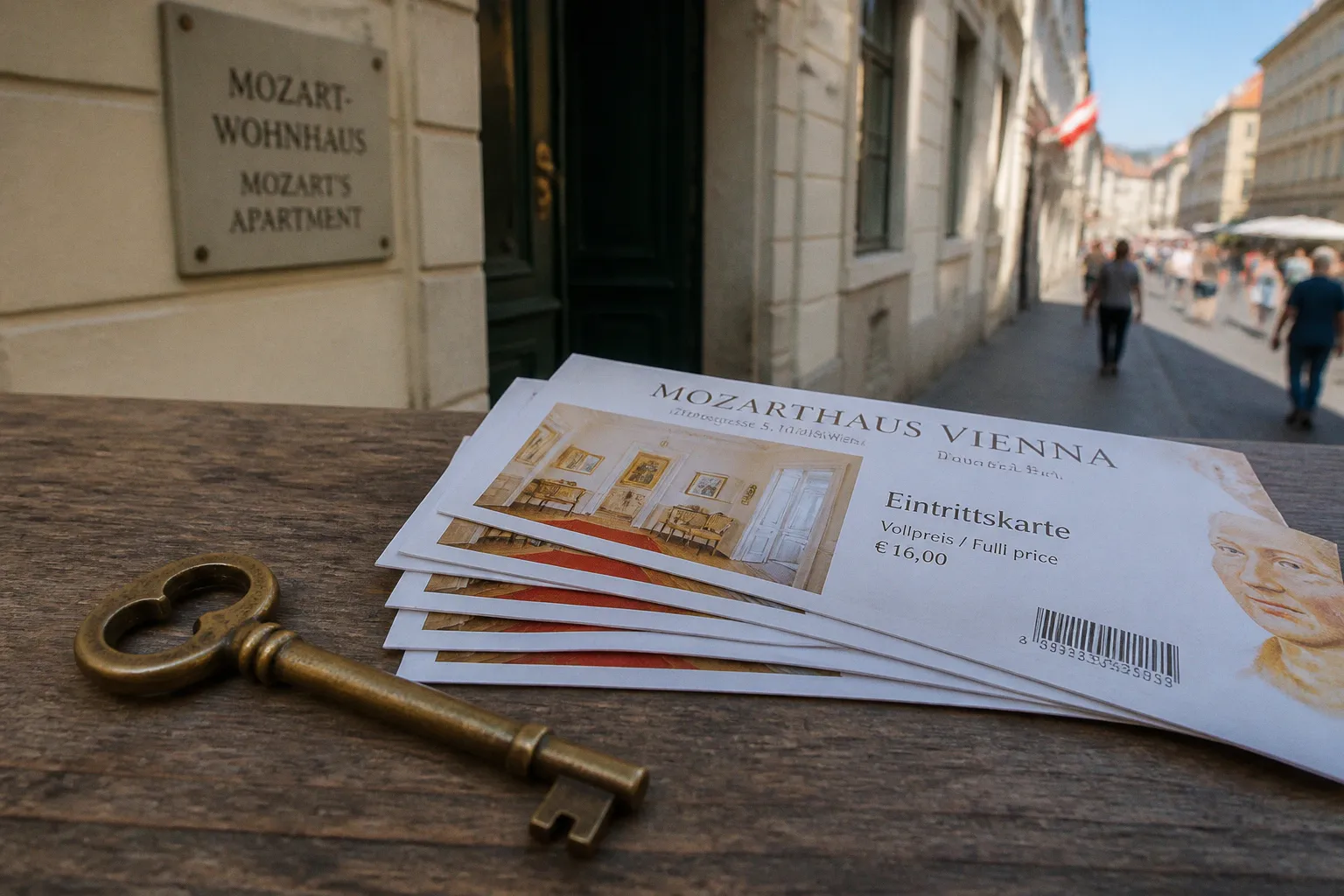
It is the only Vienna residence where Wolfgang Amadeus Mozart actually lived that still stands. Between 1784 and 1787, he worked and composed at this address, including the opera Le Nozze di Figaro—the reason locals and long-time guides still call the building the Figarohaus.
Tickets and prices
Mozarthaus Vienna
I
Save
Box office and online booking
- Adult €12
- Child €2.50
- Reduced €6
€12
Official websiteII
Our pick · combo ticket
Combo ticket · Audio guide & sound museum entry
Explore the apartment with an audio guide and visit a sound museum with this combo ticket.
III
combo ticket
Combo ticket · Concert & museum entry · 70 minutes
This combo ticket includes entry to the museum and apartment, along with a 70-minute concert.
€59
Book ticketsThe site reopened as a museum in its current three-level exhibition form on January 27, 2006, timed to the 250th anniversary of Mozart’s birth. That timeline matters when deciding whether to book tickets: the museum is a 21st-century curatorial reconstruction built around a genuine 18th-century shell, not a preserved apartment with its original furniture and decoration.
There are three practical ways to secure Mozarthaus Vienna tickets: the official online ticket shop, authorized third-party ticketing platforms, and the on-site ticket desk at Domgasse 5. All three lead to the same museum, but they solve different planning problems. Online booking prioritizes a reserved time slot. The desk prioritizes flexibility. A third-party platform can be useful when it fits into a wider sightseeing booking, although the conditions should be checked before payment.
Inside the Figarohaus: what to expect at Domgasse 5
The museum spreads across three exhibition levels inside the former residential building. Mozart’s apartment itself is located on one floor; the other levels extend the story through contextual displays, documents, and thematic material. The layout follows the surviving structure of the building as far as possible, but visitors should not expect the entire museum to be a single preserved apartment.
The historical rooms are largely unfurnished: Mozart’s 18th-century furniture did not survive. Visitors therefore do not enter a perfectly preserved domestic interior. They encounter a curated installation of historical artifacts, period paintings, original documents, and interpretive displays that reconstruct the domestic and working environment of the 1780s.
That distinction sets the right expectation for the visit. The value of Mozarthaus is not that every chair, table, and wall covering is original. It is the combination of the building, the address, the documented period of Mozart’s residence, and the material presented around it. The museum uses the rooms to explain how Mozart lived and worked in Vienna rather than asking visitors to treat the apartment as an untouched time capsule.
The central narrative is Mozart’s 1784–1787 residency. He occupied Domgasse 5 during a productive stretch of his Vienna career, when public performances, private teaching, and composition were closely connected. Le Nozze di Figaro was composed at this address, alongside other works from the same period. Mozart left the apartment in 1787, and the building passed through subsequent owners before being preserved as a museum site in the early 2000s.
The three levels operate as a chronological and thematic walkthrough:
- The lower level introduces Mozart’s arrival in Vienna and the imperial court culture in which he worked.
- The apartment level focuses on the residence itself and the rooms associated with everyday life, composition, and performance.
- The upper level follows Mozart’s later works and the building’s history after his departure.
The museum is therefore more useful to visitors who want context than to those looking only for a single famous room. Allow time to read the documents and explanatory material, especially if this is your first serious look at Mozart’s Vienna. The address provides the hook, but the exhibition supplies the framework.
Audio guides for adult visitors are available in 13 languages. A separate children’s audio track is offered in 8 languages and is structured around a shorter attention span. That option can make the visit more manageable for families, particularly because the museum’s subject matter is historical and documentary rather than built around interactive displays.
Mozart’s apartment occupies one floor, but Mozarthaus Vienna is a three-level museum. The address provides the authenticity; the exhibition provides the context.
Standard admission and pricing tiers for individual visitors
Mozarthaus Vienna uses several admission categories: standard adult, reduced, youth, and family. The current figures for each category are displayed in the booking module at the time of purchase. For planning purposes, the eligibility rules are more important than memorizing a headline price, because selecting the wrong category can create a problem at the entrance even when the difference in cost appears small.
Standard adult admission
The standard adult ticket is the baseline option for visitors who do not qualify for a reduced, youth, or family fare. It is the straightforward choice for most adult travelers booking individually or as a couple without a qualifying discount.
If you are buying online, select the standard category only after checking whether another member of your party has a valid entitlement. A family group, a student under 27, a senior aged 60 or over, and a Vienna City Card holder may not all belong in the same ticket category.
The booking screen should be treated as a set of eligibility choices, not simply as a place to select the cheapest visible amount. If the category requires proof, the visitor should be ready to show it at the entrance. A lower price is useful only when it matches the conditions attached to the ticket.
Reduced admission
The reduced ticket applies to three groups:
- Students under 27
- Seniors aged 60 and over
- Holders of the Vienna City Card
Proof of eligibility is typically checked at entry. A student should carry a valid student ID, while a senior may need government-issued identification showing age. Vienna City Card holders should have the card available rather than relying on a digital memory of having purchased it.
The City Card discount is easy to overlook because many visitors think of the card primarily as a public-transport product. For Mozarthaus Vienna, it also functions as a museum discount key. Two adults traveling with Vienna City Cards can each use the reduced ticket category without being students or seniors, provided the cards are valid and available for inspection.
This is one reason to compare the individual admission categories before purchasing a combination product or city pass. A discount that applies to the standalone ticket may also affect the calculation for a joint museum ticket, while a separate pass has its own pricing logic.
Youth admission
Visitors under 19 pay the youth rate. This is a separate category from reduced adult admission, and the age boundary matters. An 18-year-old qualifies for a youth ticket; a 19-year-old generally moves into the standard adult category unless they qualify for the student reduction.
For a family booking, check the age of each child against the current conditions rather than assuming that every minor is treated identically. The youth threshold is clear, but ticketing systems may ask for the visitor’s date of birth or another form of verification.
It is also worth checking the age requirement when comparing a family ticket with individual admission. A child who qualifies for the youth category may still be included in a family product, but the better option depends on the number of adults and children in the group.
Family admission
The family ticket covers two adults and up to three children. It is designed for a two-parent household traveling with two or three children under 19 and can be the most economical way to book that configuration in one transaction.
A single-adult family should not assume the family ticket is automatically the best choice. Compare it with one standard or reduced adult ticket plus the applicable youth tickets. The family product is built around a two-adult-plus-children structure, so the arithmetic can change when only one adult is traveling.
A useful way to approach the booking screen is to list the party before selecting tickets:
1. Note each visitor’s age on the date of the visit.
2. Mark any student, senior, or Vienna City Card eligibility.
3. Compare the family bundle with the equivalent individual categories.
4. Make sure everyone can show the required proof at the entrance.
This takes less time than correcting a category after arrival. It also prevents a common mistake: treating a discount category as a general price reduction without checking its conditions.
Combination tickets and city passes
A standalone Mozarthaus entry is not always the best-value choice. Two products can make sense when the museum is part of a broader Vienna plan: the joint Mozarthaus + Haus der Musik ticket and the Vienna Pass.
Mozarthaus + Haus der Musik
The joint ticket combines Mozarthaus with Haus der Musik, the interactive sound museum a short walk away in the same district. The pairing is geographically convenient and thematically coherent. Mozarthaus concentrates on Mozart’s life, work, and Vienna residence; Haus der Musik expands the subject into sound, listening, orchestral tradition, and musical experimentation.
The combination is sold at three price points:
- Standard adult
- Reduced, using the same general eligibility logic as the standalone reduced Mozarthaus ticket
- Children’s admission for visitors under 12
Buying the two museums together reduces the combined cost compared with purchasing each separately on the day and removes the need for a second ticket transaction. It also creates a manageable half-day route: Mozarthaus in the late morning, lunch or a short walk through the Innere Stadt, and Haus der Musik in the early afternoon.
The combination is most convincing when both museums are already on your itinerary. It is less useful if you are choosing Haus der Musik only because the bundle appears cheaper than the standalone Mozarthaus ticket. A discount is not a saving if it persuades you to add an attraction you did not intend to visit.
Consider the rhythm of the day as well as the price. Both sites are close to Stephansplatz, so the combination does not require a complicated transfer. That makes it a practical option for visitors who want two music-focused stops without dedicating an entire day to museums.
The order can also depend on the group. Families may prefer the more interactive Haus der Musik when attention is beginning to fade, while visitors focused on Mozart’s biography may want to start at Domgasse 5 and use the second museum as a broader musical extension. The ticket does not decide the route for you; it simply makes the two-site plan easier to organize.
Vienna Pass
The Vienna Pass works differently. It is a time-based sightseeing pass: you choose a validity period, typically one, two, three, or six consecutive days, and use it for the attractions included in the pass during that period. Mozarthaus Vienna is one of the included attractions.
It is not an attraction-count pass in which Mozarthaus uses up one item from a fixed quota. The relevant question is how many included attractions you can realistically visit while the pass is valid and whether the pass’s total cost compares favorably with buying those admissions separately.
The Vienna Pass is most useful for a dense sightseeing schedule. It can suit visitors who plan to move through several included museums, palaces, historic sites, and other attractions over consecutive days. It is less compelling for an itinerary built around Mozarthaus and one or two nearby visits.
The calculation should be based on your actual route, not an idealized list of everything the pass includes:
- Identify the included attractions you genuinely plan to visit.
- Group them within the pass’s validity period.
- Compare the total of the separate admission prices with the pass price.
- Account for opening hours, travel time, and the pace at which you want to see each site.
A time-based pass rewards concentration. If you buy it for a long weekend but spend much of that time walking neighborhoods, sitting in cafés, or visiting attractions outside the pass, its theoretical coverage will not translate into practical value. Conversely, if your itinerary already contains several included sights on consecutive days, the pass can simplify the booking process and reduce the need to purchase separate entries.
The Vienna Pass is a clock, not a punch card: its value depends on how many included attractions you can sensibly visit before the validity period ends.
On-site ticket desk versus advance online reservations
The decision between online booking and the ticket desk comes down to four practical variables: how far ahead you plan, how fixed your Vienna schedule is, whether you want a guaranteed entry time, and how much uncertainty you are willing to accept at Domgasse 5.
| Parameter | Online booking | On-site ticket desk |
|---|---|---|
| Booking lead time | From the day of the visit to months ahead, depending on availability | Purchase when you arrive |
| Entry time | Choose an available time slot during booking | Take the next available option |
| Queue exposure | No ticket-desk queue after arrival, assuming the booking is valid | A queue at the desk is possible |
| Schedule flexibility | Lower: the visit is tied to the selected slot | Higher: decide on the day |
| Best suited to | Fixed itineraries and busy travel periods | Spontaneous visits and changing plans |
The structural difference is simple: online booking separates the purchase decision from the moment you reach the museum, while the desk keeps the two decisions together. Booking ahead removes one variable from the day. You know that a place is reserved and can arrange lunch, another museum, or a walking route around that time.
The trade-off is commitment. A timed reservation is useful when your Vienna itinerary is firm, but it becomes restrictive when the day depends on weather, travel delays, children’s energy levels, or an unexpectedly long visit somewhere else. Check the conditions attached to the selected booking before paying, especially if your plans may change. A ticket that guarantees entry may not offer the same flexibility as a ticket bought at the desk.
The on-site option is better for visitors who want to keep the afternoon open. Domgasse 5 is central, and Mozarthaus can be added to an Innere Stadt walk without a separate cross-city journey. The cost of that flexibility is uncertainty: the desk may have a short queue, and the most convenient time slot may no longer be available.
Official shop or third-party platform?
The official online shop is the clearest route when you want a direct museum booking and the simplest view of the museum’s own ticket categories. It is also the natural place to check current prices, entry conditions, and available times.
An authorized third-party platform can be useful when you are organizing several Vienna attractions in one place or when its interface is easier to use alongside other travel bookings. Before selecting it, compare the practical conditions rather than only the displayed price:
- Is the ticket for a specific date or a specific time?
- Does the product include only admission or an additional service?
- Are cancellation or change rules different from the official shop?
- Will you receive a mobile voucher, or must you exchange it at a desk?
- Is the selected category compatible with the proof of eligibility you will carry?
The aim is not to avoid third-party booking at all costs. It is to know exactly what has been purchased. Two products can both be labeled “Mozarthaus Vienna tickets online” while offering different reservation conditions.
A third-party listing may also bundle admission with a city pass, a guided visit, or another attraction. That can be convenient, but it changes the comparison. Look at the product inclusions and redemption instructions before deciding that one listing has a lower Mozarthaus Vienna ticket price. The cheapest number on the first screen is not always the lowest total cost or the simplest arrival procedure.
Visitor logistics: opening hours, access, and audio guides
Mozarthaus Vienna operates daily from 10:00 AM to 7:00 PM, with last admission at 6:30 PM. There is no weekly closing day. That seven-day schedule makes the museum relatively easy to fit around other Vienna attractions, many of which close on Mondays or change their hours during the week.
The final admission time should be treated as a real cutoff, not a suggestion to begin the visit. Entering at 6:30 PM leaves only a limited period before closing, which is enough for a brief look but not for a relaxed three-level visit. If you want to read the documents, use the audio guide, and move through the apartment without rushing, choose an earlier slot.
The building is accessible. Visitors with mobility limitations can reach all three exhibition levels by the on-site lift. Wheelchair users do not need a separate ticket category; standard or reduced admission applies according to the visitor’s eligibility. The lift is also useful for visitors with strollers or heavy bags, since the historic stair configuration is not designed around modern luggage.
Accessibility is not only a question of reaching the upper floor. A historic building can still feel less straightforward to navigate than a purpose-built museum, particularly when moving between the original apartment level and the exhibition floors. Visitors who need specific assistance should confirm the current arrangements before traveling and allow extra time rather than treating the visit as a quick stop between fixed reservations.
The audio guide is one of the more useful additions for visitors who want the rooms to make sense as more than an address. The displays explain the period, the building, and Mozart’s work, but the audio commentary can provide a more continuous narrative as you move through the levels. Families can choose the children’s track, while adults can select from the available language options according to their preference.
A practical visit plan looks like this:
1. Arrive with the ticket category and any eligibility documents ready.
2. Begin on the level indicated by the museum’s current visitor flow.
3. Treat Mozart’s former apartment as part of the wider exhibition, not as the entire museum.
4. Leave enough time for the documentary displays and audio guide.
5. If combining the visit with Haus der Musik, allow space for a meal or an unhurried walk between the two sites.
The museum’s central location makes it tempting to squeeze Mozarthaus between other appointments. That works if you want a focused visit, but it can make the three-level layout feel compressed. A reserved morning or early-afternoon slot is easier to enjoy than a late entry chosen only because it happens to fit an already crowded schedule.
Choosing the right way to book
For most travelers, the choice is less about finding one universally best ticket and more about matching the booking method to the shape of the trip.
Book through the official online shop when you have a fixed itinerary, want to choose an available entry time, or need to see the museum’s current admission categories directly. Choose the desk when your day is deliberately flexible and you are comfortable accepting whatever time is available when you arrive. Use an authorized third-party platform when it genuinely simplifies a broader sightseeing plan, but read the redemption and cancellation terms with care.
A combination ticket is sensible when Haus der Musik is already part of the day. The Vienna Pass deserves a calculation across the whole itinerary rather than a decision based on Mozarthaus alone. Individual admission remains the cleanest option when the museum is a single planned stop.
The most important detail is the one that is easiest to miss in a quick search: Mozart’s former apartment is on one floor, but Mozarthaus Vienna is a three-level exhibition. Book the entry option that gives you enough time to see both—the surviving address and the museum built around it.
Practical info
Currency: EUR
Driving: on the right
Emergency number: 112