Australian National Maritime Museum tickets: buying options
Walking up to the ticket counter at the Australian National Maritime Museum without a plan is the most expensive way to spend a Saturday in Darling Harbour. You step inside, see the free permanent galleries, and think you have dodged a bill.
The $35 Mistake That Costs You Real Money
Then your child spots HMAS Vampire through the window, pulls you toward the ticket desk, and you are paying the standard price for a See It All pass you could have bought online for less.
Tickets and prices
Book tickets — from €21| Option | Type | From |
|---|---|---|
| See it all ticket - Family (2 adults and 3 children) | official ticket | from AUD89 |
Prices checked on July 17, 2026 · current price on the partner page.
Prices are indicative and may change — confirm the price and availability on the partner page.
Partner link — GetYourGuide ticketsThat is not a budgeting tip. It is a transaction outcome. The museum uses a tiered access model: some parts of the visit are free, while the vessels and special exhibitions require a paid ticket. If you arrive without checking which experience you actually want, you can end up paying for the broader product at the point when everyone is already committed to boarding.
The useful question is not simply whether Australian National Maritime Museum tickets are expensive. It is what the ticket includes, whether the online price is available for your visit, and whether the people in your group can actually board the vessels. A cheap ticket that does not match your plan is not a saving. It is a badly timed purchase.
Free galleries make the museum easy to enter; the paid pass is what turns a walk through the building into a full visit aboard the vessels.
Understanding the Museum's Tiered Access Model
Free entry covers the permanent galleries. You can enter the building, look through the indoor displays, and spend time with the museum's permanent collection without buying a ticket for the paid attractions. That makes the museum different from a venue where every visitor must purchase admission before seeing anything.
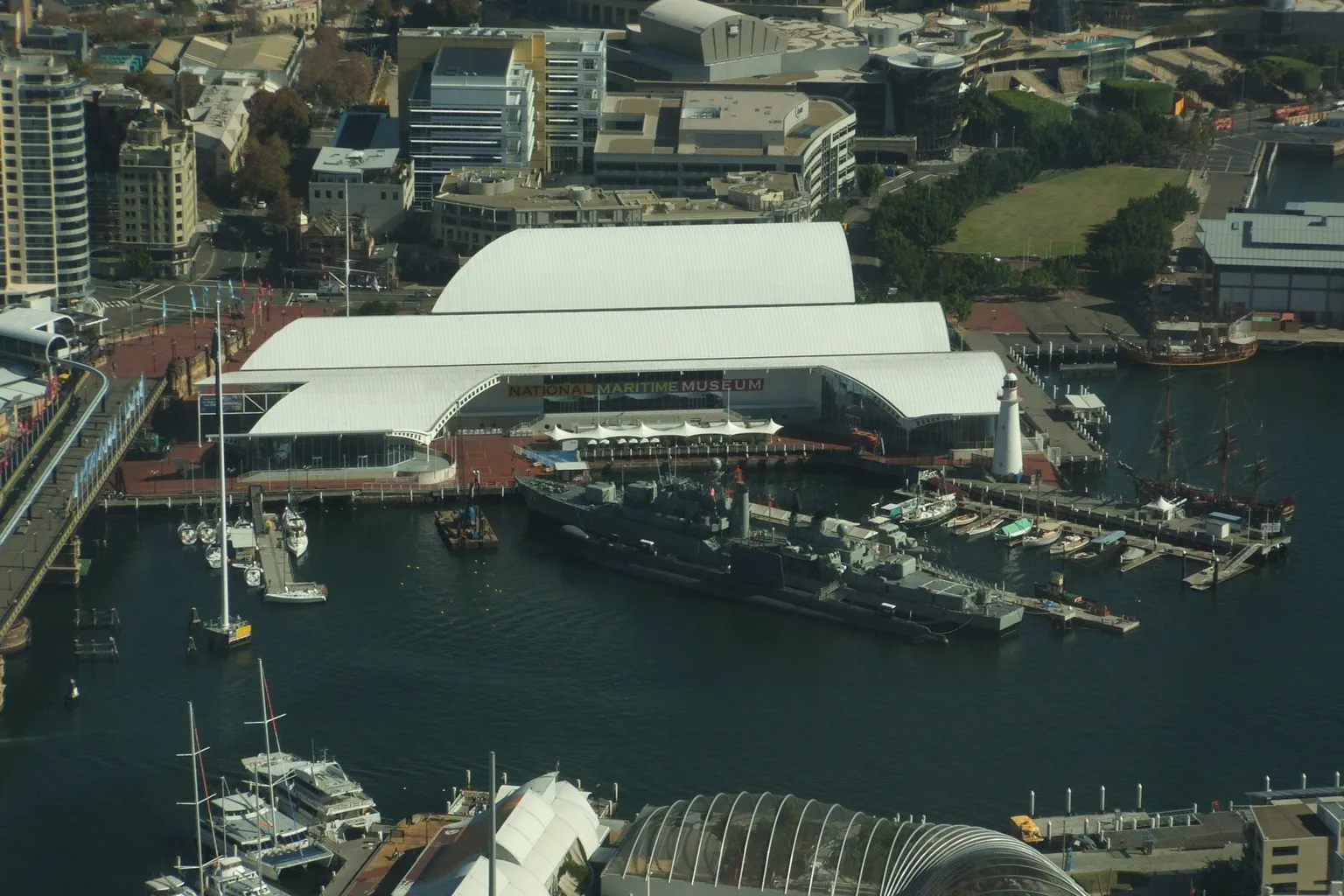
The distinction matters because the free galleries and the historic vessels are not the same experience. The vessels are the part most families have in mind when they arrive: HMAS Vampire, the submarine HMAS Onslow, and the HMB Endeavour replica. Special exhibitions also sit within the paid side of the museum's offer.
The museum's See It All pass is designed for visitors who want the broader paid experience. The published inclusions cover the permanent galleries, special exhibitions running during the visit, and boarding access to the historic vessels listed with the pass. That makes it the natural comparison point when you are working out whether to buy tickets to the Australian National Maritime Museum for a single afternoon or plan a longer visit around the whole site.
What should you not assume? Do not treat free general admission as a guarantee that every area, exhibition, or vessel is included. Ticket products can be described differently across booking pages, attraction bundles, and older travel information. Before paying, read the current product description and confirm which areas are included for the date you selected.
Likewise, do not build your budget around a vessel-by-vessel purchase unless the current ticket inventory specifically shows that option. The available products and operating arrangements are the things that need checking at the time of booking. If your plan depends on seeing one particular ship, confirm that the relevant boarding access is part of the ticket you are buying rather than relying on a broad phrase such as “museum admission.”
That small distinction saves an awkward conversation at the gangway. A ticket can get you into the museum without giving you the experience you thought you had purchased.
Free entry and paid access at a glance
| Part of the visit | What to expect |
|---|---|
| Permanent galleries | Available as part of the museum's free-access offering |
| Special exhibitions | Check the paid ticket description for inclusion during your visit |
| Historic vessels | Boarding is tied to the applicable paid ticket and operating conditions |
| See It All pass | The broad product for galleries, exhibitions, and vessel access listed in its inclusions |
If you arrive expecting to tour the submarine because you saw “general admission” somewhere online, you may be disappointed at the boarding point. The safest approach is to read the ticket description as a list of rights, not as a general promise that every part of the precinct is open to every visitor.
There is also a difference between being able to enter the museum and having enough time to use a paid ticket properly. A late arrival may still give you access to the galleries, but it can leave very little room for the vessels if the final boarding time is approaching. The ticket decision and the timing decision therefore belong together.
The See It All Pass: Pricing and Inclusions
Here is the price sheet, and it pays to look at it before you start calculating family costs:
| Ticket type | Standard price | Online advance price |
|---|---|---|
| Adult | $35.00 AUD | $31.50 AUD |
| Child, 4–15 | $25.00 AUD | $22.50 AUD |
| Concession | $30.00 AUD | $27.00 AUD |
| Family, 2 adults + 3 children | $89.00 AUD | $80.10 AUD |
The online advance price represents a 10% reduction on the listed standard price. In practical terms, that is $3.50 less per adult ticket, $2.50 less per child ticket, and a larger difference once several people are travelling together. The family ticket already changes the arithmetic, so compare the family price with the cost of separate adult and child tickets rather than assuming that one format is always cheaper.
The child ticket category covers visitors aged 4–15. That age range is the useful figure when you are working out the group total. Do not replace it with a vague assumption about “kids’ admission,” particularly if someone in the group is close to the age boundary. The booking page’s current ticket categories should be the final reference for the date and product selected.
The See It All pass covers admission to the permanent galleries, every special exhibition running during your visit, and boarding access to the historic vessels included in the product description. That is why it makes sense for a visitor who wants more than the free indoor displays. You are not paying simply to cross the museum's entrance; you are paying for the expanded itinerary.
Concession pricing applies to the eligible cardholders specified by the museum, including Australian full-time students, holders of an International Student Card, Australian or New Zealand seniors, and Australian pensioners. Bring the relevant physical card or accepted proof of eligibility. A booking made under a concession category does not remove the need to demonstrate that you qualify for it when requested.
There is also a practical reason to review the inclusions before you check out: the product name does not tell you everything about the day. A vessel may be temporarily unavailable, boarding may be affected by weather, and the final operating conditions can matter just as much as the ticket category. The pass gives you access to the included experience under the museum's operating rules; it cannot override a safety closure.
A useful way to read the price is to separate the admission decision into two questions:
- Will you use the paid attractions, or are the free galleries enough for this visit?
- If you will use them, which ticket format produces the sensible total for your group?
That prevents the common mistake of treating the See It All pass as the default admission ticket. It is the broader option, not automatically the right option for every visitor.
Maximizing Savings with Online Booking and Memberships
The 10% online advance discount is the clearest saving available in the published ticket structure. It rewards visitors who make the purchase online before arriving rather than leaving the transaction until they are standing at the museum.
The confirmed point is the discount for advance online booking. The facts do not establish a universal 24-hour minimum, so do not turn “book online in advance” into a rigid day-before rule. Check the booking page for the date and product you want, and look at the final price before payment. The discount may depend on the ticket channel, date, or availability shown in the current booking flow.
That distinction matters because a useful saving can become a false promise when it is described too precisely. There is no need to claim that the reduction appears automatically, that a particular booking window always applies, or that every online transaction follows the same process. What matters is simple: compare the advance online price with the standard price displayed for the same ticket.
For a single visit, the calculation is straightforward:
1. Count the adults, children aged 4–15, and concession visitors in your group.
2. Check whether the family ticket is cheaper than buying separate tickets.
3. Compare the online advance total with the standard total before you confirm.
4. Make sure the product includes the vessels or exhibitions you actually intend to visit.
5. Review the final checkout screen rather than budgeting from a headline price alone.
The family ticket deserves particular attention because the group composition can change the answer quickly. Two adults and three children may fit the family product neatly, while a different group may be better served by separate tickets. If your party includes concession visitors, calculate both combinations instead of assuming that the family option absorbs every member of the group on the same terms.
If you are considering annual membership, the question changes from “How much is today’s ticket?” to “How often will I return?” Adult membership is listed at $95.00 AUD, while family membership is listed at $170.00 AUD. Membership can make sense for a local visitor who expects multiple museum trips during the membership period, especially when store and café discounts are part of the package.
The break-even point depends on the ticket category, the number of people returning, and whether you value those additional member benefits. An adult planning several visits should compare the membership price with the relevant online ticket price for each visit. A family should do the same using the family admission price rather than multiplying an adult figure across the whole group.
The real saving is not the biggest-looking discount; it is choosing the ticket that matches the number of visits you will actually make.
If you are visiting from interstate or overseas and expect to come once, an advance online ticket is usually the cleaner comparison. If you live in Sydney and already know you will return, membership deserves a proper calculation. If you are only guessing that you might come back, do not treat a hopeful future visit as guaranteed value. Membership is useful when it matches a pattern, not when it is used to justify a purchase you are unsure about.
Third-party platforms may sell Australian National Maritime Museum tickets as part of wider Sydney attraction bundles. A bundle can be convenient if you already intend to visit the other attractions, but convenience is not the same as a lower ticket price. Compare the final amount, inclusions, booking restrictions, and cancellation terms with the museum's own online offer. Do not assume that an attractive bundle headline is cheaper once all parts of the transaction are visible.
The same rule applies to searches for “cheap tickets Australian National Maritime Museum.” A low displayed price may refer to a different access level, a restricted date, a bundle, or a ticket with conditions that do not suit your itinerary. Compare like with like: the same visitor categories, the same date, and the same access to vessels and exhibitions.
Essential Logistics for Boarding Historic Vessels
This is where optimism meets the gangway and optimism loses.
The most important physical restriction for families is the 90-centimetre height requirement. A child under 90 cm cannot board the historic vessels. The rule is not softened by a child's confidence, a promise to hold hands, or the fact that the child has managed similar stairs elsewhere. Historic vessels contain steep ladders, narrow routes, and difficult changes in level. The restriction exists because the boarding environment is not equivalent to walking through a modern gallery.
Measure children before you leave your accommodation, especially if someone is close to the cutoff. The point is not to create a ritual out of measuring; it is to avoid discovering at the boarding point that part of the group cannot take part in the experience. If one child does not meet the requirement, plan for an adult to remain with them while the eligible members of the group board.
That decision affects more than the ticket price. It affects how you divide the visit, whether everyone boards together, and whether the free galleries become the main activity for the person waiting behind. A family can still have a good museum day, but the itinerary needs to acknowledge the restriction instead of treating it as a minor detail.
Prams and strollers are not permitted aboard the vessels. The passages and ladders are not designed for them, and the restriction applies even when a stroller would be convenient for the rest of the day. Make a plan for the child and the equipment before you reach the gangway. The supplied information confirms that prams and strollers cannot go aboard; it does not establish that a particular storage area is monitored, weather-protected, or available for every visitor.
That means you should not leave valuables in a stroller and should not assume that parking it near the entrance guarantees a particular level of security or shelter. If you need a stroller for the museum grounds or galleries, ask staff where it may be left and what arrangements apply on the day. If the museum's current visitor information gives a specific storage instruction, follow that rather than improvising at the vessel entrance.
The boarding conditions also change the way you should think about comfort. Comfortable shoes matter more on a ship than they do in a gallery, and a child who is happy to climb a playground may still find a steep ladder or confined passage unsettling. The route is part of the attraction, but it is not designed like a flat, accessible exhibition floor.
Weather can change the paid experience
The 36°C rule is the other major logistical constraint. When the temperature reaches 36°C or higher, the vessels close. This is a heat-safety policy, not an optional scheduling adjustment, and it can affect the central reason many visitors buy the broader pass.
The galleries and exhibitions may still provide a worthwhile day, but they are not a substitute if your entire plan depends on boarding HMAS Vampire, HMAS Onslow, or the HMB Endeavour replica. Check the forecast for the day of your visit and review the museum's current operating notice if the weather is expected to be extreme.
A paid vessel ticket cannot turn a safety closure into an open gangway.
Do not read the 36°C threshold as a guarantee that every other operating detail will remain unchanged. Weather is one condition; the museum's current notices are the practical authority for the day. If the forecast is close to the threshold, allow for the possibility that your boarding plan may need to change and decide whether the free galleries and exhibitions are enough to justify the visit on their own.
The temperature rule is especially relevant to visitors buying tickets because of one specific vessel. If the galleries are your main interest, a hot day may alter the experience without destroying the purpose of the visit. If the vessels are the reason you travelled across Sydney, the same closure has a much larger effect on the value of the ticket. That is why checking the forecast belongs in the buying process, not only in the morning-afterthought category.
Navigating Seasonal Hours and Operational Closures
Regular operating hours run from 10:00 AM to 4:00 PM daily, with the last vessel boarding at 3:10 PM. That cutoff is not the same thing as the museum's closing time. Boarding a ship takes time, the self-guided route takes time, and staff need to clear the decks before the museum closes.
Arriving at 3:15 PM and expecting to begin a vessel tour is therefore a poor plan, even if the building itself remains open. The last boarding time is the deadline for starting that part of the visit. If vessels are your priority, use the closing time as the outer limit and the boarding cutoff as the real one.
During New South Wales school holidays, the museum extends its hours to 9:30 AM through 5:00 PM, with the last vessel boarding moving to 4:10 PM. The later cutoff gives families more room, but it does not make a rushed arrival sensible. Holiday crowds can change the pace of the visit, and moving through several vessels takes longer when you are stopping to read displays, manage children, or wait for other visitors on narrow sections of the route.
A sensible arrival time depends on what you want to see, but the last boarding time should never be your target arrival time. Leave room for entry, ticket questions, toilets, food, and the walk to the first vessel. If you are travelling with children or carrying more equipment than usual, that margin matters even more.
The museum is closed on Christmas Day, December 25. That closure is easy to overlook when planning a holiday itinerary because many attractions publish special seasonal schedules. Confirm the operating calendar for other public holidays, special events, and temporary closures before you set out. The regular timetable is a useful baseline, not a substitute for the current notice on the date you intend to visit.
Plan the visit around the boarding window
The order of your day should follow the least flexible part of the experience. Galleries are easier to fit around a delayed arrival; a vessel with a fixed final boarding time is not. If boarding is the priority, go to the vessels early enough to enjoy them without watching the clock.
A workable sequence looks like this:
1. Check the current ticket inclusions and choose between free gallery access, a paid See It All pass, or membership.
2. Compare standard and advance online prices for the exact date and group composition.
3. Check the forecast against the 36°C vessel closure rule.
4. Confirm that every child who plans to board meets the 90-centimetre height requirement.
5. Leave prams and strollers out of the vessel plan, and ask staff about the arrangements for keeping them elsewhere.
6. Arrive with enough time to deal with entry, food, toilets, and the walk to the first boarding point.
7. Treat the last boarding time as a hard deadline, not as a suggestion for when to begin your visit.
This order also helps if something goes wrong. A temporary vessel closure, a delayed train, or a child who needs a break is easier to absorb when the least flexible part of the visit has already been handled. Leaving all boarding until the end creates a fragile itinerary in which one small delay can turn a paid pass into a gallery-only visit.
The practical answer to “which ticket should I buy?”
For a visitor who wants only the permanent galleries, free access may be enough. There is no reason to buy a broad pass simply because it is the museum’s most visible product.
For a visitor who wants the vessels and special exhibitions, the See It All pass is the relevant product to compare. Check the standard and online advance prices, then confirm the current inclusions and operating conditions for the chosen date.
For a family, the calculation must include the 4–15 child-ticket category, the family price, and the fact that children under 90 cm cannot board the vessels. Paying for a child’s admission category does not change the physical boarding rule. The person may still enjoy the galleries, but the group should not budget on the assumption that every ticket holder will board.
For a local visitor planning repeated trips, membership may be the better long-term comparison. Its value comes from returning often enough to justify the fee and using the associated benefits, not from the label alone.
And for anyone searching for Australian National Maritime Museum discount tickets, the reliable starting point is still the museum’s own advance online price for the same product. Third-party deals can be useful, but only after you compare the final cost and access conditions. The cheapest headline is not necessarily the cheapest complete visit.
Buying tickets to the Australian National Maritime Museum is therefore less about finding a secret code than about matching the purchase to the day you are actually going to have. Free galleries, paid vessels, age categories, height restrictions, weather closures, online pricing, and boarding times all change the calculation. Read those conditions before you arrive, and the ticket becomes a plan rather than an expensive correction to one.
Practical info
Currency: AUD
Driving: on the left
Emergency number: 000