WSHFC House Key loan: a step-by-step application plan
The most expensive mistake at a Seattle closing table is not always overbidding. Sometimes it is discovering—after you have spent weeks shopping—that the financing program you counted on does not fit…
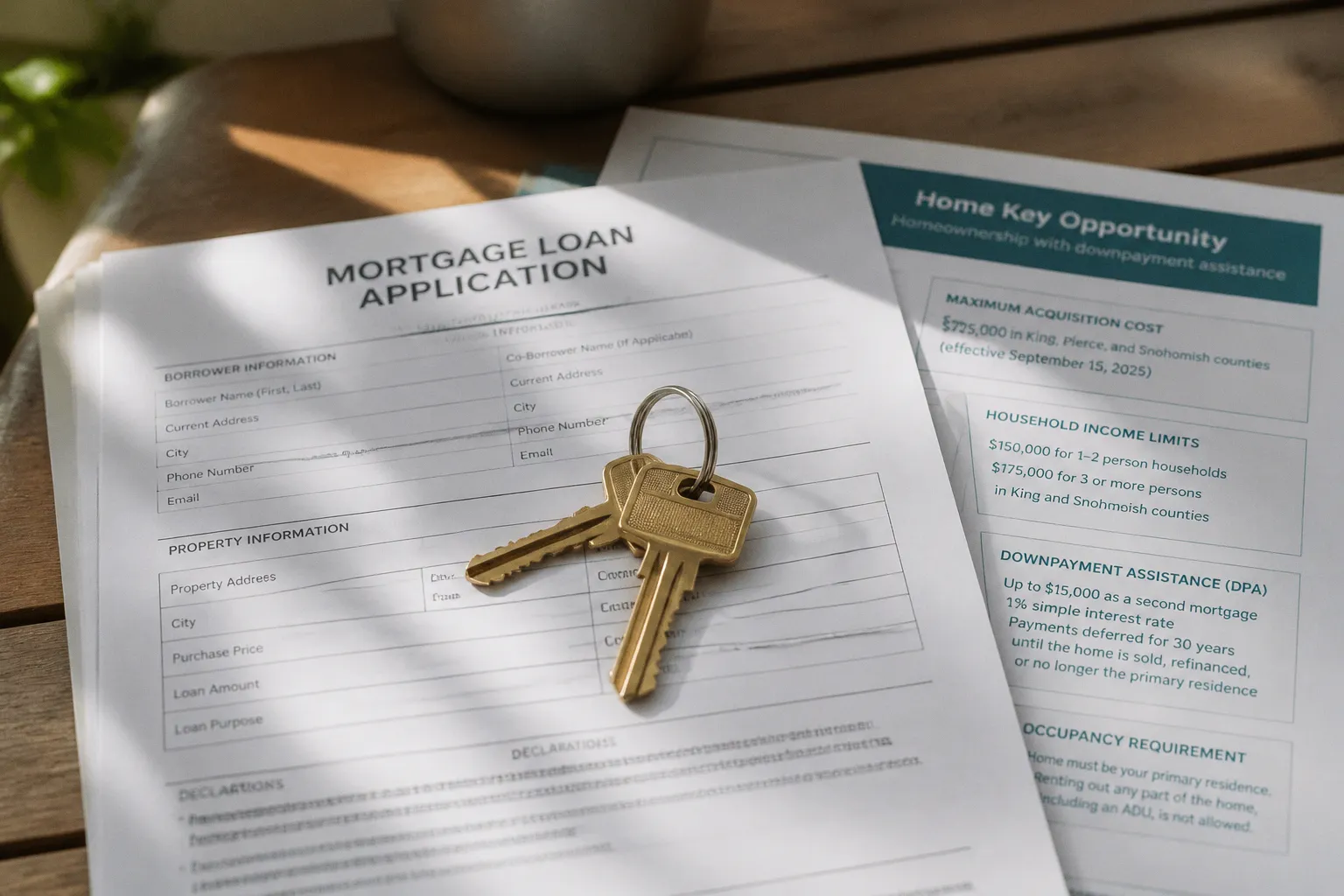
The most expensive mistake at a Seattle closing table is not always overbidding. Sometimes it is discovering—after you have spent weeks shopping—that the financing program you counted on does not fit the property, your income, or your occupancy plans.
The WSHFC House Key Opportunity program can help eligible Washington buyers get into a home with a state-sponsored first mortgage and, in some cases, deferred downpayment assistance. But this is not free money with a friendly brochure attached. The program has income limits, purchase-price caps, education requirements, lender restrictions, and strict rules about how you use the property after closing.
You need to treat the application like a transaction strategy, not a coupon hunt. Confirm eligibility before you write an offer. Verify the numbers with a participating loan officer. Then structure your financing so the program helps you compete without creating a compliance problem later.
Qualifying for the House Key Opportunity Program
Start with the first-time homebuyer rule. Under the WSHFC definition, you generally qualify as a first-time buyer if you have not owned and occupied a primary residence during the previous three years.
That wording matters. The test is not simply whether your name has ever appeared on a deed. The program looks at ownership and occupancy of a primary residence. If you owned a property years ago but have not owned and occupied a primary home within the last three years, you may meet the first-time buyer definition.
There are two recognized exceptions to that three-year rule. You may still qualify as a first-time buyer under the program if:
- You are purchasing a home in a federally designated Target Area.
- You are an honorably discharged Veteran.
Meeting the program's underwriting standards and property requirements through a participating lender is not one of those exceptions — those are baseline conditions every applicant must satisfy regardless of how long it has been since they owned a home. Credit, income, purchase-price, property type, and lender acceptance have to fit on top of first-time-buyer status; they do not replace it.
Do not assume an exception applies because a listing agent, loan officer, or online calculator says you are "probably eligible." Get the determination documented before you make the financing contingency waiver. Real estate deals are not won with optimism. They are won with verified conditions.
The first screen: answer these questions before shopping
Use this sequence with your lender:
1. Have you owned and occupied a primary residence during the last three years?
If yes, ask whether the property is in a Target Area or whether you qualify under the Veteran exception.
2. Will the home be your primary residence?
The program is designed for owner-occupants. It is not a way to finance a rental property, an investment purchase, or a second home.
3. Does your household income fit the applicable county and household-size limit?
The program evaluates household income under its rules. Do not rely only on the salary of the person signing the note.
4. Does the purchase price fit the county and location cap?
A home can be affordable by your personal budget and still fall outside the program's acquisition-cost limit.
5. Can you complete the required education seminar before the lender needs the certificate?
The homebuyer education requirement is mandatory, not decorative paperwork.
6. Does your credit profile meet the lender's underwriting standards?
The program typically requires a minimum credit score of 620, but the lender will review the complete file, including debts, income, assets, and credit history.
That list is not busywork. It is your pre-offer defense.
The House Key loan is useful only if the house, the buyer, and the buyer's long-term plans all fit the rules.
Financial thresholds: income and purchase-price limits
The two numbers that usually decide whether a buyer can use the program are household income and acquisition cost. Both can eliminate a property before you ever reach the appraisal.
For King and Snohomish counties, the stated household income limits are:
- $150,000 for households of one or two people
- $175,000 for households of three or more people
Those limits are not a suggestion to be interpreted generously after you are under contract. Your lender will determine how income is counted for the program and underwriting file. Bonuses, commissions, self-employment income, multiple jobs, and household members can complicate the calculation.
Do not make the classic mistake of comparing the program's income cap with only the base salary shown on your employment offer. If you receive variable compensation, own a business, or have a spouse or domestic partner whose income affects the household calculation, disclose it at the beginning. A surprise income calculation late in the transaction is a lousy time to discover that your financing plan was built on incomplete information.
Purchase-price caps in the central Puget Sound counties
Effective September 15, 2025, the maximum acquisition cost for a home purchased under the House Key Opportunity program in King, Pierce, and Snohomish counties is:
| Location | Non-Target Area cap | Target Area cap |
|---|---|---|
| King, Pierce, and Snohomish counties | $725,000 | $775,000 |
The cap is based on the acquisition cost—the purchase price under the program's rules—not simply the amount you borrow. That distinction matters when you are looking at a Seattle-area property with a large downpayment, seller credits, or other transaction adjustments.
A $760,000 home may be financeable through another Washington state home loan, but it is not automatically eligible for House Key just because you can bring more cash to closing. If the property is in a non-Target Area, the $725,000 cap remains the problem.
On the other hand, a property in a qualifying Target Area may fall under the $775,000 cap. You need the lender to verify the property's location under the program's rules. A neighborhood name, ZIP code, or listing description is not enough.
Income and price are separate tests
Passing one threshold does not cancel the other.
If your household income is under the limit but the property exceeds the acquisition-cost cap, House Key may not work. If the property price is under the cap but your household income is over the applicable limit, the same result applies.
That creates a practical decision tree:
- If your income is above the applicable limit, ask whether another mortgage product or down payment strategy makes more sense. Do not try to force House Key into the transaction.
- If the purchase price is above the cap, check whether the home is in a qualifying Target Area. If not, compare the cost of conventional, FHA, or other available financing.
- If both numbers fit, move to credit, education, property, and occupancy review.
- If one number is close to the line, obtain a written or documented calculation before you make an offer. "Close enough" is not an underwriting category.
The program can be valuable in Seattle's expensive market because the limits are high enough to cover many entry-level and mid-market homes in King County. But "high enough for many homes" is not the same thing as "high enough for every home you like." Your budget still has to live inside the program's box.
Mandatory education and the participating-lender requirement
You cannot complete the House Key application by downloading a form and sending it to the state. You must work with a WSHFC-trained, participating loan officer.
That lender is not just a rate quote machine. The loan officer will evaluate your credit eligibility, review the income calculation, identify the correct program structure, and submit the application through the required channel.
The lender relationship should begin before serious house hunting. You need to know:
- Whether your credit score is likely to meet the program's standards.
- How your income will be calculated.
- Whether your available funds cover closing costs and required reserves.
- Which first-mortgage structure fits your financial profile.
- Whether you can use the downpayment assistance component.
- How quickly the lender can issue a preapproval and update it as your offer changes.
The program typically calls for a minimum credit score of 620. That is a floor, not a guarantee of approval. A 620 score with high monthly debt, unstable income, recent late payments, or insufficient assets may produce a different result from a 700 score with a clean file.
Complete the homebuyer education seminar early
The WSHFC-sponsored homebuyer education seminar is free and takes five hours. You receive a certificate that is valid for up to two years.
Five hours is a reasonable trade for avoiding a financing failure. Schedule it early, preferably before you start writing offers. Waiting until you are under contract turns a manageable requirement into a deadline problem.
The course is not merely a program gate. It also forces you to confront the expenses that buyers routinely underestimate:
- Property taxes and insurance.
- Closing costs and prepaid items.
- Maintenance and repair reserves.
- The effect of interest rates on monthly payment.
- The difference between cash needed to close and total cash you should retain afterward.
- The restrictions attached to downpayment assistance.
- The consequences of refinancing, selling, or moving out.
A certificate does not lock your interest rate, reserve a particular loan product, or guarantee approval. It simply satisfies one required part of the process. Your lender still has to underwrite the transaction.
Build the file before the offer
Ask the participating lender what documents are needed and assemble them before you start negotiating. The exact file will vary, but most buyers should be prepared to explain:
- Employment and income history.
- Bank and investment account balances.
- Gift funds, if any.
- Monthly debts.
- Credit events or disputed accounts.
- The source of earnest money.
- Any ownership interest in other real estate.
- The planned use of the home after closing.
The point is not to create a mountain of paperwork for its own sake. The point is to remove uncertainty while you still have negotiating leverage.
If you wait until mutual acceptance to disclose a second property, a self-employment schedule, or a large recent deposit, you have handed the transaction a problem and the seller a reason to doubt your financing.
Using House Key downpayment assistance without misunderstanding the debt
The House Key Opportunity Downpayment Assistance program may provide up to $15,000 as a second mortgage. It carries a 1% simple interest rate, and payments are deferred for 30 years or until a triggering event occurs.
Those events include:
- The home is sold.
- The mortgage is refinanced.
- The loan is paid off.
- You stop occupying the property as your primary residence.
Call it assistance, but do not call it a grant. It is a loan. The balance does not disappear because you have owned the home for several years or because the payment is deferred.
This is where buyers get sloppy. A deferred payment can make the monthly budget look cleaner, but the debt still exists. You need to understand how it affects your future equity and your next transaction.
If you sell later
Suppose you use the full $15,000 and later sell the home. The deferred second mortgage must be addressed at sale. That reduces the proceeds available to you after paying the first mortgage, commissions, taxes, closing costs, and other transaction expenses.
If your equity is substantial, this may be manageable. If your equity is thin, the second mortgage can matter a lot. Do not build a five-year plan around the assumption that every dollar of appreciation becomes spendable cash.
If you refinance
A refinance can trigger repayment. That matters if you later want to:
- Lower your interest rate.
- Change from an adjustable-rate structure to a fixed-rate loan.
- Consolidate debt.
- Remove mortgage insurance.
- Access equity through a cash-out refinance.
- Replace the first mortgage after a major life change.
Before refinancing, ask the lender how the deferred second mortgage must be handled. You may need to repay it, subordinate it, or meet another program-specific condition. The answer depends on the transaction and current rules. Do not assume the second mortgage can simply remain in place.
If you move out
The property must remain your primary residence. If you stop occupying it as required, repayment can become due.
This is especially important for buyers who are already thinking about rental income. The program prohibits renting out any portion of the home or an accessory dwelling unit. That means you cannot casually plan to rent a basement room, lease a detached ADU, or turn the property into a house hack while keeping the House Key financing.
Do not write an offer based on projected rental income unless your lender confirms that the financing program permits it. Under House Key Opportunity rules, renting out any portion of the home or an ADU is prohibited.
The occupancy requirement also includes timing: you must occupy the property as your primary residence within 60 days of closing.
That rule changes how you evaluate a purchase. If the home requires extensive renovation before it is livable, or if your job keeps you elsewhere for several months, raise the issue before committing. A property that looks financially attractive on a spreadsheet may not fit the program's occupancy requirements in practice.
Compare the assistance with your actual cash position
Use the downpayment assistance to solve a real cash problem, not to stretch into a payment you cannot safely carry.
Your cash-to-close calculation should separate:
1. Downpayment funds.
2. Closing costs.
3. Prepaid taxes and insurance.
4. Earnest money already deposited.
5. Moving expenses.
6. Immediate repairs and furnishings.
7. A reserve for the first major surprise.
If the $15,000 assistance allows you to keep a reasonable emergency reserve, it may improve the transaction. If it merely allows you to buy a more expensive home while leaving you with no cash after closing, you have not solved the risk. You have moved it to month three.
A step-by-step House Key application plan
The cleanest application process is sequential. Do not reverse the order because a listing caught your eye.
Step 1: Identify your eligibility category
Determine whether you meet the first-time buyer requirement or qualify under the Target Area or Veteran exception. Put the answer in front of the lender before you make an offer.
If there are multiple borrowers, ask how each person's ownership history affects the application. Do not assume one eligible borrower automatically cures another borrower's prior ownership.
Step 2: Check county, household size, and income
Confirm the applicable income limit for your county and household size. For King and Snohomish counties, the stated caps are $150,000 for one- or two-person households and $175,000 for households of three or more people.
Give the lender complete income information. Include variable compensation, self-employment, and other income that may be relevant to underwriting.
Step 3: Confirm the property-price limit
For purchases in King, Pierce, and Snohomish counties after September 15, 2025, compare the home's acquisition cost with the applicable $725,000 non-Target Area cap or $775,000 Target Area cap.
Ask the lender to verify whether the property is located in a qualifying Target Area. Do not make that determination from a real estate search filter.
Step 4: Complete the five-hour seminar
Take the WSHFC-sponsored homebuyer education seminar and retain the certificate. Because the certificate is valid for up to two years, completing it early usually gives you room to shop without turning education into a closing emergency.
Step 5: Choose a participating loan officer
Work with a WSHFC-trained lender who regularly handles the program. Ask how many House Key files the loan officer has closed in the last twelve months. A lender who knows the documentation flow can spot issues before they reach underwriting, which keeps your timeline intact.
Step 6: Time the offer to the financing
Submit the application with the participating lender at the same time the offer goes in, not after. If you renegotiate price or closing date later, you want the program file already moving so the lender can update the preapproval quickly.
The House Key program is not a race to the finish line. It is a series of confirmations stacked in the right order. Run them in sequence, document each one, and keep the lender in the loop as the offer and the seller's responses evolve.
A program this detailed rewards buyers who treat it as a structured transaction. Get the rules documented early, build the file before the offer, and reserve enough cash to actually live in the home after closing. That is how House Key becomes a useful tool rather than a financing disappointment.