Seattle mortgage rate negotiation: 5 ways to lower interest
Every week I sit across from buyers in Seattle who think mortgage rates are something that happens to them.
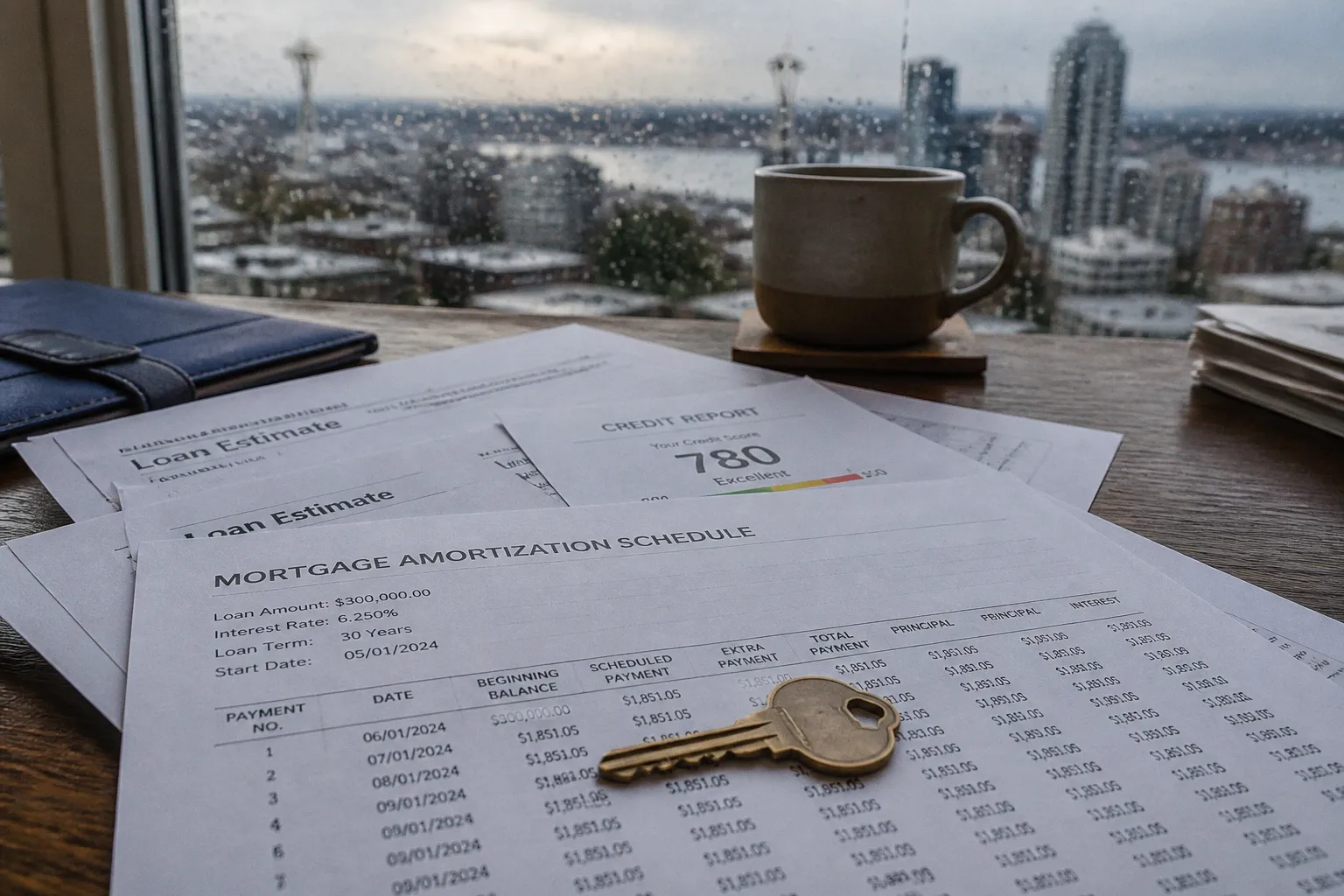
The Rate You Locked Last Week Was Higher Than Your Neighbor's. That's Not Luck—That's Laziness.
They take the first quote from their guy, sign the disclosure, and then act surprised when someone three blocks over got a better number for the same loan amount. Stop. The rate isn't handed down from above—it's negotiated, and you're losing money every day you pretend otherwise.
If you're buying in King, Pierce, or Snohomish County right now and you haven't asked for a rate match, bought down your rate, or explored a Washington state program, you've already left money on the closing table. Here's how to stop doing that.
1. Make Lenders Compete—On Paper, With Real Numbers
The single most powerful thing you can do before locking is collect Loan Estimates from at least three sources. Not prequalifications. Not "I think we can get you around..." Not the rate your cousin's friend's uncle quoted over beers. Real LE documents, same week, same loan amount, same down payment.
If your lender won't match a competitor's offer by 0.125% or shave origination fees, walk. There's always another broker.
A Loan Estimate is a standardized three-page form. When you have two or three of them side by side, you can call your preferred lender and ask, point blank: "I have a 6.25% quote from Lender B with $0 origination. Match it." Most will. Either they match, or they tell you why—and if their reason doesn't involve a real credit profile difference, you walk.
In Seattle's market this approach typically gets you roughly 0.125% to 0.25% off the rate, sometimes more in origination fees. On a $700,000 loan, that spread over 30 years is real money—easily $15,000 to $30,000 depending on the term and how long you hold the loan.
Independent mortgage brokers operate differently than retail banks. Brokers shop your loan to multiple wholesale lenders simultaneously; that shopping is their entire business model. Don't assume your bank branch has access to the same wholesale pricing a broker does—they don't. If you've only checked retail banks, you've checked the expensive shelf and stopped there.
2. Buy Down the Rate With Discount Points
A mortgage discount point costs 1% of your total loan amount and lowers your interest rate—typically by 0.125% to 0.25%, though exact pricing varies by lender, market conditions, and your loan size. On a $600,000 loan, one point runs about $6,000. On a $900,000 loan typical of Bellevue or Issaquah, you're looking at $9,000. On a Capitol Hill townhouse at $850,000 with 20% down, the loan is $680,000—each point costs roughly $6,800.
The math matters more than the marketing. Ask your lender for a break-even calculation: how many months of payment savings until the point pays for itself? If you stay in the home beyond that break-even, the point made money. If not, you bought a lower monthly payment you didn't get to keep.
| Loan Profile | Loan Amount | 1 Point Cost | Approximate Rate Drop | Break-Even Window |
|---|---|---|---|---|
| Seattle starter home | $550,000 | ~$5,500 | ~0.125%–0.25% | 4–6 years |
| Median King County | $750,000 | ~$7,500 | ~0.125%–0.25% | 4–6 years |
| Eastside luxury | $1,200,000 | ~$12,000 | ~0.125%–0.25% | 5–7 years |
Paying points makes sense if you plan to hold the loan long-term or you're trying to qualify at a specific debt-to-income ratio and need a payment reduction to clear the underwriting bar. If you're planning to refinance in 18 months or sell within three years, skip the points and keep the cash.
One nuance most buyers miss: points are often negotiable the same way the rate is. If your lender quotes 6.5% with zero points, ask what 6.375% costs in points. Then ask what 6.375% costs with $1,500 in lender credits applied to closing costs. The lender has pricing grids and most of them have flexibility inside them—flexibility they won't volunteer unless you ask.
3. Negotiate Seller-Paid Rate Buydowns
In a purchase contract, you can ask the seller to cover part of your closing costs—including a rate buydown. This is not the seller giving you cash. This is the seller absorbing a closing cost so your rate drops. It's a math swap, not a gift, and it's one of the most underused levers in Seattle purchase contracts.
Two common structures show up in Puget Sound contracts:
- Permanent buydown: Seller pays discount points upfront at closing; your rate is lower for the entire life of the loan. Best when you plan to keep the mortgage long-term.
- 2-1 temporary buydown: Seller pre-pays interest into an escrow account; your effective rate is reduced by 2% in year one and 1% in year two, then steps up to the full contract rate in year three and beyond. Best when you expect income to rise, plan to refinance before year three, or want a payment cushion during the first 24 months.
The 2-1 buydown has become more common in Seattle's slower-inventory neighborhoods because it lets sellers compete on payment without dropping list price—a psychological win for sellers who anchor on the headline number.
Maximum seller concessions depend on your loan type and down payment percentage. These are hard caps, not suggestions:
| Loan Type / LTV | Maximum Seller Concession |
|---|---|
| Conventional, >90% LTV | 3% of purchase price |
| Conventional, 75%–90% LTV | 6% of purchase price |
| Conventional, ≤75% LTV | 9% of purchase price |
| FHA loan | 6% of purchase price |
| Investment property | 2% of purchase price |
This is where your purchase contract language matters most. The escalation isn't just about price anymore—it's about what the seller funds. A seller who won't drop $50,000 on price might fund a $15,000 rate buydown because it doesn't show up in the same negotiation column for them. Talk to your agent about how to structure this in the offer—not after you've lost the house.
4. Use Washington State-Backed Programs
WSHFC rates are published. That means no margin games. Most buyers skip this option because they assume it's for someone else. It's not.
The Washington State Housing Finance Commission runs two programs Seattle buyers ignore at their own cost:
- Home Advantage: Offers set mortgage rates that often run below conventional market offerings, plus down payment assistance options structured as second mortgages with deferred payment.
- House Key Opportunity: Down payment assistance in the form of a second mortgage at favorable terms, paired with a WSHFC first mortgage.
These aren't exclusive to low-income buyers. Income limits exist but are higher than most people assume, especially in King County where the limits adjust for the local housing market. Set rates from WSHFC mean the lender can't gouge you on margin—the program's pricing is fixed and published.
The catch: you have to take a first-time homebuyer education class (usually online, a few hours) and use a participating lender. The class isn't a hurdle—it's the trade for a better rate. Participating lenders across the Seattle metro include credit unions and regional banks that work with WSHFC regularly.
If you're a first-time buyer in the Puget Sound region and you haven't checked whether you qualify for Home Advantage down payment assistance, you're skipping the most direct path to lower monthly payments available in this state.
5. Fix Your File Before You Lock
The rate you're quoted isn't a sticker price—it's a function of your credit score, debt-to-income ratio, loan amount, loan-to-value, and property type. The single biggest variable you control is your credit profile.
Three numbers move rates:
1. Credit score. Going from 720 to 760 typically drops you into a better pricing tier. A tier change can mean 0.25% or more on the rate. Pull your reports, dispute any inaccurate items, and pay every account on time for at least six months before applying.
2. Debt-to-income ratio. Lenders price risk. Drop your revolving balances below 30% of credit limits before applying. Pay down the highest-utilization card first—utilization on revolving accounts is reported monthly and weighs more than installment loan balances in most scoring models.
3. Down payment size. Every 5% additional down payment reduces your loan-to-value ratio, which reduces the lender's risk tier. Below 75% LTV, conventional seller concession limits jump to 9% (see table above), which means more room for the seller to fund a buydown on your behalf.
You control all three. If you're four to six months out from a purchase, this is your playbook. Quick wins before locking: pay down credit cards to under 30% utilization, dispute any inaccurate items on your credit reports, avoid opening new credit lines in the 90 days before application, and document any large deposits so the underwriter doesn't flag them as unexplained income.
If You're Already Locked, Read This Twice
A rate lock is a contract. Once executed, the rate is the rate for the lock period—typically 30, 45, or 60 days. You're not negotiating it down unless the lender made a clerical error or the lock period hasn't actually started. Trying to renegotiate a locked rate is the fastest way to lose your lock and your loan officer's patience.
What you can do after lock:
- Ask for a float-down option at lock-in if rates drop before closing. Some lenders offer this for a small fee; many don't. If you want the option, negotiate it before locking.
- Negotiate lender credits at closing if rates moved against you after application.
- Accept the lock and refinance later if rates drop meaningfully after closing. Don't try to renegotiate the locked rate itself—that fight is lost before it starts.
The Rule of Thumb
Pick the top two moves from this list and execute them before your next Loan Estimate. Shop three lenders. Or shop three lenders plus one broker. Or fix your credit first, then shop three lenders. Don't try to run all five at once—pick the two with the highest dollar impact on your specific loan size and timeline, and run those to completion.
If your loan is under $500,000 and you're more than 90 days from closing: credit repair and lender shopping.
If your loan is over $700,000 and you're under contract: seller concession and discount points.
If you're a first-time buyer anywhere in Puget Sound: WSHFC Home Advantage before anything else.
Seattle's housing market punishes hesitation. The rate you negotiate today is the rate you live with for 30 years. Stop leaving it to chance and start treating the rate like any other negotiable line item—because that's exactly what it is.